
 Posted by
 Learning Japanese vocabulary is more than memorizing words and their English meanings. To communicate naturally, you also need to understand how words are used in sentences and real-life situations.
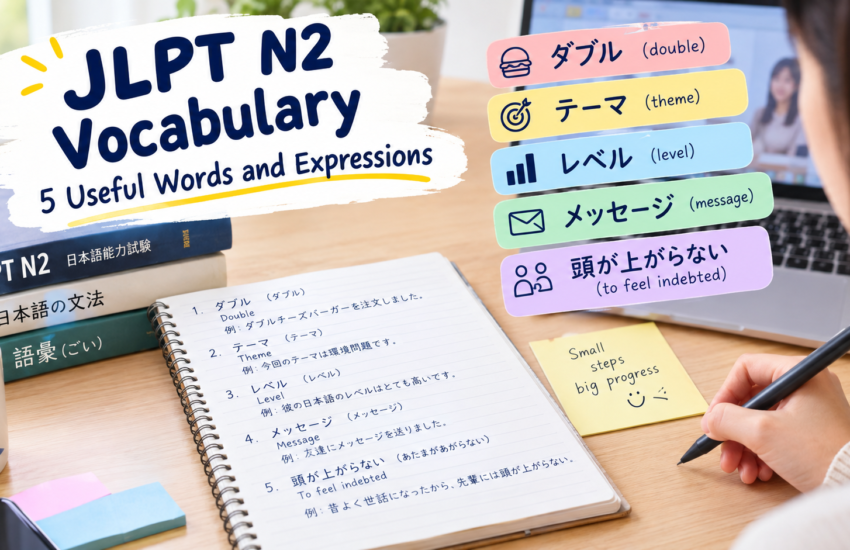
In this lesson, we will learn five useful Japanese words and expressions: ダブル, テーマ, レベル, メッセージ, and 頭が上がらない.
These words will help you talk about everyday topics, communicate with friends, and understand more nuanced Japanese expressions. The first four are commonly used loanwords, while the last is an idiomatic expression that requires a deeper understanding of Japanese culture and relationships.
Whether you are preparing for the JLPT N2 or improving your everyday Japanese, let’s explore these expressions through practical examples.
Table of Contents
- Why Learn Japanese Vocabulary in Context?
- ダブル — Double
- テーマ — Theme
- レベル — Level
- メッセージ — Message
- 頭が上がらない — To Feel Indebted
- Vocabulary Summary
- Practice Quiz
- Practical Learning Tip
- Frequently Asked Questions
Why Learn Japanese Vocabulary in Context?
At the intermediate level, knowing a word’s basic meaning is not always enough. You also need to understand how it fits into a sentence.
Learning vocabulary through examples can help you:
- Understand Japanese conversations more easily.
- Improve reading comprehension.
- Recognize common expressions in everyday situations.
- Use Japanese more naturally when speaking and writing.
- Remember vocabulary by connecting it with real experiences.
For the best results, learn each word together with its reading, meaning, example sentence, and usage.
1. ダブル — Double
Meaning: Double; twofold
Reading: ダブル
ダブル is a Japanese loanword from the English word “double.” It is used when something has two parts, two portions, or a doubled amount, depending on the context.
You may encounter this word when ordering food, choosing products, or describing quantities.
Example Sentence
今日[きょう]はダブルチーズバーガーを注文[ちゅうもん]しました。
Translation: I ordered a double cheeseburger today.
More Examples
Example 1:
ダブルの部屋[へや]を予約[よやく]しました。
Translation: I reserved a double room.
Example 2:
この商品[しょうひん]はポイントがダブルになります。
Translation: You get double points on this product.
Learning Tip
Connect ダブル with familiar situations, such as ordering a double cheeseburger or booking a room. This makes it easier to remember how the word is used.
Remember that the exact meaning of ダブル depends on the noun or situation it describes.
2. テーマ — Theme
Meaning: Theme; topic; central subject
Reading: テーマ
テーマ refers to the main subject or idea of a discussion, presentation, project, event, or piece of writing.
It is useful in school, at work, and in everyday conversations.
Example Sentence
今回[こんかい]のテーマは環境問題[かんきょうもんだい]です。
Translation: The theme this time is environmental issues.
More Examples
Example 1:
今日[きょう]の授業[じゅぎょう]のテーマは日本文化[にほんぶんか]です。
Translation: Today’s lesson theme is Japanese culture.
Example 2:
会議[かいぎ]のテーマを決[き]めましょう。
Translation: Let’s decide on the theme of the meeting.
Useful Related Vocabulary
- 環境問題[かんきょうもんだい] — environmental issues
- 授業[じゅぎょう] — lesson; class
- 会議[かいぎ] — meeting
- 決める[きめる] — to decide
Learning Tip
Practice using テーマ with subjects that interest you. For example, you could say 日本語学習[にほんごがくしゅう]が今日[きょう]のテーマです, meaning “Japanese-language learning is today’s theme.”
This is a useful way to practice speaking about lessons, presentations, and projects.
3. レベル — Level
Meaning: Level; standard; degree
Reading: レベル
レベル is a loanword used to describe someone’s ability, the difficulty of something, or the standard of a particular skill or activity.
It is especially useful when discussing language ability, education, work, and personal development.
Example Sentence
彼[かれ]の日本語[にほんご]のレベルはとても高[たか]いです。
Translation: His Japanese level is very high.
More Examples
Example 1:
日本語[にほんご]のレベルを上[あ]げたいです。
Translation: I want to improve my Japanese level.
Example 2:
この本[ほん]は私[わたし]にはレベルが高[たか]すぎます。
Translation: This book is too advanced for me.
Useful Related Vocabulary
- 能力[のうりょく] — ability
- 上げる[あげる] — to raise; to improve
- 高い[たかい] — high
- 難しい[むずかしい] — difficult
Learning Tip
Use レベル when talking about your Japanese studies. For example:
今[いま]はN2レベルの文法[ぶんぽう]を勉強[べんきょう]しています。
Translation: I am currently studying N2-level grammar.
You can also practice making sentences about your speaking, listening, reading, and writing abilities.
4. メッセージ — Message
Meaning: Message
Reading: メッセージ
メッセージ refers to a message sent or communicated to another person. It is commonly used when talking about text messages, online communication, and messages shared between people.
You can use it when discussing communication with friends, classmates, colleagues, or family members.
Example Sentence
友達[ともだち]にメッセージを送[おく]りました。
Translation: I sent a message to my friend.
More Examples
Example 1:
先生[せんせい]にメッセージを送[おく]ってもいいですか。
Translation: May I send a message to the teacher?
Example 2:
メッセージを確認[かくにん]してください。
Translation: Please check the message.
Useful Related Vocabulary
- 友達[ともだち] — friend
- 送る[おくる] — to send
- 確認する[かくにんする] — to check; to confirm
- 返事[へんじ] — reply; response
Learning Tip
Learn メッセージ with common verbs such as 送る (to send), 確認する (to check), and 返す (to reply or return).
For example:
メッセージを確認[かくにん]して、返事[へんじ]をしました。
Translation: I checked the message and replied.
This sentence helps you practice several useful expressions in one context.
5. 頭が上がらない[あたまがあがらない] — To Feel Indebted to Someone
Meaning: To feel deeply indebted to someone; to be unable to stand up to or argue against someone because of their kindness, authority, or a sense of obligation
Reading: あたまがあがらない
頭が上がらない is a Japanese idiomatic expression. Its literal meaning is “one’s head cannot rise,” but its actual meaning depends on the relationship between the people involved.
It is often used when someone has helped you greatly, supported you in the past, or done so much for you that you feel unable to refuse their requests or disagree with them easily.
Example Sentence
昔[むかし]よく世話[せわ]になったから、先輩[せんぱい]には頭[あたま]が上[あ]がらない。
Translation: My senior helped me a lot in the past, so I feel deeply indebted to them and find it difficult to disagree with them.
More Examples
Example 1:
学生時代[がくせいじだい]に先生[せんせい]に助[たす]けてもらったので、今[いま]でも先生[せんせい]には頭[あたま]が上[あ]がりません。
Translation: My teacher helped me when I was a student, so I still feel deeply indebted to them.
Example 2:
いつも仕事[しごと]を助[たす]けてくれる同僚[どうりょう]には頭[あたま]が上[あ]がらない。
Translation: I feel deeply indebted to the colleague who always helps me at work.
Understanding the Expression
Imagine that a colleague has repeatedly helped you with difficult assignments. Because you appreciate their support so much, you may find it difficult to turn down a request from them.
In this situation, you could say:
あの人[ひと]には頭[あたま]が上[あ]がらない。
Translation: I feel deeply indebted to that person.
The expression can also describe a relationship in which someone has strong authority over another person. It is not always about gratitude alone; the surrounding context helps determine the meaning.
Learning Tip
Do not translate 頭が上がらない word for word. Instead, remember the situation behind it: someone has a strong reason to feel indebted, humbled, or unable to oppose another person.
This expression is particularly useful for understanding conversations about relationships, gratitude, senior colleagues, and workplace dynamics.
Vocabulary Summary
| Japanese | Reading | Meaning |
| ダブル | ダブル | Double |
| テーマ | テーマ | Theme; topic |
| レベル | レベル | Level; standard |
| メッセージ | メッセージ | Message |
| 頭が上がらない | あたまがあがらない | To feel indebted; to find it difficult to oppose someone |
Practice Quiz
Test your understanding of today’s vocabulary.
Question 1
Which word means “theme” or “main topic”?
A. レベル
B. テーマ
C. メッセージ
Answer: B. テーマ
Question 2
How would you say “I sent a message to my friend”?
A. 友達にメッセージを送りました。
B. 友達にテーマを送りました。
C. 友達にレベルを送りました。
Answer: A. 友達にメッセージを送りました。
Question 3
What does レベル mean in the following sentence?
日本語のレベルを上げたいです。
A. I want to send a Japanese message.
B. I want to improve my Japanese level.
C. I want to decide on a Japanese theme.
Answer: B. I want to improve my Japanese level.
Question 4
Which expression describes feeling deeply indebted to someone?
A. ダブル
B. テーマ
C. 頭が上がらない
Answer: C. 頭が上がらない
Question 5
Complete the sentence with the correct word.
今日の授業の___は日本文化です。
A. テーマ
B. メッセージ
C. ダブル
Answer: A. テーマ
Practical Learning Tip: Learn Words Through Sentences
Instead of memorizing vocabulary in isolation, create a complete sentence for every new word.
Try this simple routine:
- Read: Read each Japanese word and its example sentence aloud.
- Understand: Check the meaning and identify the situation in which the word is used.
- Write: Create one original sentence using the word.
- Speak: Say your sentence aloud without looking at your notes.
- Review: Revisit the vocabulary the next day and later in the week.
For the expression 頭が上がらない, imagine a real situation involving a helpful teacher, colleague, or senior. Connecting the expression to a story can make its meaning easier to remember.
Frequently Asked Questions
1. Are these five words useful for JLPT N2 learners?
They are useful for developing Japanese vocabulary and understanding everyday communication. However, this list is a learning resource, not an official JLPT N2 vocabulary list, and it does not guarantee that every item will appear on the examination.
2. What is the difference between テーマ and レベル?
テーマ means the main subject or idea of something. レベル describes a degree, standard, or level of ability.
For example, the theme of a lesson could be Japanese culture, while the level of the lesson could be intermediate.
3. Is 頭が上がらない a polite expression?
It is a common idiomatic expression that can be used in ordinary conversation. Whether it is appropriate in a formal situation depends on the context. In formal communication, you may prefer a more direct expression of gratitude, such as 大変感謝しております[たいへんかんしゃしております] (“I am very grateful”).
4. How can I remember Japanese loanwords more easily?
Connect each loanword with a familiar situation and learn it in a complete sentence. For example, associate ダブル with ordering food, テーマ with a lesson, and メッセージ with communicating with friends.
5. How should I prepare for JLPT N2?
Build a consistent study routine that includes vocabulary, grammar, kanji, reading, listening, and practice questions. Review your weak areas regularly and use Japanese in practical situations whenever possible.
Image Suggestions
- [IMAGE: A Japanese learner studying vocabulary in a notebook with five Japanese words displayed clearly, clean educational style, 16:9 landscape.]
- [IMAGE: A Japanese classroom or online lesson showing a teacher explaining vocabulary and example sentences, warm professional style, 16:9 landscape.]
Internal Link Suggestions
- JLPT Courses N5–N1: https://myjapaneseonline.com/home/courses
- My Japanese Online Blog: https://myjapaneseonline.com/blog/
- My Japanese Online Homepage: https://myjapaneseonline.com/
Consider adding a relevant link to the JLPT N2 course page near the end of the article.
External Official Link
- The Official JLPT Website: https://www.jlpt.jp/
JLPT schedules and rules can change. Always confirm the latest information on the official JLPT website.
Continue Your Japanese Learning Journey
Use today’s vocabulary as a starting point for your next Japanese study session.
- Learn the meanings and readings of all five expressions.
- Read each example sentence aloud.
- Write one original sentence for each word.
- Practice explaining the meaning of 頭が上がらない in English.
- Review the vocabulary later in the week.
If you want to strengthen your Japanese step by step, My Japanese Online offers structured online Japanese courses from N5 to N1, taught by licensed native Japanese teachers. Regular practice with vocabulary, grammar, reading, and listening can help you build a stronger foundation for your JLPT preparation.
Keep learning a little every day, and put your Japanese vocabulary into practice! 🇯🇵
Short WhatsApp Promotion
📘 New Blog for Japanese Learners! 🇯🇵
Today’s topic: 5 Useful Japanese Vocabulary Words for JLPT N2 Learners
Learn five practical Japanese words and expressions, including ダブル, テーマ, レベル, メッセージ, and 頭が上がらない, with meanings, example sentences, and a quick quiz.
Read the blog here: [Insert Blog Link]
Keep learning Japanese one word at a time! ✨
References and Editorial Note
- My Japanese Online, 5 JLPT N2 Vocabulary Words You Can Use in Everyday Japanese. Reviewed on 2026-10-11 for topic overlap.
- My Japanese Online, 5 JLPT N2 Vocabulary Words for Everyday Japanese. Reviewed on 2026-10-11 for topic overlap.
- Japan Foundation and Japan Educational Exchanges and Services, The Official JLPT Website. Consult for official examination information.
Editorial note: This article uses the supplied vocabulary and example sentences as its foundation. It takes a practical communication and idiom-focused angle to distinguish it from existing general N2 vocabulary articles. The JLPT does not provide a definitive official vocabulary list for each level, so the article avoids claiming that these five items are guaranteed N2 examination content.