
 Posted by
 Learning JLPT N2 vocabulary is not only about memorizing difficult words. The best way to remember new vocabulary is to understand how words are used in real situations.
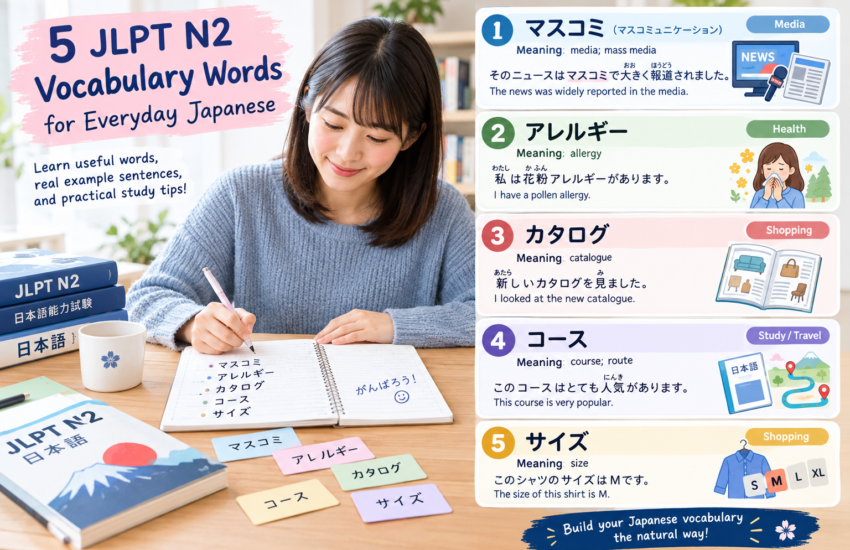
Today, let’s learn five useful Japanese words related to media, health, shopping, courses, and sizes.
These words can appear in everyday conversations, reading materials, advertisements, websites, and other practical situations.
Table of Contents
- Why Study JLPT N2 Vocabulary in Context?
- マスコミ[マスコミ] — Media
- アレルギー — Allergy
- カタログ — Catalogue
- コース — Course; Route
- サイズ — Size
- Vocabulary Summary
- How to Remember These 5 N2 Words
- Practice Quiz
- Practical Learning Tip
- Frequently Asked Questions
- Continue Your JLPT N2 Study
Why Study JLPT N2 Vocabulary in Context?
At the N2 level, Japanese learners need to understand vocabulary beyond simple daily conversations.
Learning words with example sentences can help you:
- Understand Japanese articles more easily
- Improve reading comprehension
- Recognize vocabulary in conversations
- Build a stronger N2 vocabulary base
- Use Japanese more naturally in daily life
Instead of memorizing a word by itself, try to remember the word + meaning + example sentence together.
1. マスコミ — Media
マスコミ(マスコミュニケーション)
Meaning: media; mass media
マスコミ is a common abbreviation of マスコミュニケーション and refers broadly to mass media.
Example
そのニュースはマスコミで大(おお)きく報道(ほうどう)されました。
Translation: The news was widely reported in the media.
Learning Tip
You may encounter マスコミ when reading or listening to Japanese discussions about:
- News
- Television
- Newspapers
- Public opinion
- Social issues
Related word
報道(ほうどう) — news reporting; coverage
2. アレルギー — Allergy
アレルギー
Meaning: allergy
アレルギー is a useful word for talking about health and food.
Example
私(わたし)は花粉(かふん)アレルギーがあります。
Translation: I have a pollen allergy.
You may also hear this word when discussing food, medicine, animals, or seasonal allergies.
Practical Japanese
If you have a food allergy, you may need to explain it clearly when eating at a restaurant or buying food.
For example:
卵(たまご)アレルギーがあります。
I have an egg allergy.
Learning Tip
Try creating your own sentence by replacing 花粉 with another word, such as a food or other allergen.
3. カタログ — Catalogue
カタログ
Meaning: catalogue
カタログ is used for a collection of products, services, or information presented together.
Example
新(あたら)しいカタログを見(み)ました。
Translation: I looked at the new catalogue.
You may encounter カタログ when shopping or looking at products and services.
Practical Japanese
For example:
カタログを送(おく)ってください。
Please send me the catalogue.
Learning Tip
When learning vocabulary, connect a new word to a situation you already know. For カタログ, imagine looking through a catalogue while choosing a product.
4. コース — Course; Route
コース
Meaning: course; route
コース can have different meanings depending on the context.
It can refer to a course of study, a route, or a planned course or path.
Example
このコースはとても人気(にんき)があります。
Translation: This course is very popular.
Learning Tip
Always look at the surrounding sentence to understand which meaning of コース is intended.
For example, in a learning context, コース can refer to a course of study. In another situation, it can refer to a route or planned path.
5. サイズ — Size
サイズ
Meaning: size
サイズ is a very common word when talking about clothes, shoes, products, and other items.
Example
このシャツのサイズはMです。
Translation: The size of this shirt is M.
Practical Japanese
When shopping, you may hear questions or expressions such as:
サイズは何(なん)ですか。
What size is it?
Mサイズをください。
I would like a size M.
Learning Tip
Try using サイズ with different products:
- シャツのサイズ — shirt size
- 靴(くつ)のサイズ — shoe size
- サイズを確認(かくにん)する — check the size
Vocabulary Summary
| Japanese | Meaning | Useful Context |
| マスコミ | media | News and society |
| アレルギー | allergy | Health and food |
| カタログ | catalogue | Shopping and products |
| コース | course; route | Study, travel, routes |
| サイズ | size | Shopping and products |
How to Remember These 5 N2 Words
Try the 5-5-5 method:
1. Read
Read each Japanese word and example sentence aloud five times.
2. Write
Write one original sentence for each word.
3. Review
Review the five words again after five days.
For example:
マスコミ → news
アレルギー → health
カタログ → shopping
コース → study/route
サイズ → shopping
Creating these simple connections can make vocabulary easier to recall.
Practice Quiz
Choose the correct Japanese word.
1. Which word means “media”?
A. サイズ
B. マスコミ
C. カタログ
Answer: B. マスコミ
2. Which word means “allergy”?
A. アレルギー
B. コース
C. マスコミ
Answer: A. アレルギー
3. Which word can mean “course” or “route”?
A. サイズ
B. カタログ
C. コース
Answer: C. コース
4. Which word is commonly used when talking about the size of clothes?
A. サイズ
B. アレルギー
C. マスコミ
Answer: A. サイズ
Practical Learning Tip
Don’t study JLPT vocabulary as isolated lists.
For each new word:
- Read the word.
- Learn its meaning.
- Read the example sentence.
- Create your own sentence.
- Review it later.
For N2 learners, this approach can help you recognize vocabulary more easily when reading Japanese articles, websites, conversations, and other real-world materials.
Frequently Asked Questions
Is this vocabulary useful for JLPT N2?
These five words are useful vocabulary for intermediate Japanese learners and can help expand your vocabulary for everyday communication and reading.
How many Japanese words should I study every day?
There is no single correct number. A small group of words studied consistently can be more manageable than trying to memorize a large list at once.
Should I memorize the example sentences?
You do not need to memorize every sentence word-for-word. Instead, understand how the target word works and create your own example.
How can I improve my N2 vocabulary?
Combine vocabulary study with reading, listening, writing, and regular review. Learning words in context is especially useful for understanding how Japanese is actually used.
Continue Your JLPT N2 Study
If you are preparing for JLPT N2, vocabulary is only one part of your preparation. Regular practice with grammar, kanji, reading, listening, and exam-style questions can help you build a more complete study routine.
Internal Link Suggestions:
- JLPT N5–N1 course page:https://myjapaneseonline.com/home/courses
- Blog:https://myjapaneseonline.com/blog/
- My Japanese Online:https://myjapaneseonline.com/
If you want structured JLPT preparation with licensed native Japanese teachers, My Japanese Online offers online Japanese courses from N5 to N1.
Your Next Step
Today, try this:
☐ Learn the five vocabulary words
☐ Read each example sentence aloud
☐ Write one sentence using each word
☐ Review the words again later
☐ Try to notice these words when reading or listening to Japanese
Keep learning a few words every day, and build your Japanese step by step. 🇯🇵
External Official Links
References
This article uses the vocabulary and example sentences supplied for the Daily JLPT N2 Vocabulary lesson. Existing My Japanese Online blog content was reviewed to avoid repeating the same general vocabulary article angle.