
 Posted by
Learning JLPT vocabulary N5 to N1 is an important step toward improving your Japanese reading, listening, and communication skills. Whether you are a beginner or an advanced learner, studying new words every day can help you build a stronger vocabulary.
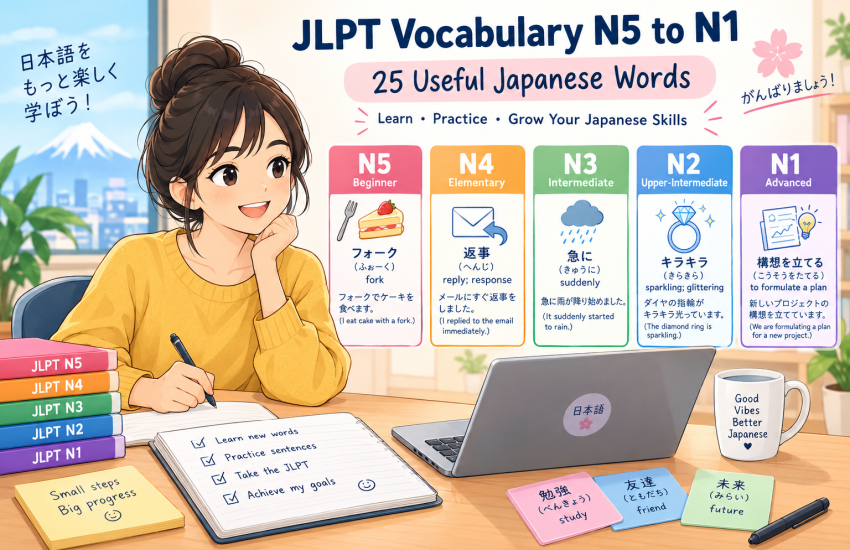
In this Day 38 vocabulary lesson, you will learn 25 Japanese words and expressions across five JLPT levels. Each word includes its reading, English meaning, and an example sentence to help you understand how it is used.
From everyday vocabulary such as フォーク (fork) and 歯[は] (tooth) to advanced expressions such as 構想[こうそう]を立[た]てる (to formulate a plan), this guide will help you practice Japanese step by step.
Let’s learn Japanese step by step!
Why Study JLPT Vocabulary Every Day?
Regular vocabulary practice helps you recognize Japanese words in different contexts. It also gives you more opportunities to practice reading, listening, speaking, and writing.
Instead of trying to memorize all 25 words at once, start with the vocabulary that matches your current level.
- N5: Build a foundation with everyday words and actions.
- N4: Improve communication in daily and workplace situations.
- N3: Understand more detailed descriptions and expressions.
- N2: Learn expressive vocabulary and natural Japanese phrases.
- N1: Develop a deeper understanding of advanced expressions and formal communication.
1. JLPT N5 Vocabulary: Everyday Japanese
N5 learners should focus on familiar situations, simple sentences, and frequently used vocabulary.
🍴 1. フォーク — Fork
Meaning: Fork
Example:
フォークでケーキを食[た]べます。
Translation: I eat cake with a fork.
Learning tip: フォーク is written in katakana. Practice using it with food-related vocabulary such as ケーキ (cake), パン (bread), and スプーン (spoon).
🦷 2. 歯[は] — Tooth
Meaning: Tooth; teeth
Example:
毎日[まいにち]歯[は]をみがきます。
Translation: I brush my teeth every day.
Learning tip: Connect 歯[は] with your daily routine. The expression 歯をみがく means “to brush one’s teeth.”
🌓 3. 半分[はんぶん] — Half
Meaning: Half; one half
Example:
ケーキを半分[はんぶん]に切[き]りました。
Translation: I cut the cake in half.
Learning tip: Use 半分[はんぶん] when talking about sharing food or dividing something into two equal parts.
🏃 4. 走[はし]る — To Run
Meaning: To run
Example:
毎朝[まいあさ]公園[こうえん]で走[はし]ります。
Translation: I run in the park every morning.
Learning tip: Remember that 走[はし]る is the dictionary form. Its polite present form is 走ります[はしります].
😅 5. 下手[へた] — Not Good At Something
Meaning: Unskillful; not good at
Example:
私[わたし]は歌[うた]が下手[へた]です。
Translation: I am not good at singing.
Learning tip: 下手[へた] is often used with が when describing a skill. Its opposite is 上手[じょうず], meaning “good at” or “skillful at.”
2. JLPT N4 Vocabulary: Daily Communication
N4 vocabulary helps learners express themselves more clearly in everyday conversations and familiar situations.
📩 6. 返事[へんじ] — Reply; Response
Meaning: Reply; answer; response
Example:
メールにすぐ返事[へんじ]をしました。
Translation: I replied to the email immediately.
Learning tip: 返事[へんじ] is useful when talking about messages, questions, and conversations.
📉 7. 以下[いか] — At Most; Or Less
Meaning: The stated amount or number and anything below it
Example:
五歳[ごさい]以下[いか]の子供[こども]は無料[むりょう]です。
Translation: Children aged five and under are free.
Learning tip: 以下[いか] is often used with ages, prices, quantities, and limits. For example, 十人以下[じゅうにんいか] means “ten people or fewer.”
🧱 8. 壁[かべ] — Wall
Meaning: Wall
Example:
壁[かべ]に写真[しゃしん]をかけました。
Translation: I hung a picture on the wall.
Learning tip: Learn 壁[かべ] with everyday objects and places around your home.
🏢 9. 会議室[かいぎしつ] — Meeting Room
Meaning: Meeting room; conference room
Example:
会議[かいぎ]は三階[さんがい]の会議室[かいぎしつ]で行[おこな]います。
Translation: The meeting will be held in the meeting room on the third floor.
Learning tip: This word is particularly useful for office communication. 会議[かいぎ] means “meeting,” while 室[しつ] means “room” in compound words.
✅ 10. 必[かなら]ず — Definitely; Without Fail
Meaning: Certainly; definitely; without fail
Example:
約束[やくそく]は必[かなら]ず守[まも]ってください。
Translation: Please make sure to keep your promises.
Learning tip: 必[かなら]ず emphasizes that something must or will happen. You may encounter it in instructions, promises, and everyday conversations.
3. JLPT N3 Vocabulary: Describing Situations and Changes
N3 learners benefit from vocabulary that helps them explain events, express opinions, and understand more detailed information.
⚡ 11. 急[きゅう]に — Suddenly
Meaning: Suddenly; unexpectedly
Example:
急[きゅう]に雨[あめ]が降[ふ]り始[はじ]めました。
Translation: It suddenly started to rain.
Learning tip: 急[きゅう]に is often used when something happens unexpectedly or without warning.
✨ 12. 大[たい]した — Significant; Remarkable
Meaning: Great; significant; considerable
Example:
それは大[たい]した問題[もんだい]ではありません。
Translation: That is not a big problem.
Learning tip: In the expression 大した問題ではない, 大した is used to downplay the seriousness or importance of something. Context determines whether 大した carries a positive or negative sense.
😋 13. 上手[うま]い — Skillful; Delicious
Meaning: Skillful; good at something; delicious
Example:
彼[かれ]は料理[りょうり]が上手[うま]いです。
Translation: He is good at cooking.
Learning tip: 上手[うま]い is commonly used in conversation. It can describe a person’s skill or the good taste of food. For example, この料理はうまい means “This food is delicious.”
📦 14. 輸入[ゆにゅう] — Import; Importation
Meaning: Import; to import
Example:
日本[にほん]は多[おお]くの食料[しょくりょう]を輸入[ゆにゅう]しています。
Translation: Japan imports a lot of food.
Learning tip: 輸入[ゆにゅう] is useful for topics related to trade, economics, and business. The opposite is 輸出[ゆしゅつ], meaning “export.”
🚀 15. 急速[きゅうそく] — Rapid; Rapidly
Meaning: Rapid; fast; rapid speed
Example:
技術[ぎじゅつ]は急速[きゅうそく]に進歩[しんぽ]しています。
Translation: Technology is advancing rapidly.
Learning tip: 急速[きゅうそく] often appears in formal writing and discussions about technological, social, or economic change.
4. JLPT N2 Vocabulary: Expressive Japanese
N2 learners need to understand more nuanced expressions, including words that describe emotions, movement, and changes in situations.
🎁 16. わくわく — Excited; Thrilled
Meaning: Feeling excited or looking forward to something
Example:
プレゼントの箱[はこ]を開[あ]けるときは、わくわくしますね。
Translation: You feel excited when opening a present, don’t you?
Learning tip: わくわく expresses positive excitement or anticipation. It is often used when looking forward to a trip, event, or special occasion.
😔 17. くよくよ — Worrying; Brooding
Meaning: To worry repeatedly about something; to brood
Example:
もう終[お]わったことだから、くよくよしても仕方[しかた]がない。
Translation: It’s already over, so there is no use worrying about it.
Learning tip: くよくよ often describes dwelling on something negative. Learn it as the expression くよくよする.
💍 18. キラキラ — Sparkling; Glittering
Meaning: Sparkling; glittering; shining brightly
Example:
ダイヤの指輪[ゆびわ]がキラキラ光[ひか]っています。
Translation: The diamond ring is sparkling.
Learning tip: キラキラ is a Japanese mimetic expression that describes something shining or glittering. You can also use it to describe sparkling eyes or decorations.
🚉 19. どっと — All at Once; In a Rush
Meaning: All at once; in a sudden rush
Example:
駅[えき]から人[ひと]がどっと出[で]てきました。
Translation: A crowd of people came out of the station all at once.
Learning tip: どっと emphasizes a large number of people or something happening in a sudden rush. It is often used with verbs describing movement or a sudden change.
📈 20. ぐんぐん — Rapidly; Steadily
Meaning: Rapidly; strongly; steadily
Example:
売[う]り上[あ]げがぐんぐん伸[の]びています。
Translation: Sales are increasing rapidly.
Learning tip: ぐんぐん suggests noticeable progress or growth. It can describe rising sales, improving skills, or a growing child.
5. JLPT N1 Vocabulary: Advanced Expressions
N1 learners encounter more specialized phrases and expressions used in formal discussions, professional situations, and detailed explanations.
🌡️ 21. 平年並[へいねんな]みの気温[きおん] — Average Seasonal Temperature
Meaning: Temperature around the normal or average level for the time of year
Example:
今年[ことし]の冬[ふゆ]は平年並[へいねんな]みの気温[きおん]です。
Translation: Temperatures this winter are around the seasonal average.
Learning tip: 平年並み means “about the usual or average level for the time of year.” You may see it in weather reports and seasonal forecasts.
📝 22. 構想[こうそう]を立[た]てる — To Formulate a Plan
Meaning: To develop a concept; to formulate a plan
Example:
新[あたら]しいプロジェクトの構想[こうそう]を立[た]てています。
Translation: We are developing a concept for a new project.
Learning tip: 構想[こうそう] refers to an idea or overall concept, while 立てる[たてる] means “to establish” or “to formulate” in this expression. It is useful in planning and professional discussions.
🏢 23. 会場[かいじょう]の手配[てはい] — Venue Arrangements
Meaning: Arrangements to secure or prepare a venue
Example:
会議[かいぎ]のために会場[かいじょう]の手配[てはい]をしました。
Translation: I arranged the venue for the meeting.
Learning tip: 手配[てはい] means making the necessary arrangements. It can also be used for travel, accommodation, transportation, and event planning.
⚠️ 24. 目[め]の前[まえ]の問題[もんだい] — The Problem at Hand
Meaning: The immediate problem; the issue directly in front of you
Example:
まずは目[め]の前[まえ]の問題[もんだい]を解決[かいけつ]しましょう。
Translation: Let’s first solve the problem at hand.
Learning tip: 目の前 literally means “in front of one’s eyes.” In this expression, it refers to a current or immediate situation that needs attention.
📖 25. いきさつを話[はな]す — To Explain the Circumstances
Meaning: To explain how something happened; to describe the circumstances
Example:
事件[じけん]のいきさつを詳[くわ]しく話[はな]してください。
Translation: Please explain in detail how the incident happened.
Learning tip: いきさつ refers to the sequence of events or background that led to a particular situation. It is useful when explaining the history of an incident or how a decision was reached.
How to Remember These 25 JLPT Vocabulary Words
Learning 25 words across five levels can feel challenging, but a structured approach makes it manageable.
1. Start with Your Current JLPT Level
If you are preparing for N5, focus on the first five words. If you are studying N3 or N2, begin with the vocabulary for your level and review the easier words regularly.
2. Learn Words Through Sentences
Do not memorize only the English meanings. Read the Japanese examples aloud and notice how the words connect with particles and verbs.
For example:
- 急に雨が降り始めました。 — It suddenly started to rain.
- 売り上げがぐんぐん伸びています。 — Sales are increasing rapidly.
- 目の前の問題を解決しましょう。 — Let’s solve the problem at hand.
3. Group Similar Words Together
Connecting related words can make revision easier.
- Change and speed: 急に、急速、ぐんぐん
- Emotions and impressions: わくわく、くよくよ、キラキラ
- Business and planning: 会議室、輸入、構想を立てる、会場の手配
4. Make Your Own Example Sentences
Choose three words each day and write a sentence about your own life. Try using the vocabulary in a conversation or short paragraph.
5. Review Regularly
Review the words you learned yesterday before moving on to new vocabulary. Revisit difficult words after a few days and use them in different sentences.
Mini Practice Quiz
Test your understanding of today’s vocabulary.
Question 1: Which word means “tooth”?
A. 壁[かべ]
B. 歯[は]
C. 半分[はんぶん]
Question 2: Which expression means “suddenly”?
A. 急に[きゅうに]
B. ぐんぐん
C. わくわく
Question 3: What does 輸入[ゆにゅう] mean?
A. Export
B. Import
C. Meeting room
Question 4: Which expression means “to worry or brood repeatedly”?
A. キラキラ
B. どっと
C. くよくよ
Question 5: What does 構想を立てる[こうそうをたてる] mean?
A. To formulate a plan
B. To explain an incident
C. To arrange a venue
Answers: 1-B, 2-A, 3-B, 4-C, 5-A.
Frequently Asked Questions
1. How many vocabulary words should I learn each day for the JLPT?
Start with five words a day if you are a beginner. More advanced learners may study additional words, provided they also review previously learned vocabulary.
2. Should I study vocabulary from every JLPT level?
Focus primarily on the level you are preparing for. Reviewing lower-level words can strengthen your foundation, while exploring higher-level vocabulary can gradually broaden your understanding.
3. Is learning example sentences useful for JLPT preparation?
Yes. Example sentences show how vocabulary works in context and help you recognize particles, grammar patterns, and common word combinations.
4. How can I remember advanced Japanese expressions?
Break expressions into smaller parts, learn their meanings, and practice them in realistic sentences. Reviewing them regularly helps you become more familiar with their usage.
5. Can vocabulary practice improve Japanese speaking skills?
Yes. Reading example sentences aloud and creating your own sentences can support speaking practice. Combining vocabulary study with listening and conversation practice provides a more balanced learning routine.
Continue Your Japanese Learning Journey
Building Japanese vocabulary takes time, practice, and regular revision. Whether you are learning your first N5 words or exploring advanced N1 expressions, every new word gives you another way to understand and communicate in Japanese.
For structured Japanese learning support, My Japanese Online offers JLPT courses from N5 to N1, private lessons, and instruction from licensed native Japanese teachers.
Explore the relevant course page: [Add the appropriate My Japanese Online JLPT course link].
Your Next Step
- Review the five words from your current JLPT level.
- Read each example sentence aloud.
- Complete the mini quiz.
- Write three original Japanese sentences.
- Review today’s vocabulary again tomorrow.
Study a little every day and keep building your Japanese confidence! 頑張[がんば]りましょう!
Internal Link Suggestions
- JLPT N5–N1 course page:https://myjapaneseonline.com/home/courses
- Blog:https://myjapaneseonline.com/blog/
- My Japanese Online:https://myjapaneseonline.com/
External Learning Resource
- Official JLPT website: https://www.jlpt.jp/
Use the official website for JLPT-related information and announcements.