
 Posted by
 Learning a few Japanese words every day can make your JLPT N3 preparation more manageable. However, simply memorizing Japanese words and their English meanings is not always enough.
A better approach is to learn each word in context. When you understand how a word works in a sentence, you can recognize it more easily in reading and listening practice and become more confident using it yourself.
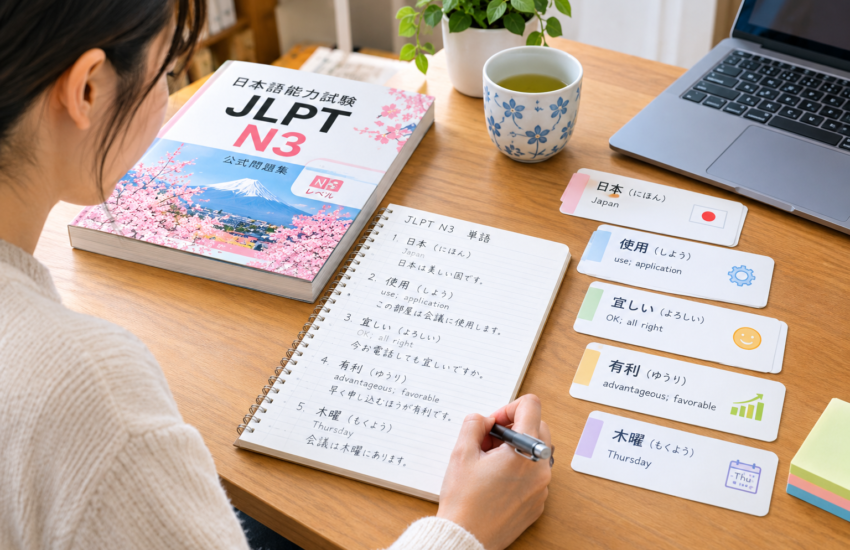
Today, let’s learn five useful JLPT N3 vocabulary words:
- 日本[にほん] — Japan
- 使用[しよう] — use; application
- 宜[よろ]しい — (respectful) OK; all right
- 有利[ゆうり] — advantageous; favorable
- 木曜[もくよう] — Thursday
Let’s look at each word and see how you can use it.
1. 日本[にほん] — Japan 🇯🇵
Meaning: Japan
日本[にほん] is the common Japanese word for Japan. You will see and hear it frequently in conversations, textbooks, news, travel information, and everyday communication.
Example
日本[にほん]は美[うつく]しい国[くに]です。
Translation: Japan is a beautiful country.
Useful expressions
You can combine 日本[にほん] with many other words:
- 日本語[にほんご] — Japanese language
- 日本人[にほんじん] — Japanese person
- 日本文化[にほんぶんか] — Japanese culture
- 日本料理[にほんりょうり] — Japanese cuisine
Study tip
When learning 日本[にほん], try learning related words at the same time. This helps you build vocabulary around a common topic instead of memorizing isolated words.
2. 使用[しよう] — Use; Application 🛠️
Meaning: use; usage; application
使用[しよう] is useful when talking about using something for a particular purpose. It is often seen in more formal situations, such as signs, instructions, offices, facilities, and written Japanese.
Example
この部屋[へや]は会議[かいぎ]に使用[しよう]します。
Translation: This room will be used for a meeting.
Common expressions
You may see 使用[しよう] in expressions such as:
- 使用する — to use
- 使用方法[しようほうほう] — method of use
- 使用時間[しようじかん] — usage time
- 使用禁止[しようきんし] — use prohibited
Study tip
Pay attention to 使用[しよう] when reading Japanese instructions or notices. Recognizing formal vocabulary like this can be especially useful for intermediate learners.
3. 宜[よろ]しい — (Respectful) OK; All Right 🙇♀️
Meaning: OK; all right; acceptable
宜[よろ]しい is a polite and respectful expression related to よい / いい, meaning “good” or “okay.”
It is particularly useful when asking for permission or confirmation in polite situations.
Example
今[いま]お電話[でんわ]しても宜[よろ]しいですか。
Translation: Is it all right if I call you now?
A useful pattern
One important pattern to remember is:
~ても宜[よろ]しいですか。
This can be used when asking politely whether something is allowed or acceptable.
For example:
ここに座[すわ]っても宜[よろ]しいですか。
Translation: Is it all right if I sit here?
Study tip
When studying polite Japanese, don’t only memorize the English meaning. Practice the complete sentence pattern so you can use it naturally.
4. 有利[ゆうり] — Advantageous; Favorable 📈
Meaning: advantageous; favorable
有利[ゆうり] is used when something gives you an advantage or puts you in a favorable position.
You may encounter this word when talking about applications, opportunities, decisions, competitions, work, or study.
Example
早[はや]く申[もう]し込[こ]むほうが有利[ゆうり]です。
Translation: It is more advantageous to apply early.
Useful expression
A useful pattern is:
~ほうが有利です
This means that one option is more advantageous than another.
For example:
早[はや]く準備[じゅんび]するほうが有利[ゆうり]です。
Translation: It is more advantageous to prepare early.
Related idea
When you see 有利[ゆうり], think about the idea of having an advantage.
The opposite concept is:
不利[ふり] — disadvantageous; unfavorable
Learning these two words together can make them easier to remember.
5. 木曜[もくよう] — Thursday 📅
Meaning: Thursday
木曜[もくよう] is a shortened form related to 木曜日[もくようび], meaning Thursday.
Days of the week are essential vocabulary for making appointments, talking about schedules, and discussing plans.
Example
会議[かいぎ]は木曜[もくよう]にあります。
Translation: The meeting is on Thursday.
Days of the week
Here are the seven days of the week:
| Japanese | Reading | English |
| 月曜 | げつよう | Monday |
| 火曜 | かよう | Tuesday |
| 水曜 | すいよう | Wednesday |
| 木曜 | もくよう | Thursday |
| 金曜 | きんよう | Friday |
| 土曜 | どよう | Saturday |
| 日曜 | にちよう | Sunday |
You will also commonly see the longer forms ending in 曜日[ようび], such as 木曜日[もくようび].
Study tip
Practice the days of the week together rather than learning only one day. This makes it easier to understand schedules and appointments.
How These 5 Words Can Help Your Japanese
These five words cover different situations that JLPT N3 learners may encounter.
日本[にほん] is useful for talking about Japan, Japanese language, and culture.
使用[しよう] can appear in formal instructions and practical situations.
宜[よろ]しい helps you understand polite requests and permission.
有利[ゆうり] is useful when discussing advantages and choices.
木曜[もくよう] helps you talk about schedules and appointments.
The key is not just to memorize the English translations. Try to understand each word inside a complete sentence.
Practice: Can You Remember the Words?
Match each Japanese word with its meaning.
- 日本[にほん]
- 使用[しよう]
- 宜[よろ]しい
- 有利[ゆうり]
- 木曜[もくよう]
A. Thursday
B. Japan
C. advantageous; favorable
D. use; application
E. OK; all right
Answers
1 → B
2 → D
3 → E
4 → C
5 → A
How many did you get correct?
Practical JLPT N3 Vocabulary Study Tip
Try the 5-5-5 method for today’s vocabulary:
1. Read each word 5 times
Read the Japanese word and its reading aloud.
2. Write 5 sentences
Choose at least one of today’s words and create your own Japanese sentences.
3. Review for 5 minutes
Before starting tomorrow’s vocabulary, spend five minutes reviewing today’s words.
For example, make your own sentence with 有利[ゆうり]:
日本語[にほんご]を早[はや]く勉強[べんきょう]するほうが有利[ゆうり]です。
Translation: It is advantageous to start studying Japanese early.
Creating your own sentences helps you move from simply recognizing a word to actually using it.
Vocabulary Summary
| Japanese | Reading | Meaning |
| 日本 | にほん | Japan |
| 使用 | しよう | use; application |
| 宜しい | よろしい | OK; all right |
| 有利 | ゆうり | advantageous; favorable |
| 木曜 | もくよう | Thursday |
Frequently Asked Questions
Is this vocabulary useful for JLPT N3?
These five words are suitable for N3-level vocabulary practice and are useful for developing intermediate Japanese vocabulary.
What is the difference between 木曜 and 木曜日?
木曜[もくよう] is the shortened form, while 木曜日[もくようび] is the full form. Both refer to Thursday.
Is 宜[よろ]しい a polite expression?
Yes. 宜[よろ]しい is a polite and respectful expression related to よい / いい. It can be used when asking for permission or confirmation.
How can I remember 有利[ゆうり]?
Connect 有利[ゆうり] with the idea of having an advantage. You can also learn its opposite, 不利[ふり], at the same time.
Should I memorize vocabulary with example sentences?
Yes. Example sentences help you understand how vocabulary works in context. Try creating your own sentence after learning each new word.
Internal Link Suggestions
- JLPT N5–N1 course page:https://myjapaneseonline.com/home/courses
- Blog:https://myjapaneseonline.com/blog/
- My Japanese Online:https://myjapaneseonline.com/
Your Next Step
Choose one word from today’s lesson and create three Japanese sentences with it.
For example, practice:
有利[ゆうり]
Then review the five words again tomorrow.
Consistent vocabulary practice can help you gradually build a stronger Japanese foundation for reading, listening, and communication.
If you want structured JLPT preparation with licensed native Japanese teachers, My Japanese Online offers online Japanese courses from N5 to N1.
JLPT schedules and rules can change. Always confirm the latest information on the official JLPT website.
References
- My Japanese Online, “5 JLPT N3 Words You Can Learn Through Real Japanese Context.”
- My Japanese Online, “5 Essential JLPT N3 Vocabulary Words You Should Know Today.”
Short WhatsApp Promotion
📘 New Blog for Japanese Learners
Today’s topic: 5 JLPT N2 Words for Everyday Japanese
Learn 5 useful Japanese words with readings, meanings, example sentences, and practical study tips.
Read here: https://myjapaneseonline.com/blog/
External : https://www.jlpt.jp/