
 Posted by
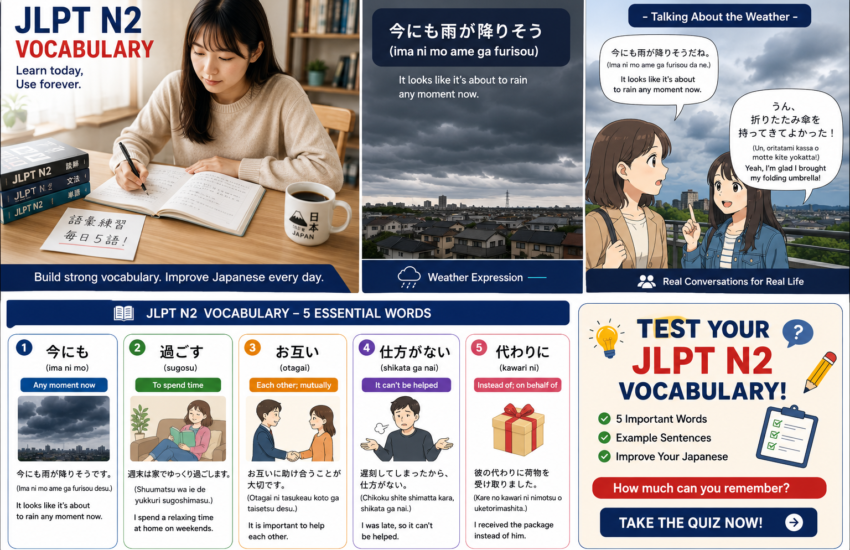
 Learning JLPT N2 vocabulary becomes much easier when you study words in real-life situations instead of memorizing lists. In this article, you’ll learn five useful N2 expressions, their meanings, example sentences, and practical tips so you can start using them naturally in everyday conversations.
Why These Words Matter
As you progress to the JLPT N2 level, you’ll notice that vocabulary becomes more nuanced. Many words describe emotions, personality, and situations rather than simple objects or actions.
Mastering these expressions will help you:
- Understand native Japanese conversations more easily.
- Express yourself more naturally.
- Improve your JLPT reading and listening skills.
- Build confidence in everyday communication.
Today’s JLPT N2 Vocabulary
| Japanese | Reading | Meaning |
| 今にも | いまにも | any moment now; about to |
| あいにく | あいにく | unfortunately |
| いっせいに | いっせいに | all at once |
| 気短い | きみじかい | short-tempered |
| だらしない | だらしない | sloppy; untidy |
1. 🌧️ 今にも(いまにも)
Meaning
今にも is used when something looks like it is about to happen very soon.
Example
空が暗い。今にも雨が降りそうだ。
Translation
The sky is dark. It looks like it’s about to rain at any moment.
Other Examples
- 今にも泣きそうです。
She looks like she’s about to cry. - 今にも電車が来そうです。
The train looks like it’s about to arrive.
Learning Tip
You’ll often hear 今にも with 〜そうだ, which means “looks like…” or “seems about to…”.
2. 😔 あいにく
Meaning
あいにく expresses disappointment when something cannot happen as hoped.
Example
あいにく、夜は用事があるんです。
Translation
Unfortunately, I already have plans tonight.
Other Examples
- あいにく今日は休みです。
Unfortunately, we’re closed today. - あいにく席がありません。
Unfortunately, there are no seats available.
Learning Tip
This word is commonly used in polite conversations, customer service, and business situations.
3. 🙋 いっせいに
Meaning
いっせいに means “simultaneously” or “all at once.”
Example
みんな、いっせいに手を上げた。
Translation
Everyone raised their hands at once.
Other Examples
- 鳥がいっせいに飛び立った。
The birds flew away all at once. - 生徒がいっせいに笑った。
The students laughed simultaneously.
Learning Tip
You’ll often see this word in news reports, classrooms, and daily conversations.
4. 😠 気短い(きみじかい)
Meaning
気短い describes someone who becomes impatient or angry very quickly.
Example
彼は気短い性格です。
Translation
He has a short temper.
Other Examples
- 気短い人とは仕事が大変です。
Working with short-tempered people can be difficult. - あまり気短くならないでください。
Please don’t lose your patience.
Learning Tip
This word is usually used to describe personality rather than temporary emotions.
5. 👕だらしない
だらしない
Meaning
だらしない describes someone who is careless, untidy, or lacks discipline.
Example
彼は服装がだらしないです。
Translation
He is sloppy in his appearance.
Other Examples
- 部屋がだらしない。
The room is messy. - 時間にだらしない人です。
He isn’t punctual.
Learning Tip
Besides appearance, だらしない can describe bad habits, poor time management, or lack of responsibility.
Mini Conversation
A: 空が真っ暗だね。
B: 本当だ。今にも雨が降りそう。
A: あいにく傘を持ってきてないよ。
B: みんな、いっせいに駅へ走っているね!
Translation
A: The sky is really dark.
B: You’re right. It looks like it’s about to rain.
A: Unfortunately, I didn’t bring an umbrella.
B: Look! Everyone is running to the station at once.
Common Mistakes
❌ Using あいにく for happy situations.
❌ Using 気短い to describe temporary anger instead of personality.
❌ Confusing だらしない with simply being tired. It refers to being careless or untidy.
Practice Quiz
Choose the correct answer.
1. Which word means “all at once”?
A. あいにく
B. 気短い
C. いっせいに
✅ Answer: C
2. Which word describes someone with a short temper?
A. だらしない
B. 気短い
C. 今にも
✅ Answer: B
Study Tips
To remember new vocabulary more effectively:
- Read each sentence aloud.
- Create your own example using each word.
- Review the words after one day and one week.
- Watch Japanese dramas or news and try to recognize these expressions.
Related JLPT N2 Vocabulary
- のんびり — leisurely
- あわてる — to panic
- 落ち着く(おちつく)— to calm down
- 真面目(まじめ)— serious
- 我慢する(がまんする)— to endure
Frequently Asked Questions
Are these words commonly used in daily Japanese?
Yes. Native speakers frequently use these expressions in everyday conversations.
Are these vocabulary words included in the JLPT N2 exam?
Yes. These are commonly encountered words at the JLPT N2 level.
How should I study JLPT N2 vocabulary?
Study words in context, make your own example sentences, and review them regularly using spaced repetition.
Key Takeaways
- ✔ Learn vocabulary through real situations.
- ✔ Practice using complete sentences instead of memorizing individual words.
- ✔ Review regularly to improve long-term retention.
- ✔ Use conversations to build natural speaking skills.
Continue Your Japanese Journey
If you’re preparing for the JLPT N2 exam or want to improve your practical Japanese, My Japanese Online offers structured online lessons taught by licensed native Japanese teachers. From JLPT preparation to Business Japanese and private lessons, you’ll receive personalized guidance to help you achieve your learning goals.
Link Suggestions
- Blog Home: My Japanese Online Blog
- LPT Courses: JLPT Courses (N5–N1)
- Official JLPT Website: Japanese-Language Proficiency Test (JLPT)
- JLPT in Japan (JEES): MyJLPT Portal