
 Posted by
Introduction
Traveling by train in Japan is one of the most convenient ways to explore the country. From busy stations in Tokyo and Osaka to smaller stations in local towns, trains connect people to shopping areas, tourist attractions, workplaces, and residential neighborhoods.
However, Japanese train stations can sometimes feel confusing, especially if you are not familiar with Japanese characters.
You may see signs written in kanji, hiragana, katakana, and English. You may also notice different platform numbers, arrows, station codes, and Japanese words that you have never studied before.
The good news is that you do not need to understand every Japanese word to navigate a train station.
In this guide, you will learn how to read common Japanese train station signs, understand important directions, and recognize useful Japanese vocabulary for traveling around Japan.
1. Understanding Japanese Station Names
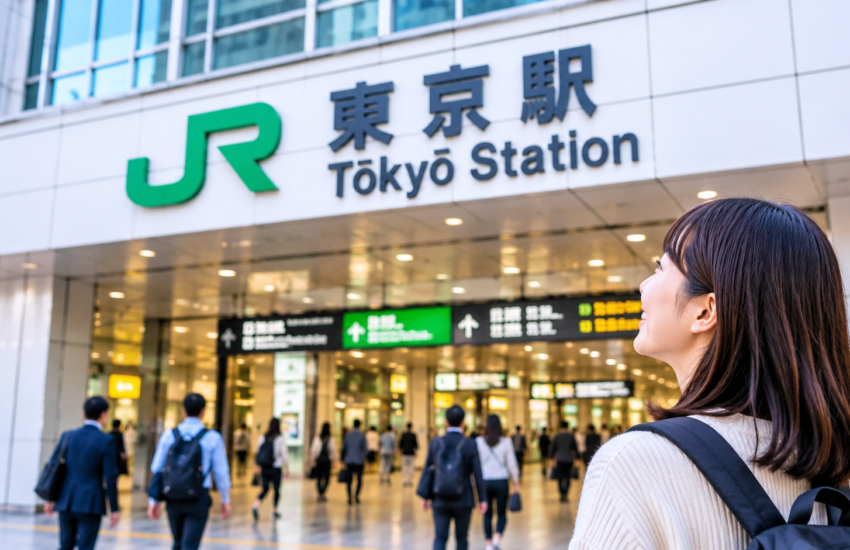
The first important sign to recognize is the station name.
Japanese station names are often displayed in Japanese and English. Depending on the railway company and location, you may also see Chinese and Korean translations.
For example:
- 東京駅(とうきょうえき)– Tokyo Station
- 新宿駅(しんじゅくえき)– Shinjuku Station
- 渋谷駅(しぶやえき)– Shibuya Station
- 大阪駅(おおさかえき)– Osaka Station
- 京都駅(きょうとえき)– Kyoto Station
The Japanese character 駅(えき)means “station.”
When looking for your destination, remember that the station name may appear in kanji as well as English.
Learning Tip: Save the Japanese spelling of your destination on your smartphone. You can compare it with the station signs when traveling.
[IMAGE: Japanese railway platform sign showing a station name in Japanese and English, with neighboring station names.]
2. Common Japanese Train Station Signs
Learning a few important Japanese words can make traveling much easier.
Here are some common signs you may see inside Japanese train stations.
① 入口(いりぐち)– Entrance
入口 means entrance.
You will see this sign near station entrances, building entrances, and other public facilities.
Example:
駅の入口はどこですか。
(えきのいりぐちはどこですか。)
Where is the station entrance?
② 出口(でぐち)– Exit
出口 means exit.
Follow this sign when you want to leave the station.
Example:
出口はあちらです。
(でぐちはあちらです。)
The exit is over there.
③ 改札(かいさつ)– Ticket Gate
改札 refers to the ticket gate or ticket barrier.
You will usually find ticket gates between the station’s general area and the paid train area.
Look for this sign when entering or leaving the railway area.
④ 乗り換え(のりかえ)– Transfer
乗り換え means changing from one train or railway line to another.
For example, if you are traveling from one station to another and need to change trains, follow the 乗り換え signs.
Example:
新宿駅で乗り換えます。
(しんじゅくえきでのりかえます。)
I will change trains at Shinjuku Station.
⑤ ホーム – Platform
ホーム means train platform.
You may see this word on directional signs leading to the platform.
Example:
ホームはどこですか。
Where is the platform?
⑥ トイレ – Toilet
トイレ means toilet or restroom.
Look for this sign when you need to find a restroom inside the station.
⑦ エレベーター – Elevator
エレベーター means elevator.
This sign is especially useful if you are traveling with large suitcases, children, or people who need step-free access.
⑧ エスカレーター – Escalator
エスカレーター means escalator.
Follow this sign to find an escalator connecting different floors.
3. How to Understand Platform Numbers
Finding the correct platform is one of the most important parts of traveling by train in Japan.
Platform numbers are often displayed using 番線(ばんせん)or other platform-number indicators.
For example:
- 1番線(いちばんせん)– Platform 1
- 2番線(にばんせん)– Platform 2
- 3番線(さんばんせん)– Platform 3
- 4番線(よんばんせん)– Platform 4
If your train departs from Platform 3, look for 3番線.
However, platform numbering and the way it is displayed can vary between railway operators and stations.
Practical Tip: Always check the departure information board before going down the stairs or boarding a train. Confirm the platform number, destination, and departure time.
[IMAGE: Japanese train station departure board showing train destinations, departure times, and platform numbers.]
4. Understanding Train Direction Signs
Train direction signs help you identify which train to take.
You may see Japanese words indicating the train’s destination or direction.
Here are some useful expressions:
| Japanese | Reading | Meaning |
| 行き | いき | Bound for |
| 方面 | ほうめん | Direction; toward |
| 東京方面 | とうきょうほうめん | Toward Tokyo |
| 大阪行き | おおさかいき | Bound for Osaka |
| 上り | のぼり | Upbound direction |
| 下り | くだり | Downbound direction |
For example:
東京行き(とうきょういき)
This means a train bound for Tokyo.
大阪方面(おおさかほうめん)
This means the direction toward Osaka.
Remember that 上り and 下り depend on the railway line’s designated direction. Do not assume they always mean north and south.
5. Understanding Different Types of Trains
Not every train stops at every station.
Japanese railway systems have different train categories, and choosing the wrong train may cause you to miss your destination.
Here are some important words:
普通(ふつう)– Local Train
A local train generally stops at every station along its route.
快速(かいそく)– Rapid Train
A rapid train skips some stations and usually travels faster than a local train.
急行(きゅうこう)– Express Train
An express train skips certain stations. Its stopping pattern depends on the railway operator.
特急(とっきゅう)– Limited Express
A limited express train generally stops at selected stations and may require an additional limited-express ticket or fare.
新幹線(しんかんせん)– Shinkansen
The Shinkansen is Japan’s high-speed railway network, commonly known as the bullet train.
Important Tip: Before boarding, check the train category, destination, departure time, and whether your ticket is valid for that service.
6. Useful Signs for Transfers and Station Facilities
Large Japanese stations can have many facilities and connecting railway lines.
Learning the following words will help you find what you need.
| Japanese | Reading | English Meaning |
| 駅員 | えきいん | Station staff |
| 案内所 | あんないじょ | Information counter |
| 切符売り場 | きっぷうりば | Ticket office |
| 精算機 | せいさんき | Fare adjustment machine |
| 駅事務室 | えきじむしつ | Station office |
| 忘れ物 | わすれもの | Lost property |
| 非常口 | ひじょうぐち | Emergency exit |
| コインロッカー | こいんろっかー | Coin locker |
These words are particularly useful when you need assistance, want to buy a ticket, or have misplaced your belongings.
7. Five Useful Japanese Phrases for Train Travel
Even if you can understand English station signs, knowing a few Japanese expressions can make communication easier.
Here are five practical phrases.
1. この電車は東京に行きますか。
Reading: このでんしゃはとうきょうにいきますか。
Meaning: Does this train go to Tokyo?
2. 何番線ですか。
Reading: なんばんせんですか。
Meaning: Which platform is it?
3. 駅はどこですか。
Reading: えきはどこですか。
Meaning: Where is the station?
4. 乗り換えはどこですか。
Reading: のりかえはどこですか。
Meaning: Where can I transfer?
5. この駅で降りますか。
Reading: このえきでおりますか。
Meaning: Do I get off at this station?
You can practice these phrases before traveling. Even simple Japanese questions can help you communicate with station staff and other passengers.
8. Practical Tips for Reading Japanese Train Station Signs
Here are some easy ways to make your train journey smoother.
- Check the English station name: Look for the English translation below or beside the Japanese station name.
- Remember important kanji: Learn common characters such as 駅 (station), 出口 (exit), and 入口 (entrance).
- Follow the arrows: Directional arrows help you find platforms, exits, and transfer routes.
- Check the train destination: Make sure the train is going in the correct direction.
- Look at the departure board: Confirm the train category, platform, and departure time.
- Use station numbers and line colors: Some railway networks use station codes and line colors to make navigation easier.
- Ask station staff: If you are unsure, politely ask for help.
You can also use a railway route-search application to check your route and train connections before leaving.
9. Japanese Train Station Vocabulary to Remember
Let’s review ten useful Japanese words.
| Japanese | Reading | English Meaning |
| 駅 | えき | Station |
| 電車 | でんしゃ | Train |
| 改札 | かいさつ | Ticket gate |
| 出口 | でぐち | Exit |
| 入口 | いりぐち | Entrance |
| 乗り換え | のりかえ | Transfer |
| ホーム | ほーむ | Platform |
| 切符 | きっぷ | Ticket |
| 特急 | とっきゅう | Limited express |
| 駅員 | えきいん | Station staff |
Try learning two or three words every day and looking for them when you visit a Japanese train station.
10. Frequently Asked Questions (FAQ)
Q1. Are Japanese train station signs written in English?
Many major stations and popular tourist routes display station names and important directions in English. Some also provide Chinese and Korean translations. However, multilingual support varies depending on the railway company and location.
Q2. What does 出口 mean in Japanese train stations?
出口(でぐち)means exit. Follow this sign when you want to leave the station.
Q3. What does 乗り換え mean?
乗り換え(のりかえ)means transfer or changing trains. Follow this sign when you need to change railway lines or trains.
Q4. How can I find the correct train platform in Japan?
Check the departure information board for the train destination, departure time, train category, and platform number. Then follow the directional signs to the correct platform.
Q5. Do I need to know Japanese to travel by train in Japan?
You do not need to be fluent in Japanese to use many train services. English signs, route maps, station numbers, and navigation applications can help. However, learning basic Japanese railway vocabulary makes traveling easier.
Practical Learning Tip: Learn Japanese Through Real-Life Experiences
One effective way to improve your Japanese is to connect vocabulary with everyday situations.
When you visit a train station, try reading three signs in Japanese.
For example:
- Find the 改札(かいさつ)sign.
- Look for the 出口(でぐち)sign.
- Identify the ホーム(platform)sign.
Try saying each word aloud and remembering its meaning.
This small activity helps you connect Japanese vocabulary with real-world experiences.
Conclusion
Understanding Japanese train station signs does not have to be difficult.
By learning common words such as 駅, 改札, 出口, 乗り換え, and ホーム, you can become more comfortable navigating train stations in Japan.
Start with a few basic expressions, practice reading station signs, and gradually expand your vocabulary.
Japanese is easier to learn when you connect it with situations you experience every day.
Want to improve your practical Japanese skills?
At My Japanese Online, you can learn Japanese through structured online lessons with licensed native Japanese teachers. Whether you want to improve everyday conversation, prepare for the JLPT, or communicate confidently in Japan, our lessons can support your learning journey.
Start learning Japanese step by step with My Japanese Online!
Internal Link Suggestions
- Japanese Vocabulary for Daily Life – Read Japanese Vocabulary for Daily Life (JLPT N5–N1)
- Japanese Conversation Practice – Explore Japanese Conversation Courses
- Beginner Japanese Course (N5–N4) – Explore JLPT N5–N1 Courses
- Private Japanese Classes – Visit My Japanese Online and enquire about private classes.
External References
- JR West – Line Symbol / Color and Station Number Usage Guide:
https://www.westjr.co.jp/travel-information/en/train-usage-guide/howto/howtosign/ - JR Shikoku – Japanese Signs Frequently Found at Stations and on Trains:
https://www.jr-shikoku.co.jp/global/pdf_guide/english.pdf - Japan-Guide – Taking the Train in Japan:
https://www.japan-guide.com/e/e2016.html
Access date: October 31, 2026.
Your Next Step
Before your next train journey in Japan, practice reading five station signs and remembering their meanings. Start with 出口, 入口, 改札, 乗り換え, and ホーム.