
 Posted by
Introduction
Learning Japanese vocabulary for N4 learners is an important step toward improving your Japanese communication skills. At this level, students should develop their vocabulary, understand common expressions, and practice using Japanese words in everyday conversations.
In this lesson, we will learn five useful Japanese vocabulary words with their readings, English meanings, and practical example sentences.
These words will help you understand Japanese expressions and build confidence when communicating in Japanese.
For JLPT N4 learners, building vocabulary through example sentences is a useful way to improve both understanding and communication.
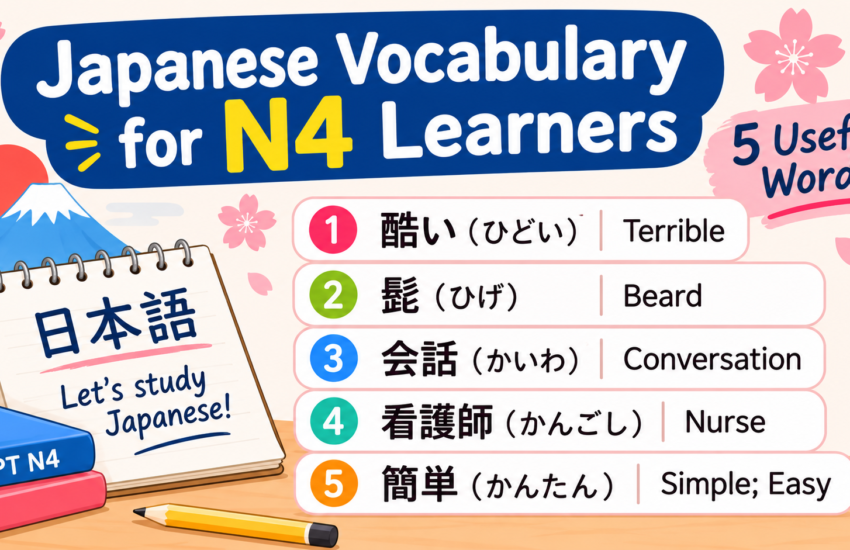
In this lesson, we will introduce five useful Japanese vocabulary words:
- 酷い[ひどい] — Terrible; awful
- 髭[ひげ] — Beard
- 会話[かいわ] — Conversation
- 看護師[かんごし] — Nurse
- 簡単[かんたん] — Simple; easy
Let’s explore their meanings, sentence patterns, and practical usage.
Table of Contents
- 酷い[ひどい] – Terrible; Awful
- 髭[ひげ] – Beard
- 会話[かいわ] – Conversation
- 看護師[かんごし] – Nurse
- 簡単[かんたん] – Simple; Easy
- How to Remember Japanese Vocabulary
- JLPT N4 Vocabulary Practice Quiz
- Frequently Asked Questions
1. 酷い[ひどい] — Terrible; Awful
Meaning: Terrible, awful, severe, or harsh.
酷い[ひどい] is an adjective used to describe something very bad, unpleasant, or serious.
You can use this word when talking about bad weather, difficult experiences, or unpleasant situations.
Example Sentences
1. 昨日[きのう]はひどい天気[てんき]でした。
Translation: The weather was terrible yesterday.
2. ひどい頭痛[ずつう]があります。
Translation: I have a terrible headache.
3. それはひどい話[はなし]ですね。
Translation: That’s a terrible story.
Related Vocabulary
- 悪い[わるい] — Bad
- 天気[てんき] — Weather
- 頭痛[ずつう] — Headache
- 痛い[いたい] — Painful
Learning Tip: Practice using 酷い[ひどい] to describe different situations. For example, talk about bad weather, a difficult day, or an unpleasant experience.
2. 髭[ひげ] — Beard
Meaning: Beard; facial hair.
髭[ひげ] is a noun used when talking about facial hair, especially around the chin and cheeks.
This word is useful when describing someone’s appearance.
Example Sentences
1. 彼[かれ]は長[なが]い髭[ひげ]があります。
Translation: He has a long beard.
2. 父[ちち]は毎朝[まいあさ]髭[ひげ]を剃[そ]ります。
Translation: My father shaves his beard every morning.
3. あの人[ひと]は髭[ひげ]が短[みじか]いです。
Translation: That person has a short beard.
Related Vocabulary
- 髪[かみ] — Hair
- 顔[かお] — Face
- 長い[ながい] — Long
- 短い[みじかい] — Short
- 剃る[そる] — To shave
Learning Tip: Look at pictures of different people and try describing their appearance in Japanese. Practice using 髭[ひげ], 髪[かみ], 長い[ながい], and 短い[みじかい].
3. 会話[かいわ] — Conversation
Meaning: Conversation; dialogue.
会話[かいわ] is an important word for Japanese learners because it relates directly to speaking and communication.
You can use it when talking about conversations with friends, teachers, colleagues, or other people.
Example Sentences
1. 友達[ともだち]と日本語[にほんご]で会話[かいわ]します。
Translation: I have conversations in Japanese with my friends.
2. 日本語[にほんご]の会話[かいわ]を練習[れんしゅう]しています。
Translation: I am practicing Japanese conversation.
3. 先生[せんせい]との会話[かいわ]は楽[たの]しかったです。
Translation: The conversation with my teacher was enjoyable.
Useful Expressions
- 会話をする[かいわをする] — To have a conversation
- 会話を練習する[かいわをれんしゅうする] — To practice conversation
- 日本語の会話[にほんごのかいわ] — Japanese conversation
- 日常会話[にちじょうかいわ] — Everyday conversation
Learning Tip: Try speaking Japanese for five minutes every day. You can practice introducing yourself, discussing your hobbies, or talking about your daily routine.
Remember, making mistakes is a natural part of learning a new language.
4. 看護師[かんごし] — Nurse
Meaning: Nurse.
看護師[かんごし] refers to a healthcare professional who provides nursing care to patients.
This vocabulary is useful when visiting hospitals, talking about occupations, or discussing healthcare in Japan.
Example Sentences
1. 看護師[かんごし]は病人[びょうにん]を助[たす]けます。
Translation: Nurses help sick people.
2. 母[はは]は病院[びょういん]で看護師[かんごし]として働[はたら]いています。
Translation: My mother works as a nurse at a hospital.
3. 看護師[かんごし]に質問[しつもん]しました。
Translation: I asked the nurse a question.
Related Vocabulary
- 医者[いしゃ] — Doctor
- 病院[びょういん] — Hospital
- 病人[びょうにん] — Sick person
- 患者[かんじゃ] — Patient
- 薬[くすり] — Medicine
- 助ける[たすける] — To help
Learning Tip: Learn occupation-related vocabulary together. Knowing words such as 医者[いしゃ], 看護師[かんごし], and 先生[せんせい] will help you talk about different professions in Japanese.
5. 簡単[かんたん] — Simple; Easy
Meaning: Simple, easy, or uncomplicated.
簡単[かんたん] is a な-adjective used to describe something that is not difficult.
It is commonly used when talking about questions, tasks, explanations, instructions, and activities.
Example Sentences
1. この問題[もんだい]はとても簡単[かんたん]です。
Translation: This question is very easy.
2. 簡単[かんたん]な日本語[にほんご]で説明[せつめい]してください。
Translation: Please explain it in simple Japanese.
3. 今日[きょう]は簡単[かんたん]な料理[りょうり]を作[つく]りました。
Translation: I made a simple dish today.
Important Grammar Point
簡単[かんたん] is a な-adjective.
When it comes before a noun, use な.
- 簡単な問題[かんたんなもんだい] — An easy question
- 簡単な料理[かんたんなりょうり] — A simple dish
- 簡単な説明[かんたんなせつめい] — A simple explanation
When it comes at the end of a sentence, use です.
このテストは簡単[かんたん]です。
Translation: This test is easy.
Learning Tip: Try making three sentences using 簡単[かんたん]. Describe an easy question, a simple meal, and an easy Japanese lesson.
Vocabulary Summary
| Japanese | Reading | English Meaning |
| 酷い | ひどい | Terrible; awful |
| 髭 | ひげ | Beard |
| 会話 | かいわ | Conversation |
| 看護師 | かんごし | Nurse |
| 簡単 | かんたん | Simple; easy |
How to Remember These Five Japanese Words
Memorizing new vocabulary becomes easier when you practice using each word rather than only reading its English meaning.
Here are five practical study methods:
1. Read the vocabulary aloud
Practice pronouncing each Japanese word several times.
2. Write one example sentence
Create your own sentence for every new word. This helps you understand how the vocabulary works in context.
3. Connect words with real situations
For example:
- Use 酷い[ひどい] when describing bad weather.
- Use 髭[ひげ] when describing someone’s appearance.
- Use 会話[かいわ] when practicing speaking.
- Use 看護師[かんごし] when discussing occupations.
- Use 簡単[かんたん] when describing something easy.
4. Practice speaking
Read your example sentences aloud. If possible, practice with a Japanese teacher or language partner.
5. Review regularly
Review the words the next day and again after a few days. Short, consistent study sessions can help you remember vocabulary.
Quick JLPT N4 Vocabulary Practice Quiz
Test your understanding of today’s five words!
1. What does 酷い[ひどい] mean?
A. Beautiful
B. Terrible
C. Easy
Answer: B. Terrible
2. Which word means beard?
A. 髭[ひげ]
B. 髪[かみ]
C. 顔[かお]
Answer: A. 髭[ひげ]
3. What is the Japanese word for conversation?
A. 質問[しつもん]
B. 会話[かいわ]
C. 説明[せつめい]
Answer: B. 会話[かいわ]
4. Which word means nurse?
A. 医者[いしゃ]
B. 学生[がくせい]
C. 看護師[かんごし]
Answer: C. 看護師[かんごし]
5. What does 簡単[かんたん] mean?
A. Difficult
B. Simple or easy
C. Expensive
Answer: B. Simple or easy
Frequently Asked Questions (FAQ)
1. Is learning vocabulary important for JLPT N4?
Yes. Vocabulary is an important part of Japanese learning. Understanding words helps you improve reading, listening, and everyday communication.
2. How can I remember Japanese vocabulary more easily?
Learn new words with example sentences, read them aloud, write your own sentences, and review regularly.
3. What is the difference between 会話[かいわ] and 質問[しつもん]?
会話[かいわ] means conversation or dialogue between people. 質問[しつもん] means a question or inquiry.
4. How do I use 簡単[かんたん] correctly?
簡単[かんたん] is a な-adjective. Use な before a noun, as in 簡単な問題[かんたんなもんだい], and use です at the end of a polite sentence.
5. Can I improve my Japanese speaking skills by learning five words daily?
Learning five words daily can help expand your vocabulary. To improve speaking, also practice pronunciation, sentence formation, listening, and real conversations.
Practical Learning Tip: Learn, Speak, and Review!
Try this simple daily routine:
- Learn five new Japanese words.
- Read five example sentences.
- Write five original sentences.
- Speak Japanese for five minutes.
- Review previously learned vocabulary.
Remember, learning Japanese is a gradual process. Regular practice and active communication can help you become more confident.
Internal Link Suggestions
- JLPT N5–N1 course page:https://myjapaneseonline.com/home/courses
- Blog:https://myjapaneseonline.com/blog/
- My Japanese Online:https://myjapaneseonline.com/
External : https://www.jlpt.jp/
Your Next Step
Choose one word from today’s lesson and use it in a sentence about your own life.
For example:
毎日[まいにち]、友達[ともだち]と日本語[にほんご]で会話[かいわ]します。
Translation: I have conversations in Japanese with my friends every day.
Keep practicing and gradually challenge yourself with more advanced vocabulary and grammar.
Learn Japanese with My Japanese Online
Would you like to improve your Japanese vocabulary, grammar, speaking, and listening skills?
My Japanese Online offers structured JLPT preparation courses from N5 to N1, taught by licensed native Japanese teachers.
Whether you are preparing for the JLPT or improving your everyday Japanese communication, our online lessons can support your learning journey step by step.
Start building your Japanese skills with My Japanese Online!
📘 New Blog for Japanese Learners! 🇯🇵
Today’s topic: 5 JLPT N4 Words to Improve Your Everyday Japanese
Learn five useful Japanese words with meanings, example sentences, and a quick practice quiz!
Improve your Japanese vocabulary one day at a time. ✨
Read here: https://myjapaneseonline.com/blog/