
 Posted by
 Introduction
JLPT N1 vocabulary includes advanced words and expressions that help you understand native Japanese conversations, newspapers, books, and the JLPT N1 exam. In this lesson, you’ll learn five useful JLPT N1 vocabulary expressions with meanings, example sentences, English translations, and practical usage tips.
Table of Contents
- Why Learn These Expressions?
- Vocabulary List
- Usage Tips
- Common Mistakes
- Practice Quiz
- Study Tip
- FAQ
- Conclusion
Why Learn These Expressions?
Mastering JLPT N1 vocabulary is an important step toward advanced Japanese proficiency. These words and expressions frequently appear in newspapers, novels, business documents, academic articles, and formal conversations. Understanding advanced vocabulary not only helps you prepare for the JLPT N1 exam but also improves your ability to communicate naturally with native speakers.
Rather than memorizing words in isolation, try to learn them through example sentences and real-life situations. This approach makes it easier to understand their meaning and remember how they are used in context.
JLPT N1 Vocabulary List
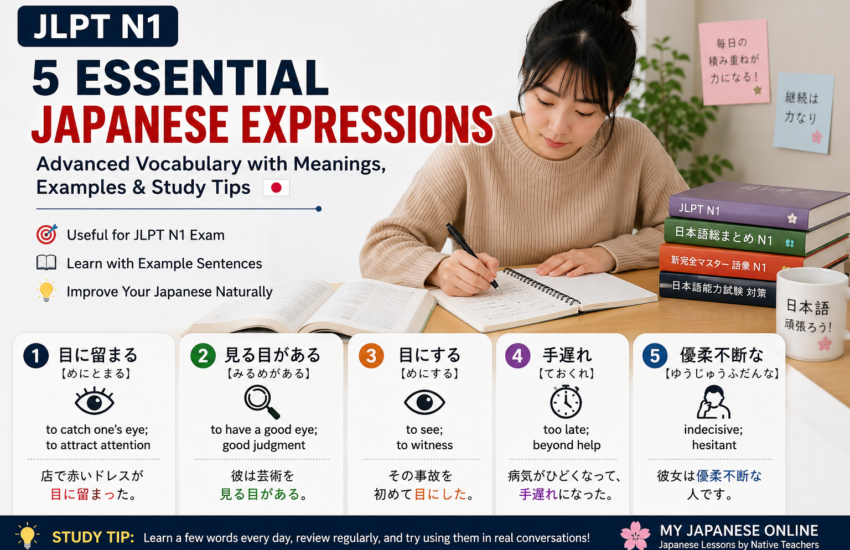
1. 目に留まる【めにとまる】
Meaning: To catch one’s eye; to attract attention
Example:
店【みせ】で赤【あか】いドレスが目【め】に留【と】まった。
The red dress caught my eye at the shop.
Usage Tip:
Use 目に留まる when something naturally attracts your attention without intentionally looking for it. It is commonly used in shopping, advertisements, art, and everyday conversations.
2. 見る目がある【みるめがある】
Meaning: To have a good eye; to have good judgment
Example:
彼【かれ】は芸術【げいじゅつ】を見【み】る目【め】がある。
He has a good eye for art.
Usage Tip:
This expression praises someone’s ability to judge quality or recognize talent. It is often used when talking about art, business, sports, or selecting good products.
3. 目にする【めにする】
Meaning: To see; to witness; to come across
Example:
その事故【じこ】を初【はじ】めて目【め】にした。
I witnessed that accident for the first time.
Usage Tip:
目にする is a natural expression used when you happen to see something, such as news, advertisements, events, or incidents. It is more formal than simply saying 見る.
4. 手遅れ【ておくれ】
Meaning: Too late; beyond help
Example:
病気【びょうき】がひどくなって、手遅【ておく】れになった。
The illness worsened, and it became too late.
Usage Tip:
Use 手遅れ when action is taken too late to change the outcome. It is commonly used when discussing health, accidents, deadlines, or missed opportunities.
5. 優柔不断な【ゆうじゅうふだんな】
Meaning: Indecisive; hesitant
Example:
彼女【かのじょ】は優柔不断【ゆうじゅうふだん】な人【ひと】です。
She is an indecisive person.
Usage Tip:
優柔不断 describes someone who has difficulty making decisions. It is often used when talking about personality, shopping, career choices, or everyday decision-making.
Common Mistakes
Explain one or two mistakes learners often make when using these expressions.
Practice Quiz
Example:
Which expression means “to have good judgment”?
A. 手遅れ
B. 見る目がある
C. 目にする
Answer: B
Study Tip
Review today’s vocabulary by creating one original sentence for each expression and saying it aloud several times.
Frequently Asked Questions
- Are these expressions common in daily conversation?
- Are they important for the JLPT N1 exam?
- How can I remember advanced vocabulary more effectively?
Continue Learning with My Japanese Online
Join our WhatsApp Channel for free daily JLPT vocabulary:
https://whatsapp.com/channel/0029Vb74C2T0wajtXvwo5r0p
Explore more Japanese learning resources:
- Website: https://myjapaneseonline.com
- Blog: https://myjapaneseonline.com/blog/
Conclusion
Summarize the lesson, encourage regular review, and invite readers to continue learning with My Japanese Online.
References
- My Japanese Online Daily JLPT Vocabulary (Day XX)
This template works well because it keeps a consistent structure across your blog while allowing each day’s vocabulary to create a fresh, original article with strong SEO potential.