
 Posted by
 Introduction
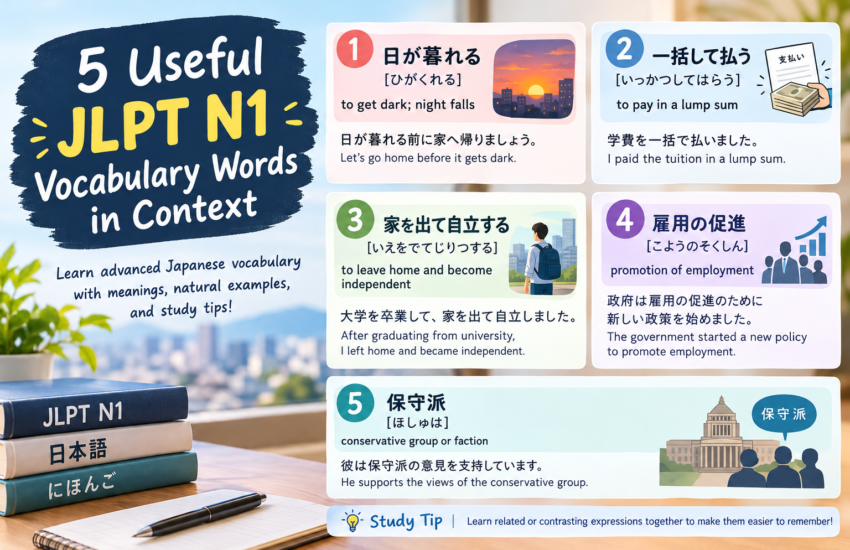
Studying JLPT N1 vocabulary is not just about memorizing difficult Japanese words. At an advanced level, it is important to understand how words and expressions are used in sentences and different situations.
Today’s vocabulary includes expressions related to daily life, money, independence, employment, and social discussions.
In this lesson, we will learn:
- 日が暮れる[ひがくれる] — to get dark; night falls
- 一括して払う[いっかつしてはらう] — to pay in a lump sum
- 家を出て自立する[いえをでてじりつする] — to leave home and become independent
- 雇用の促進[こようのそくしん] — promotion of employment
- 保守派[ほしゅは] — conservative group or faction
Learning these expressions with natural example sentences can help you recognize and use advanced Japanese more effectively.
1. 日が暮れる[ひがくれる] — To Get Dark; Night Falls
Meaning
日が暮れる[ひがくれる] means “to get dark” or “for night to fall.”
It describes the transition from daylight to evening.
Example
日[ひ]が暮[く]れる前[まえ]に家[いえ]へ帰[かえ]りましょう。
Let’s go home before it gets dark.
Useful Expression
日が暮れる前に
= before it gets dark
This expression can be useful when talking about outdoor activities, travelling, or making plans.
Another Example
日[ひ]が暮[く]れる前[まえ]に山[やま]を下[お]りましょう。
Let’s come down the mountain before it gets dark.
Learning Tip
Try to remember 日が暮れる as one expression rather than memorizing each word separately.
2. 一括して払う[いっかつしてはらう] — To Pay in a Lump Sum
Meaning
一括して払う[いっかつしてはらう] means to pay the entire amount at one time.
You may also hear or see:
一括で払う[いっかつではらう]
Both expressions describe paying the full amount at once.
Example
学費[がくひ]を一括[いっかつ]で払[はら]いました。
I paid the tuition in a lump sum.
Related Vocabulary
一括払い[いっかつばらい] — lump-sum payment
分割払い[ぶんかつばらい] — payment in installments
These two terms are useful to learn together because they describe different payment methods.
Example
学費[がくひ]は一括払い[いっかつばらい]と分割払い[ぶんかつばらい]から選[えら]べます。
You can choose between a lump-sum payment and installment payments for the tuition.
Learning Tip
When studying advanced vocabulary, learn related or contrasting expressions together. This can make them easier to remember and recognize in context.
3. 家を出て自立する[いえをでてじりつする] — To Leave Home and Become Independent
Meaning
自立する[じりつする] means “to become independent” or “to become self-reliant.”
The expression 家を出て自立する describes leaving one’s family home and becoming independent.
Example
大学[だいがく]を卒業[そつぎょう]して、家[いえ]を出[で]て自立[じりつ]しました。
After graduating from university, I left home and became independent.
Important Point
The expression 自立する does not necessarily mean only leaving home.
It can also refer to financial or personal independence.
For example:
経済的[けいざいてき]に自立[じりつ]する。
To become financially independent.
Related Vocabulary
- 自立[じりつ] — independence; self-reliance
- 経済的[けいざいてき] — financial; economic
- 独立[どくりつ] — independence; independence as a state or status
Learning Tip
Pay attention to the context when you see 自立する. It can describe different forms of independence, not only moving out of the family home.
4. 雇用の促進[こようのそくしん] — Promotion of Employment
Meaning
雇用[こよう] means “employment,” while 促進[そくしん] means “promotion” or “encouragement.”
Therefore:
雇用の促進[こようのそくしん]
= promotion of employment
This expression is particularly useful when reading formal Japanese related to employment, economics, society, or public policy.
Example
政府[せいふ]は雇用[こよう]の促進[そくしん]のために新[あたら]しい政策[せいさく]を始[はじ]めました。
The government started a new policy to promote employment.
Related Vocabulary
- 雇用[こよう] — employment
- 促進[そくしん] — promotion; encouragement
- 政策[せいさく] — policy
- 就職[しゅうしょく] — finding employment; getting a job
- 失業[しつぎょう] — unemployment
Where You May Encounter This Expression
You may encounter vocabulary such as 雇用 and 促進 in:
- Japanese news
- Business articles
- Government-related writing
- Economic discussions
- Formal reports
JLPT Learning Tip
At the N1 level, learning word combinations can be more useful than studying isolated words.
For example:
雇用 + 促進 + 政策
Understanding how these words work together can help you follow formal Japanese passages more easily.
5. 保守派[ほしゅは] — Conservative Group or Faction
Meaning
保守派[ほしゅは] refers to a conservative group or faction, particularly in discussions about politics, society, or ideas.
The word consists of:
- 保守[ほしゅ] — conservative; conservatism
- 派[は] — group; faction; school of thought
Example
彼[かれ]は保守派[ほしゅは]の意見[いけん]を支持[しじ]しています。
He supports the views of the conservative group.
Related Vocabulary
- 保守的[ほしゅてき] — conservative
- 意見[いけん] — opinion; view
- 支持[しじ]する — to support
- 立場[たちば] — position; standpoint
- 主張[しゅちょう] — claim; assertion
Usage Note
保守派 is generally used when discussing political, social, or ideological positions.
When you encounter this word in Japanese reading material, look at the surrounding sentences to understand what specific position or viewpoint is being discussed.
Learning Tip
Advanced Japanese often contains words that describe viewpoints and positions. Learning related vocabulary such as 立場, 主張, 意見, and 支持 can help you understand opinion-based texts.
Vocabulary Summary
| Japanese | Reading | Meaning |
| 日が暮れる | ひがくれる | to get dark; night falls |
| 一括して払う | いっかつしてはらう | to pay in a lump sum |
| 家を出て自立する | いえをでてじりつする | to leave home and become independent |
| 雇用の促進 | こようのそくしん | promotion of employment |
| 保守派 | ほしゅは | conservative group or faction |
How to Study These JLPT N1 Expressions
Learning five words or expressions at a time can be a practical way to build your vocabulary.
Try this simple routine.
1. Read the Japanese aloud
Read each expression and example sentence several times.
2. Check the meaning
Make sure you understand the expression as a whole rather than translating every word individually.
3. Create your own sentence
For example:
日[ひ]が暮[く]れる前[まえ]に駅[えき]に着[つ]きたいです。
I want to arrive at the station before it gets dark.
4. Review the next day
Review today’s vocabulary before starting a new vocabulary list.
5. Use the words actively
Try using the expressions in your own writing or conversation whenever possible.
Practical Learning Tip: Study Vocabulary in Context
Advanced Japanese vocabulary is easier to understand when you learn it with related words and realistic sentences.
For example:
雇用[こよう]
employment
雇用の促進[こようのそくしん]
promotion of employment
政策[せいさく]
policy
These words can appear together in formal writing.
Similarly:
保守[ほしゅ]
conservative; conservatism
保守派[ほしゅは]
conservative group or faction
保守的[ほしゅてき]
conservative
Learning vocabulary as groups can help you recognize related expressions when reading Japanese.
Quick Practice Quiz
1. What does 日が暮れる mean?
A. To wake up
B. To get dark
C. To become independent
Answer: B. To get dark
2. Which expression means “to pay in a lump sum”?
A. 分割払い
B. 一括して払う
C. 自立する
Answer: B. 一括して払う
3. What does 自立する mean?
A. To become independent
B. To find employment
C. To support an opinion
Answer: A. To become independent
4. Which word means “employment”?
A. 雇用
B. 政策
C. 支持
Answer: A. 雇用
5. What does 保守派 refer to?
A. A payment method
B. A conservative group or faction
C. A type of employment
Answer: B. A conservative group or faction
Frequently Asked Questions
Are these useful expressions for advanced Japanese learners?
Yes. These expressions cover everyday, financial, social, and formal contexts and can help advanced learners expand their vocabulary.
Should I memorize the words individually?
It is better to learn vocabulary together with example sentences and related expressions. This helps you understand how the vocabulary is used in context.
How can I improve my JLPT N1 vocabulary?
Study vocabulary regularly and combine memorization with reading, listening, grammar practice, and sentence creation. Reviewing previously learned vocabulary is also important.
Is learning vocabulary enough for JLPT N1 preparation?
No. JLPT preparation should include vocabulary and grammar, reading, and listening practice. The JLPT assesses these areas, so a balanced study routine is important.
How many words should I study each day?
There is no single number that works for every learner. A small, consistent daily routine can be more manageable than trying to memorize a large number of words at once.
Internal Link Suggestions
- JLPT N5–N1 course page:https://myjapaneseonline.com/home/course
- Blog:https://myjapaneseonline.com/blog/
- My Japanese Online:https://myjapaneseonline.com/
My Japanese Online already publishes daily JLPT vocabulary content, including N1 vocabulary, so this article should be positioned specifically around learning advanced expressions in context rather than as another general vocabulary list.
External Official Link
- Official JLPT Website: JLPT Official Website
JLPT schedules and rules can change. Always confirm the latest information on the official JLPT website.
Your Next Step
Choose one expression from today’s lesson and write three original Japanese sentences using it.
For example, choose:
自立する[じりつする]
Then write sentences about:
- Living independently
- Financial independence
- Your future goals
After writing your sentences, review all five expressions again tomorrow.
Learn Japanese with My Japanese Online
If you want structured Japanese learning with licensed native Japanese teachers, My Japanese Online offers online Japanese lessons from JLPT N5 to N1, as well as Business Japanese and private lessons.
For advanced learners, structured N1 study can help you develop vocabulary, grammar, reading, and listening skills together.
Start your next study session with five words, five sentences, and a little consistent practice every day.