
 Posted by
 Learning Japanese vocabulary is not only about memorizing words for the JLPT. The real goal is to understand and use Japanese in everyday situations.
For N4 learners, practical vocabulary can help you talk about travel, emergencies, school, work, and people around you. The official JLPT describes N4 as the ability to understand basic Japanese, including familiar daily topics and conversations spoken relatively slowly.
Table of Contents
- What is JLPT N4 Vocabulary?
- 飛行場(ひこうじょう)
- 急ぐ(いそぐ)
- 地震(じしん)
- 課長(かちょう)
- 髪(かみ)
- Study Tips
- FAQ
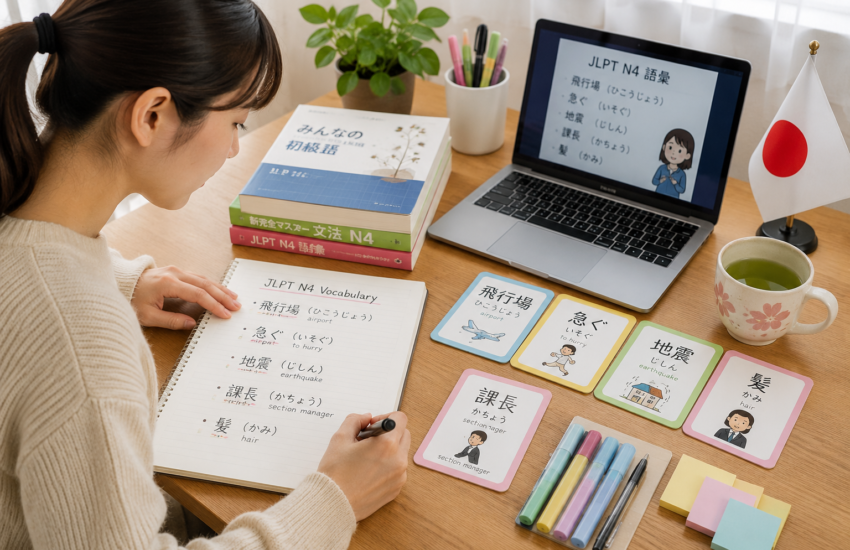
In this lesson, we will learn five practical Japanese words:
飛行場[ひこうじょう] — airfield; airport
急ぐ[いそぐ] — to hurry; to rush
地震[じしん] — earthquake
課長[かちょう] — section manager; section chief
髪[かみ] — hair
Let’s learn how to use each word naturally.
1. 飛行場[ひこうじょう] — Airfield; Airport
Meaning: airfield; airport
Reading: ひこうじょう
Kanji: 飛行場
飛行場[ひこうじょう] refers to a place where airplanes take off and land. Depending on the context, it can be translated as “airfield” or “airport.”
Example
飛行場[ひこうじょう]で友達[ともだち]を待[ま]ちます。
Translation: I will wait for my friend at the airfield/airport.
Related word
空港[くうこう] — airport
If you are talking specifically about a passenger airport, 空港[くうこう] is a very common word to know.
Practice
飛行場[ひこうじょう]までどうやって行[い]きますか。
Translation: How will you get to the airport?
2. 急ぐ[いそぐ] — To Hurry; To Rush
Meaning: to hurry; to rush
Reading: いそぐ
Kanji: 急ぐ
急ぐ[いそぐ] is a practical verb when you need to do something quickly or arrive somewhere without being late.
Example
学校[がっこう]へ急[いそ]いで行[い]きます。
Translation: I hurry to school.
Notice the form:
急ぐ (dictionary form) → 急いで (te-form)
More examples
駅[えき]まで急[いそ]ぎました。
Translation: I hurried to the station.
急[いそ]いでください。
Translation: Please hurry.
Learning tip
Try making sentences about your daily routine:
朝[あさ]、学校[がっこう]へ急[いそ]ぎます。
会社[かいしゃ]へ急[いそ]ぎました。
電車[でんしゃ]に乗[の]るために急[いそ]ぎます。
Using the same word in different sentences helps you remember it more naturally.
3. 地震[じしん] — Earthquake
Meaning: earthquake.
Reading: じしん.
Kanji: 地震.
地震(じしん) means “earthquake.” This is an important JLPT N4 vocabulary word because Japan experiences earthquakes, and you may hear it in news reports, public announcements, or everyday conversations.
Example
昨日[きのう]、大[おお]きな地震[じしん]がありました。
Translation: There was a big earthquake yesterday.
Practical expressions
地震[じしん]がありました。
Translation: There was an earthquake.
地震[じしん]は大丈夫[だいじょうぶ]でしたか。
Translation: Were you okay during the earthquake?
地震[じしん]に気[き]をつけてください。
Translation: Please be careful about earthquakes.
Related vocabulary
| Japanese | Reading | Meaning |
|———-|———|———|
| 地震 | じしん | earthquake |
| 避難 | ひなん | evacuation |
| 避難所 | ひなんじょ | evacuation shelter |
| 防災 | ぼうさい | disaster prevention |
| 震度 | しんど | seismic intensity |
For learners living in Japan, learning basic disaster-related vocabulary can make announcements and emergency information easier to understand.
4. 課長[かちょう] — Section Manager; Section Chief
Meaning: section manager; section chief
Reading: かちょう
Kanji: 課長
課長[かちょう] is a workplace title used for a manager who leads a section or department unit.
This word is especially important for learners studying Japanese for work.
Example
田中[たなか]さんは課長[かちょう]です。
Translation: Mr. Tanaka is a section manager.
More examples
課長[かちょう]に報告[ほうこく]します。
Translation: I will report to the section manager.
課長[かちょう]は会議[かいぎ]に参加[さんか]します。
Translation: The section manager will participate in the meeting.
Related workplace vocabulary
| Japanese | Reading | Meaning |
|———-|———|———|
| 部長 | ぶちょう | department manager |
| 社長 | しゃちょう | company president |
| 社員 | しゃいん | company employee |
| 会議 | かいぎ | meeting |
| 報告 | ほうこく | report |
Knowing workplace titles can help you understand conversations and introductions in Japanese companies.
5. 髪[かみ] — Hair
Meaning: hair
Reading: かみ
Kanji: 髪
髪[かみ] is a very common everyday word. You can use it when talking about someone’s appearance, hairstyle, or hair care.
⚠️ Note: かみ can also mean 神 (god), 紙 (paper), or 上 (above) depending on the kanji used. Pay attention to the kanji to avoid confusion!
Example
彼女[かのじょ]は髪[かみ]が長[なが]いです。
Translation: She has long hair.
More examples
髪[かみ]を切[き]りました。
Translation: I cut my hair.
髪[かみ]が短[みじか]いです。
Translation: My hair is short.
髪[かみ]を洗[あら]います。
Translation: I wash my hair.
Related vocabulary
| Japanese | Reading | Meaning |
|———-|———|———|
| 長い | ながい | long |
| 短い | みじかい | short |
| 美容院 | びよういん | hair salon |
| 髪型 | かみがた | hairstyle |
| 切る | きる | to cut |
This vocabulary is essential for everyday conversations, especially when talking about appearance or visiting a hair salon.
[IMAGE: Japanese hair salon with a learner talking to a stylist]
JLPT N4 Vocabulary Summary
| Japanese | Reading | Meaning | Situation |
|———-|———|———|———–|
| 飛行場 | ひこうじょう | Airfield; airport | Travel |
| 急ぐ | いそぐ | To hurry; to rush | Daily life |
| 地震 | じしん | Earthquake | Emergency |
| 課長 | かちょう | Section manager | Workplace |
| 髪 | かみ | Hair | Daily conversation |
Word Families & Compounds
| Base Word | Compound | Reading | Meaning |
|———–|———-|———|———|
| 急ぐ | 急行 | きゅうこう | Express train |
| 急ぐ | 緊急 | きんきゅう | Emergency |
| 地震 | 震度 | しんど | Seismic intensity |
| 地震 | 余震 | よしん | Aftershock |
| 髪 | 髪型 | かみがた | Hairstyle |
| 髪 | 長髪 | ちょうはつ | Long hair |
How to Remember These N4 Words
Rather than memorizing isolated English translations, try learning each word together with a Japanese sentence.
1. Read the word aloud
Say each Japanese word several times.
For example:
地震[じしん] — earthquake
2. Learn vocabulary in context
Learning vocabulary in full sentences helps you remember words more effectively and understand how they’re used naturally.
For example:
昨日[きのう]、大[おお]きな地震[じしん]がありました。
3. Create your own sentence
Change the example to something related to your own life.
For example:
毎朝[まいあさ]、学校[がっこう]へ急[いそ]ぎます。
4. Review regularly
Review today’s five words tomorrow, then again after a few days.
A simple review routine can help you remember vocabulary for longer.
5. Practice listening
Don’t only study how words look. Listen to Japanese sentences and try to recognize familiar vocabulary.
This is particularly valuable for N4 learners because the JLPT N4 listening section focuses on understanding conversations in everyday situations when they are spoken relatively slowly.
A Quick Practice Quiz
Choose the correct Japanese word.
1. “Earthquake” is:
A. 髪[かみ]
B. 地震[じしん]
C. 課長[かちょう]
Answer: B. 地震[じしん]
2. “To hurry” is:
A. 急ぐ[いそぐ]
B. 切る[きる]
C. 待つ[まつ]
Answer: A. 急ぐ[いそぐ]
3. “Section manager” is:
A. 社員[しゃいん]
B. 課長[かちょう]
C. 学生[がくせい]
Answer: B. 課長[かちょう]
4. “Hair” is:
A. 髪[かみ]
B. 頭[あたま]
C. 顔[かお]
Answer: A. 髪[かみ]
5. Which word is related to air travel?
A. 飛行場[ひこうじょう]
B. 美容院[びよういん]
C. 会議[かいぎ]
Answer: A. 飛行場[ひこうじょう]
6. Fill in the blank:
昨日、大きい___がありました。
A. 飛行場
B. 地震
C. 髪
Answer: B. 地震
Frequently Asked Questions
Is JLPT N4 vocabulary practical for daily life?
Yes. N4 focuses on basic Japanese and familiar everyday topics. Learning practical vocabulary can help you understand conversations, signs, and simple written information more confidently.
How many Japanese words should I study every day?
There is no single required number. A practical approach is to learn a small number of words consistently and review older vocabulary regularly.
Should I learn Japanese vocabulary with example sentences?
Yes. Example sentences show you how a word works in context and make it easier to remember how to use it naturally.
Is 飛行場 the same as 空港?
They can overlap in meaning, but 空港[くうこう] is a very common word for an airport, especially a passenger airport. **飛行場[ひこうじょう]** can refer more broadly to an airfield or airport.
Is vocabulary enough for the JLPT N4?
No. Vocabulary is only one part of JLPT preparation. N4 preparation should also include grammar, kanji, reading, and listening. The official N4 test specifications include vocabulary, grammar, reading, and listening components.
### How can I distinguish between homophones like かみ?
Pay attention to the kanji and context. 髪 (hair), 神 (god), 紙 (paper), and 上 (above) are all read as かみ but have different meanings and kanji. In written Japanese, the kanji makes the meaning clear. In spoken Japanese, context will help you understand which word is being used.
Practical Learning Tip
Try a 5-word daily routine:
Read → Say → Write → Make a sentence → Review
For today’s vocabulary, say these words aloud:
飛行場[ひこうじょう] → 急ぐ[いそぐ] → 地震[じしん] → 課長[かちょう] → 髪[かみ]
Then create one original Japanese sentence for each word.
Small, consistent practice can make your Japanese vocabulary stronger over time.
Continue Your JLPT Journey
If you are preparing for JLPT N4, structured study can help you work on vocabulary alongside grammar, kanji, reading, and listening.
My Japanese Online offers structured JLPT courses from N5 to N1, with lessons taught by licensed native Japanese teachers.
Internal Links:
Japanese Learning Blog: https://myjapaneseonline.com/blog/
My Japanese Online: https://myjapaneseonline.com
[More Japanese Vocabulary Articles]
Your Next Step
Before moving on to tomorrow’s vocabulary, test yourself:
☐ Can you read all five words?
☐ Can you explain their meanings?
☐ Can you make one sentence with each word?
☐ Can you recognize them when listening?
☐ Can you remember them tomorrow without looking?
If you want to study Japanese step by step with licensed native Japanese teachers, My Japanese Online can support your JLPT learning journey.
External Official Link
Official JLPT Website: https://www.jlpt.jp/
MyJLPT Portal: https://www.myjlpt.jp/