
 Posted by
 Learning Japanese vocabulary becomes easier when you study words in context.
For JLPT N4 learners, it is useful to learn new words together with example sentences. This helps you understand not only what a word means, but also how it is used in Japanese.
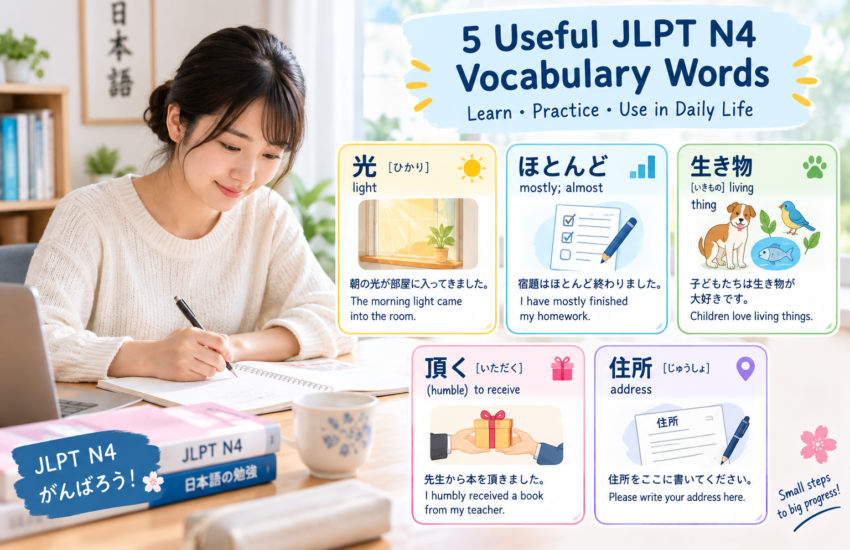
In this lesson, we will learn five useful N4 vocabulary words:
- 光[ひかり] — light
- ほとんど — mostly; almost
- 生き物[いきもの] — living thing
- 頂く[いただく] — to receive (humble)
- 住所[じゅうしょ] — address
Let’s learn each word with a simple example.
Why Learn JLPT N4 Vocabulary in Context?
Simply memorizing an English translation is not always enough.
For example, if you learn:
光[ひかり] — light
you should also see how it works in a Japanese sentence:
朝[あさ]の光[ひかり]が部屋[へや]に入[はい]ってきました。
Translation: The morning light came into the room.
Studying vocabulary with sentences can help you:
- Understand Japanese sentences more naturally
- Remember new words more easily
- Improve reading practice
- Recognize vocabulary while listening
- Build useful vocabulary for everyday communication
1. 光[ひかり] — Light
Meaning: light
Reading: ひかり
光[ひかり] is a noun meaning “light.” It can be used when talking about natural light, such as sunlight, or light more generally.
Example
朝[あさ]の光[ひかり]が部屋[へや]に入[はい]ってきました。
Translation: The morning light came into the room.
Practice
Try making a sentence about light in your home.
窓[まど]から光[ひかり]が入[はい]ります。
Translation: Light comes in through the window.
Related vocabulary
- 朝[あさ] — morning
- 部屋[へや] — room
- 窓[まど] — window
- 太陽[たいよう] — sun
2. ほとんど — Mostly; Almost
Meaning: mostly; almost
Reading: ほとんど
ほとんど is a useful word for talking about something that is nearly complete or something that happens in most cases.
Example
宿題[しゅくだい]はほとんど終[お]わりました。
Translation: I have mostly finished my homework.
Here, ほとんど tells us that the homework is nearly finished.
Practice
You can use ほとんど when talking about your daily activities.
仕事[しごと]はほとんど終[お]わりました。
Translation: I have mostly finished my work.
Learning ほとんど is useful because you will often see it in everyday Japanese.
3. 生き物[いきもの] — Living Thing
Meaning: living thing
Reading: いきもの
生き物[いきもの] refers to a living thing or creature. It can be used when talking generally about animals, insects, and other living things.
Example
子[こ]どもたちは生[い]き物[もの]が大好[だいす]きです。
Translation: Children love living things.
Practice
Try using 生き物[いきもの] when talking about animals.
動物[どうぶつ]は大切[たいせつ]な生[い]き物[もの]です。
Translation: Animals are important living things.
Related vocabulary
- 動物[どうぶつ] — animal
- 鳥[とり] — bird
- 魚[さかな] — fish
- 虫[むし] — insect
4. 頂く[いただく] — To Receive
Meaning: to receive (humble)
Reading: いただく
頂[いただ]く is a humble expression that can be used instead of receiving something with the more neutral verb もらう.
Example
先生[せんせい]から本[ほん]を頂[いただ]きました。
Translation: I humbly received a book from my teacher.
This expression is especially useful when speaking politely about receiving something from another person.
Practice
Try changing the object in the sentence.
先生[せんせい]から手紙[てがみ]を頂[いただ]きました。
Translation: I received a letter from my teacher.
Learning Tip
Pay attention to the situation when you encounter 頂く[いただく]. Japanese has different expressions depending on politeness and the relationship between speakers.
For JLPT N4 learners, learning the basic meaning and recognizing it in sentences is a good starting point.
5. 住所[じゅうしょ] — Address
Meaning: address
Reading: じゅうしょ
住所[じゅうしょ] means “address.” This is a practical word that you may encounter when filling out forms or providing personal information.
Example
住所[じゅうしょ]をここに書[か]いてください。
Translation: Please write your address here.
You may see 住所[じゅうしょ] on forms, applications, or other everyday documents.
Practice
A useful sentence to remember is:
住所[じゅうしょ]は何[なん]ですか。
Translation: What is your address?
Related vocabulary
- 名前[なまえ] — name
- 電話番号[でんわばんごう] — telephone number
- 郵便番号[ゆうびんばんごう] — postal code
- 住所[じゅうしょ] — address
JLPT N4 Vocabulary Summary
| Japanese | Reading | Meaning |
| 光 | ひかり | light |
| ほとんど | ほとんど | mostly; almost |
| 生き物 | いきもの | living thing |
| 頂く | いただく | to receive (humble) |
| 住所 | じゅうしょ | address |
How to Remember These 5 Words
Try a simple three-step vocabulary routine.
1. Read the Japanese aloud
Practice saying each word:
光[ひかり]
ほとんど
生き物[いきもの]
頂[いただ]く
住所[じゅうしょ]
2. Read the example sentences
Don’t study only the English meanings.
Read the Japanese sentences aloud and pay attention to how each word is used.
3. Create your own sentence
For example:
朝[あさ]の光[ひかり]がきれいです。
Translation: The morning light is beautiful.
Then create another sentence using a different word:
住所[じゅうしょ]を書[か]きました。
Translation: I wrote my address.
Creating your own sentences helps turn vocabulary recognition into active language practice.
Quick Practice Quiz
1. What does 光[ひかり] mean?
A. Water
B. Light
C. Air
Answer: B. Light
2. Which word means “mostly; almost”?
A. ほとんど
B. 住所[じゅうしょ]
C. 生き物[いきもの]
Answer: A. ほとんど
3. What does 生き物[いきもの] mean?
A. Living thing
B. Building
C. Address
Answer: A. Living thing
4. Which word is a humble expression meaning “to receive”?
A. 書く[かく]
B. 頂く[いただく]
C. 入る[はいる]
Answer: B. 頂く[いただく]
5. What does 住所[じゅうしょ] mean?
A. Telephone
B. Address
C. Letter
Answer: B. Address
Practical Learning Tip
Try the 5-5-5 method:
- Learn 5 new words.
- Read 5 example sentences aloud.
- Spend 5 minutes reviewing the words the next day.
You can also connect each word to something you see or do.
For example:
- See sunlight → 光[ひかり]
- Nearly finish your homework → ほとんど
- See an animal → 生き物[いきもの]
- Receive something politely → 頂く[いただく]
- Fill out a form → 住所[じゅうしょ]
This makes vocabulary practice more connected to real-life situations.
Frequently Asked Questions
Is this vocabulary useful for JLPT N4?
These words are useful for N4-level Japanese study and practical vocabulary practice. A complete JLPT N4 study plan should also include grammar, kanji, reading, and listening.
How should I memorize JLPT N4 vocabulary?
Study words with example sentences instead of memorizing English translations alone. Regular review and creating your own sentences can also help reinforce new vocabulary.
What does ほとんど mean in Japanese?
ほとんど can mean “mostly” or “almost,” depending on the sentence and context.
Is 頂く[いただく] a polite Japanese word?
頂く[いただく] is a humble expression. It can be used when speaking politely about receiving something.
Where can I use 住所[じゅうしょ]?
You may encounter 住所[じゅうしょ] when filling out forms, applications, or providing address information.
Internal Link Suggestions
- JLPT N4 Course: https://forms.gle/QjfrZtQBoPffWWyE8
- JLPT Japanese Vocabulary: https://myjapaneseonline.com/blog/
- My Japanese Online:https://myjapaneseonline.com/
External Official Links
- Official JLPT website: https://www.jlpt.jp/
- Your Next Step
Today, write one original Japanese sentence for each of these five words:
光[ひかり]・ほとんど・生き物[いきもの]・頂[いただ]く・住所[じゅうしょ]
Then read your five sentences aloud.
If you want to study Japanese step by step with structured lessons and licensed native Japanese teachers, My Japanese Online can support your JLPT learning journey.
References
- My Japanese Online, existing JLPT N4 vocabulary articles, accessed 2026-09-28.
- Vocabulary supplied for this lesson by My Japanese Online.