
 Posted by
 Learning JLPT N5 Japanese vocabulary becomes easier when you connect new words with situations you may experience in everyday life.
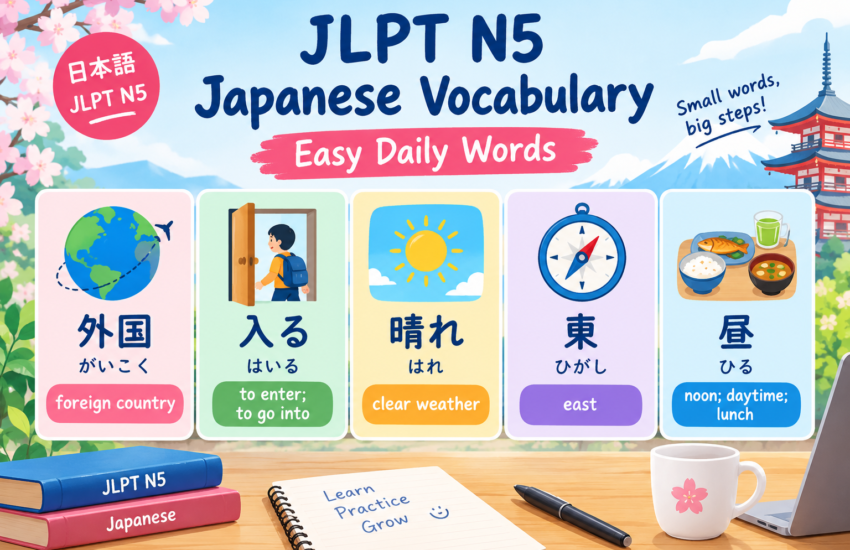
In this lesson, we will learn useful Japanese words related to foreign countries, entering places, weather, directions, and daytime.
Table of Contents
- JLPT N5 Japanese Vocabulary for Everyday Situations
- 外国[がいこく] — Foreign Country
- 入る[はいる] — To Enter
- 晴れ[はれ] — Clear Weather
- 東[ひがし] — East
- 昼[ひる] — Noon, Daytime, or Lunch
- Vocabulary Practice
- How to Remember N5 Vocabulary
- FAQ
- Your Next Step
These words are suitable for beginner Japanese learners and can also be useful when preparing for JLPT N5.
JLPT N5 Japanese Vocabulary for Everyday Situations
Here are today’s five vocabulary words:
| Japanese | Reading | Meaning |
| 外国 | がいこく | foreign country |
| 入る | はいる | to enter; to go into |
| 晴れ | はれ | clear weather |
| 東 | ひがし | east |
| 昼 | ひる | noon; daytime; lunch |
Let’s learn how to use each word naturally.
1. 外国[がいこく] — Foreign Country
外国[がいこく] means foreign country.
This is a useful word when talking about traveling, living abroad, or visiting another country.
Example
いつか外国[がいこく]へ行[い]ってみたいです。
English: I want to go to a foreign country someday.
Easy Practice
Try making your own sentence:
外国[がいこく]へ行[い]きたいです。
English: I want to go to a foreign country.
💡 Memory tip:
Think of 外国[がいこく] whenever you talk about a country outside your own country.
2. 入る[はいる] — To Enter
入る[はいる] means to enter or to go into.
You can use this verb when entering a room, building, shop, classroom, or other place.
Example
部屋[へや]に入[はい]る前[まえ]に、ノックしてください。
English: Please knock before entering the room.
Useful Pattern
Place + に + 入る[はいる]
For example:
部屋[へや]に入[はい]ります。
English: I enter the room.
💡 Memory tip:
Imagine opening a door and going inside. That action is 入る[はいる].
3. 晴れ[はれ] — Clear Weather
晴れ[はれ] means clear weather.
It is useful when talking about the weather and describing a sunny or clear day.
Example
今日[きょう]は晴[は]れで、気持[きも]ちがいいです。
English: It’s clear today, and it feels nice.
Easy Practice
今日は晴れです。
English: It is sunny today.
💡 Memory tip:
When you look outside and see a clear sky, remember 晴れ[はれ].
4. 東[ひがし] — East
東[ひがし] means east.
It is one of the four basic directions in Japanese.
- 東[ひがし] — east
- 西[にし] — west
- 南[みなみ] — south
- 北[きた] — north
Example
私[わたし]の家[いえ]は駅[えき]の東[ひがし]にあります。
English: My house is to the east of the station.
Easy Practice
駅[えき]の東[ひがし]にあります。
English: It is to the east of the station.
💡 Memory tip:
Use 東[ひがし] when describing where a place is located.
5. 昼[ひる] — Noon, Daytime, or Lunch
昼[ひる] can mean noon, midday, daytime, or lunch, depending on the expression.
A very common word is:
昼ごはん[ひるごはん] — lunch
Example
昼[ひる]ごはんは何[なに]を食[た]べますか。
English: What will you eat for lunch?
Easy Practice
昼[ひる]ごはんを食[た]べます。
English: I eat lunch.
💡 Memory tip:
Remember the connection:
昼[ひる] → 昼ごはん[ひるごはん]
Daytime → lunch
Practice JLPT N5 Japanese Vocabulary in Context
One effective way to remember JLPT N5 Japanese vocabulary is to connect several words in one situation.
Imagine a sunny day.
It is 昼[ひる], and the weather is 晴れ[はれ].
You check a map and see that your destination is to the 東[ひがし] of the station.
You want to travel to a 外国[がいこく] someday, so you are practicing Japanese words that can help you describe places and daily activities.
When you arrive at a building, you 入る[はいる].
This simple story gives you a way to remember all five words together.
JLPT N5 Japanese Vocabulary Practice
Test yourself without looking at the answers.
Fill in the blanks
1. 今日は__です。
It is sunny today.
2. 駅の__にあります。
It is to the east of the station.
3. __ごはんを食べます。
I eat lunch.
4. 部屋に__ります。
I enter the room.
5. いつか__へ行ってみたいです。
I want to go to a foreign country someday.
Answers
- 晴れ[はれ]
- 東[ひがし]
- 昼[ひる]
- 入[はい]
- 外国[がいこく]
How to Remember JLPT N5 Japanese Vocabulary
Try this simple study method:
Read → Say → Write → Use → Review
Read
Read each Japanese word and its meaning.
Say
Say the word aloud several times.
Write
Write the word while checking its reading.
Use
Create a short Japanese sentence.
Review
Review the same vocabulary again the next day.
Instead of trying to memorize many words at once, focus on using a small group of words correctly.
Quick Vocabulary Review
| Word | Reading | Meaning |
| 外国 | がいこく | foreign country |
| 入る | はいる | to enter |
| 晴れ | はれ | clear weather |
| 東 | ひがし | east |
| 昼 | ひる | noon / daytime / lunch |
Beginner Japanese Learning Tip
When studying JLPT N5 Japanese vocabulary, do not only memorize the English translation.
Learn each word together with:
- Japanese spelling
- Reading
- Meaning
- Example sentence
- A situation where you can use it
For example, don’t only memorize:
昼 = lunch
Instead, remember:
昼ごはん[ひるごはん]は何を食べますか。
This gives you both the vocabulary and a useful sentence pattern.
Frequently Asked Questions
What is JLPT N5 Japanese vocabulary?
JLPT N5 Japanese vocabulary refers to beginner-level Japanese words that learners study as part of their basic Japanese language development and JLPT N5 preparation.
What does 外国[がいこく] mean?
外国[がいこく] means foreign country.
What does 入る[はいる] mean?
入る[はいる] means to enter or to go into.
What does 晴れ[はれ] mean?
晴れ[はれ] means clear weather.
What does 東[ひがし] mean?
東[ひがし] means east.
What does 昼[ひる] mean?
昼[ひる] can mean noon, midday, daytime, or lunch, depending on the context.
Your JLPT N5 Vocabulary Challenge
Before finishing today’s lesson, try this challenge:
☐ Read all five words aloud.
☐ Write each word once.
☐ Read the example sentences.
☐ Make one sentence using 入る[はいる].
☐ Make one sentence using 東[ひがし].
☐ Use 昼[ひる] in a sentence about lunch.
☐ Review the five words tomorrow.
Small, regular practice can help you build a stronger Japanese vocabulary step by step.
Learn Japanese with My Japanese Online
If you want to study Japanese systematically, My Japanese Online provides structured Japanese lessons for learners from JLPT N5 to N1.
If you are preparing for JLPT N5, you can combine vocabulary study with grammar, kanji, reading, listening, and practical Japanese practice.
https://myjapaneseonline.com/home/courses
For supporting images, use descriptive variations rather than repeating the exact keyword unnaturally.
Internal Link Suggestions
Add relevant internal links to:
- JLPT N5–N1 course page:https://myjapaneseonline.com/home/courses
- Blog:https://myjapaneseonline.com/blog/
- My Japanese Online:https://myjapaneseonline.com/
External Resource
Add a relevant official JLPT resource:
Official JLPT website — https://www.jlpt.jp/
Important WordPress setting: Make the external JLPT link DoFollow unless your site’s SEO policy requires otherwise.
SEO Implementation Checklist
Before publishing, check these Rank Math settings:
- Focus Keyword: JLPT N5 Japanese Vocabulary
- ✅ Exact keyword in SEO title
- ✅ Exact keyword near the beginning of SEO title
- ✅ Exact keyword in meta description
- ✅ Exact keyword in URL
- ✅ Exact keyword in first paragraph
- ✅ Exact keyword in the content
- ✅ Exact keyword in H2 heading
- ✅ Exact keyword in image alt text
- ✅ Keyword used naturally throughout the article
- ✅ Internal links added
- ✅ External official link added
- ✅ External link set to DoFollow
- ✅ Table of Contents added through your WordPress TOC plugin
- ✅ Featured image added
- ✅ Supporting images added
- ✅ No unnecessary keyword stuffing
Recommended WordPress Focus Keyword:
JLPT N5 Japanese Vocabulary