
 Posted by
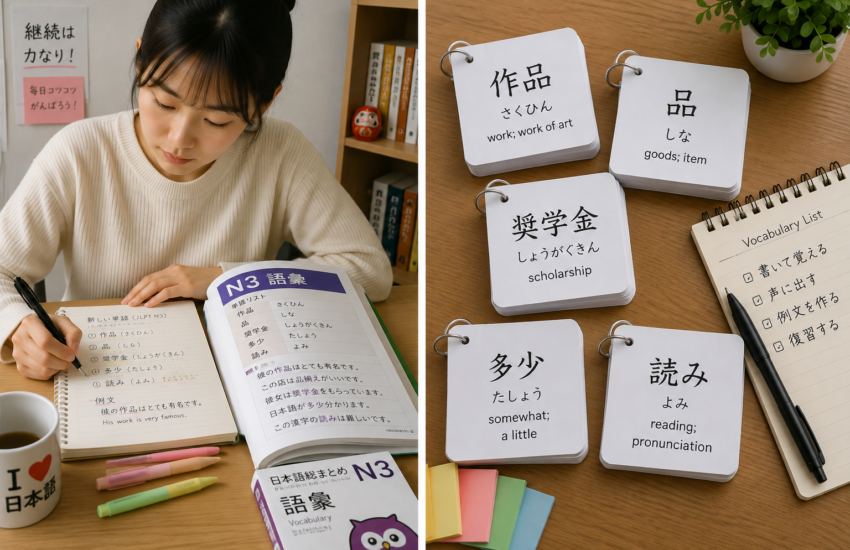
 Expanding your vocabulary is one of the most effective ways to prepare for the JLPT N3 exam. At the N3 level, you’ll encounter words used in newspapers, conversations, workplaces, and everyday life.
In this article, we’ll explore five useful JLPT N3 vocabulary words, learn how to use them naturally, and share a simple study tip to help you remember them.
1. 作品(さくひん)— Work of Art; Creative Work
Meaning: A work of art, book, movie, music, or other creative production.
Example:
彼の作品はとても有名です。
(かれの さくひん は とても ゆうめい です。)
Translation: His work is very famous.
When to use it
You can use 作品 when talking about:
- Paintings
- Books
- Movies
- Music
- Photography
- Anime and manga
2. 品(しな)— Item; Goods; Quality
Meaning: An item, product, goods, or sometimes quality.
Example:
この店は品揃えがいいです。
(この みせ は しなぞろえ が いい です。)
Translation: This shop has many items.
Common Expression
品揃え(しなぞろえ)
Meaning: Product selection or assortment.
You’ll often see this word in shopping malls, supermarkets, and online stores.
3. 奨学金(しょうがくきん)— Scholarship
Meaning: Financial support provided to students for education.
Example:
彼女は奨学金をもらっています。
(かのじょ は しょうがくきん を もらって います。)
Translation: She receives a scholarship.
Where you’ll hear it
This word is common when discussing:
- Studying in Japan
- Universities
- International students
- Educational funding
4. 多少(たしょう)— Somewhat; A Little; More or Less
Meaning: To a certain degree or a little.
Example:
日本語が多少分かります。
(にほんご が たしょう わかります。)
Translation: I understand Japanese a little.
Practical Use
This expression is useful when introducing your Japanese ability.
For example:
- 日本語が多少話せます。
- I can speak Japanese a little.
5. 読み(よみ)— Reading; Pronunciation
Meaning: The reading or pronunciation of kanji or written text.
Example:
この漢字の読みは難しいです。
(この かんじ の よみ は むずかしい です。)
Translation: The reading of this kanji is difficult.
Why It Matters
Many kanji have multiple readings, making 読み an important concept for JLPT N3 learners. Building your knowledge of kanji readings improves both reading comprehension and vocabulary recognition.
How These Words Help Your JLPT N3 Preparation
These vocabulary words appear in everyday Japanese and are useful for:
- Reading articles and books
- Shopping and daily conversations
- School and university life
- Understanding kanji
- Expressing your language ability
Learning vocabulary in context—not just by memorizing definitions—will help you remember words more effectively.
Vocabulary Summary
| Japanese | Reading | Meaning |
| 作品 | さくひん | Work of art; creative work |
| 品 | しな | Item; goods; quality |
| 奨学金 | しょうがくきん | Scholarship |
| 多少 | たしょう | Somewhat; a little |
| 読み | よみ | Reading; pronunciation |
Why Daily JLPT N3 Vocabulary Practice Matters
Learning five new JLPT N3 vocabulary words every day is an effective way to build your Japanese skills gradually. Instead of memorizing isolated words, try using each one in a sentence and reviewing it regularly. This method improves vocabulary retention, reading comprehension, and speaking confidence while preparing you for the JLPT N3 exam.
Practical Learning Tip
Instead of memorizing words individually, create one original sentence for each new vocabulary word. Speaking and writing your own examples will help move the vocabulary into your long-term memory.
Frequently Asked Questions
Is this vocabulary suitable for JLPT N3?
Yes. These words are commonly studied by learners preparing for the JLPT N3 level.
How many new words should I study each day?
Studying five to ten new words daily with review sessions is a practical goal for most learners.
What’s the best way to remember Japanese vocabulary?
Learn each word with an example sentence, review it regularly, and use it in conversation whenever possible.
Should I also study kanji with vocabulary?
Yes. Learning vocabulary together with kanji and their readings helps improve both recognition and reading comprehension.
Internal Links (My Japanese Online)
- My Japanese Online: https://myjapaneseonline.com/
- Blog: https://myjapaneseonline.com/blog/
External Reference
- Official JLPT Website: https://www.jlpt.jp/e/