
 Posted by
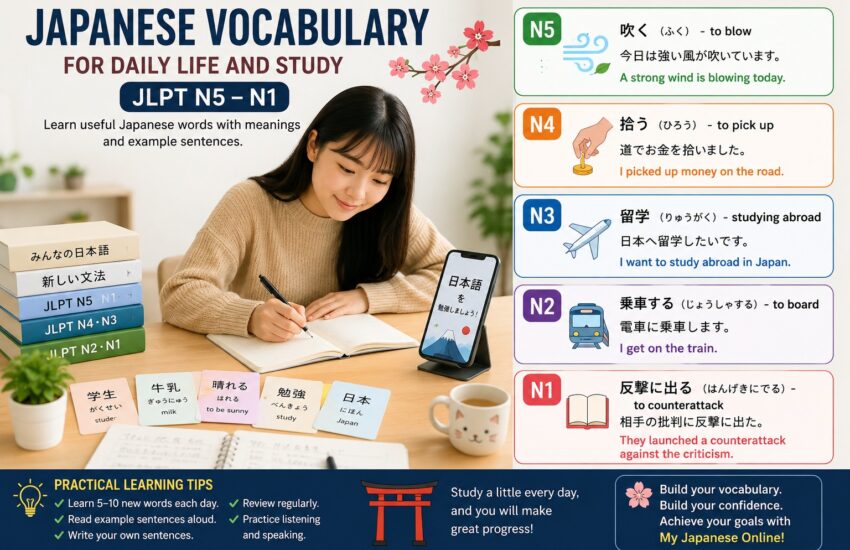
 Learning Japanese vocabulary for daily life is one of the best ways to improve your communication skills. Whether you are preparing for the JLPT, planning to study in Japan, or simply enjoying Japanese culture, practical vocabulary helps you understand conversations and express yourself more naturally.
In this Day 22 vocabulary lesson, you’ll learn useful words from JLPT N5 to N1, complete with meanings and example sentences that you can use in everyday situations.
[IMAGE: Japanese learner studying vocabulary with notebook, flashcards, and smartphone]
Table of Contents
- JLPT N5 Vocabulary
- JLPT N4 Vocabulary
- JLPT N3 Vocabulary
- JLPT N2 Vocabulary
- JLPT N1 Vocabulary
- Practical Learning Tips
- FAQ
Japanese Vocabulary for Daily Life – JLPT N5
These beginner words are useful in everyday conversations.
🌬️ 吹く(ふく)— to blow
Example
今日は強い風が吹いています。
A strong wind is blowing today.
🎓 学生(がくせい)— student
Example
私は日本語の学生です。
I am a Japanese language student.
🥛 牛乳(ぎゅうにゅう)— milk
Example
毎朝牛乳を飲みます。
I drink milk every morning.
👖 履く(はく)— to wear (shoes, trousers)
Example
靴を履いて外に出ます。
I put on my shoes and go outside.
☀️ 晴れる(はれる)— to be sunny
Example
明日は晴れるでしょう。
It will be sunny tomorrow.
Japanese Vocabulary for Daily Life – JLPT N4
Expand your daily communication with these useful words.
🥶 冷える(ひえる)— to grow cold
夜になると空気が冷えます。
The air gets cold at night.
🖐️ 拾う(ひろう)— to pick up
道でお金を拾いました。
I picked up money on the road.
🔁 一度(いちど)— once
一度日本へ行きたいです。
I want to visit Japan once.
🌾 田舎(いなか)— countryside
私の田舎は静かです。
My hometown countryside is quiet.
🍓 ジャム — jam
パンにジャムをつけます。
I put jam on bread.
Japanese Vocabulary for Daily Life – JLPT N3
These words are helpful for school, travel, and daily communication.
📘 真面目(まじめ)— serious
彼はとても真面目な学生です。
He is a very serious student.
➗ 半ば(なかば)— halfway
仕事はまだ半ばです。
The work is only halfway done.
✈️ 留学(りゅうがく)— studying abroad
日本へ留学したいです。
I want to study abroad in Japan.
🧑 青年(せいねん)— youth
その青年は夢を持っています。
The young man has dreams.
📩 招待(しょうたい)— invitation
パーティーに招待されました。
I was invited to the party.
[IMAGE: International students studying Japanese together]
Japanese Vocabulary for Daily Life – JLPT N2
Useful vocabulary for school, work, and daily life.
🚆 乗車する(じょうしゃする)— to board
電車に乗車します。
I get on the train.
➡️ 側(がわ)— side
道路の右側を歩きます。
I walk on the right side of the road.
🏞️ 囲まれている(かこまれている)— surrounded by
この町は山に囲まれています。
This town is surrounded by mountains.
📖 読書する(どくしょする)— to read books
寝る前に読書します。
I read before going to bed.
🧒 児童(じどう)— child
この学校には多くの児童がいます。
There are many children at this school.
Japanese Vocabulary for Daily Life – JLPT N1
Advanced vocabulary commonly found in news and formal conversations.
🔥 反撃に出る(はんげきにでる)— to counterattack
相手の批判に反撃に出た。
They launched a counterattack against the criticism.
👖 ズボンの裾(すそ)— trouser hem
ズボンの裾が長すぎます。
The trouser cuffs are too long.
⏰ 賞味期限が切れる(しょうみきげんがきれる)— to be past the expiry date
この牛乳は賞味期限が切れています。
This milk is past the expiry date.
⚖️ よしあし — merits and demerits
計画のよしあしを判断する。
Judge the good and bad points of the plan.
📚 著書(ちょしょ)— written work
彼の著書は多くの人に読まれています。
His book is read by many people.
[IMAGE: Advanced learner reading Japanese books in a library]
Practical Learning Tip
To remember vocabulary more effectively:
- Learn 5–10 new words each day.
- Read each example sentence aloud.
- Write your own sentence using the new word.
- Review yesterday’s vocabulary before learning new words.
- Practice listening and speaking whenever possible.
Consistency is the key to improving your Japanese.
Why Daily Vocabulary Practice Matters
Studying vocabulary every day helps you:
- Improve speaking confidence
- Understand real conversations
- Prepare for JLPT exams
- Read Japanese more easily
- Build long-term fluency
Even 10–15 minutes of daily study can make a significant difference.
FAQ
How many Japanese words should I learn each day?
Learning 5–10 new words daily is a realistic and effective goal.
Is vocabulary enough to pass the JLPT?
Vocabulary is essential, but you should also practice grammar, reading, and listening.
Which JLPT level should beginners start with?
Most beginners start with JLPT N5 before progressing to higher levels.
Can I use these words in everyday conversations?
Yes. Many of these words are commonly used in daily life, school, travel, and work.
Internal Link
External Official Links
- Official JLPT Website: https://www.jlpt.jp/e/
- MyJLPT Portal: https://www.jlpt-overseas.jp/