
 Posted by
 Introduction
OThe learn Japanese timeline is one of the most important questions for beginners starting Japanese.
The learn Japanese timeline depends on your study time, consistency, and learning method.
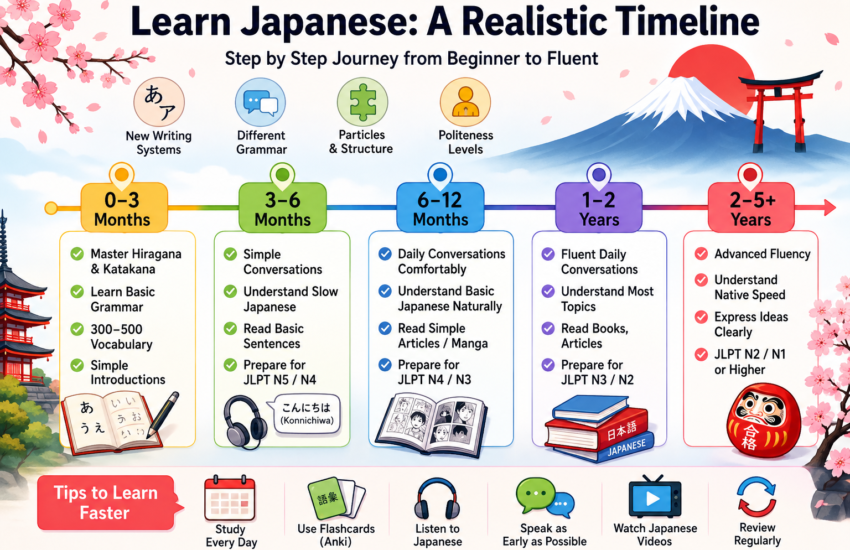
This guide explains the complete learn Japanese timeline from beginner to fluency.
The honest answer is: it depends.
Your progress depends on several factors, including how much time you study, how consistently you practice, the learning methods you use, and your personal goals. Some learners can hold basic conversations within a few months, while others may take several years to achieve advanced fluency.
In this guide, you’ll discover a realistic timeline for learning Japanese—from complete beginner to advanced level. We’ll explain what you can expect at each stage, how many study hours are typically required, and practical strategies to help you learn faster without feeling overwhelmed.
By the end, you’ll have a clear understanding of what it takes to learn Japanese and how to create a study plan that works for you.
Table of Contents
- Introduction
- Learn Japanese Timeline Overview
- 0–3 Months
- 3–6 Months
- 6–12 Months
- 1–2 Years
- Conclusion
Is Japanese Really Difficult to Learn?
Japanese is often considered one of the most challenging languages for English speakers. While it is very different from English, it is far from impossible to learn.
The biggest challenges include:
- Learning three writing systems: Hiragana, Katakana, and Kanji
- Understanding the Japanese sentence structure (Subject–Object–Verb)
- Using particles instead of word order to indicate meaning
- Mastering different levels of politeness in speech
The good news is that Japanese grammar is highly consistent. Once you understand the rules, there are relatively few exceptions compared to English.
Factors That Affect How Fast You Learn Japanese
Everyone learns at a different pace. Your progress depends on several important factors:
- Daily study time: The more consistently you study, the faster you’ll improve.
- Learning method: A structured course is usually more effective than random study.
- Balanced practice: Reading, listening, speaking, and writing should all be included.
- Consistency: Studying a little every day is more effective than studying for hours once a week.
- Exposure: Listening to real Japanese through conversations, podcasts, anime, or TV shows helps improve comprehension.
Learn Japanese Timeline Overview
Learn Japanese Timeline: 0–3 Months
- Slow but steady progress
- Good for maintaining a learning habit
- May take several years to reach conversational ability
30 Minutes Per Day
- Consistent beginner-level progress
- Learn the fundamentals within 6–12 months
- Ideal for casual or hobby learners
1 Hour Per Day
- Strong beginner-to-intermediate progress
- Reach approximately JLPT N5 in 3–6 months
- Hold basic conversations within 6–12 months
2+ Hours Per Day
- Rapid improvement
- Reach JLPT N4 within a year
- Develop solid conversational skills in 12–18 months
Learn Japanese Timeline: 3–6 Months
With regular daily study, you can expect to:
- Master Hiragana and Katakana
- Learn essential grammar patterns
- Understand common greetings and everyday phrases
- Build a vocabulary of approximately 300–500 words
- Introduce yourself and have simple conversations
Learn Japanese Timeline: 6–12 Months
After six months of consistent practice, many learners can:
- Hold simple everyday conversations
- Understand slow, clear spoken Japanese
- Read basic sentences and short passages
- Prepare for the JLPT N5 or even N4 exam
Learn Japanese Timeline: 1–2 Years
With regular study and practice, you may be able to:
- Communicate comfortably in daily situations
- Use fundamental grammar naturally
- Read simple articles, graded readers, or manga with some assistance
- Prepare for JLPT N4 or even N3, depending on your study intensity
What Does “Fluent” Really Mean?
Fluency means different things to different learners. For most people, conversational fluency means being able to:
- Speak naturally without frequent pauses
- Understand everyday conversations
- Read common Japanese materials
- Express opinions and ideas clearly
A realistic timeline for conversational fluency is:
- 1–2 years with intensive daily study
- 3–5 years with casual, part-time study
Common Mistakes That Slow Down Learning
Avoid these common mistakes to make faster progress:
- Studying without regular review
- Memorizing vocabulary without learning grammar
- Avoiding speaking practice
- Depending only on language-learning apps
- Learning words without real-life context
Tips to Learn Japanese Faster
Here are some proven strategies:
- Study every day, even if it’s only 20–30 minutes.
- Use spaced repetition systems like Anki.
- Start speaking as early as possible, even if you make mistakes.
- Watch Japanese videos with subtitles.
- Learn grammar through complete sentences instead of isolated rules.
- Review previous lessons regularly.
Sample Weekly Study Plan
Monday: Grammar and sentence patterns
Tuesday: Vocabulary and flashcards
Wednesday: Listening practice
Thursday: Speaking practice
Friday: Reading practice
Weekend: Review previous lessons and enjoy free practice through anime, podcasts, or conversation.
Frequently Asked Questions
Can I learn Japanese in six months?
Yes, you can learn the basics and hold simple conversations within six months. However, achieving full fluency usually takes much longer.
Is one hour of study per day enough?
Absolutely. Studying for one hour every day can help you build strong beginner-to-intermediate Japanese skills over time.
What is the fastest way to learn Japanese?
The most effective approach combines grammar study, vocabulary building, listening practice, speaking, reading, and regular review.
Do I need to learn Kanji to speak Japanese?
Not immediately. You can begin speaking without Kanji, but learning it is essential for reading and achieving long-term fluency.
Conclusion
Learning Japanese is a journey, not a race. While everyone’s timeline is different, one factor consistently leads to success: daily, consistent practice.
Whether your goal is traveling in Japan, passing the JLPT, watching anime without subtitles, or becoming fluent, steady progress is far more important than studying for long hours occasionally.
Stay motivated, keep practicing, and enjoy the learning process. Every lesson brings you one step closer to mastering Japanese.