
 Posted by
 Learning Japanese vocabulary for daily life is one of the most effective ways to improve your Japanese language skills. Whether you’re preparing for the JLPT, studying in Japan, working with Japanese colleagues, or traveling, knowing practical vocabulary helps you communicate naturally and confidently.
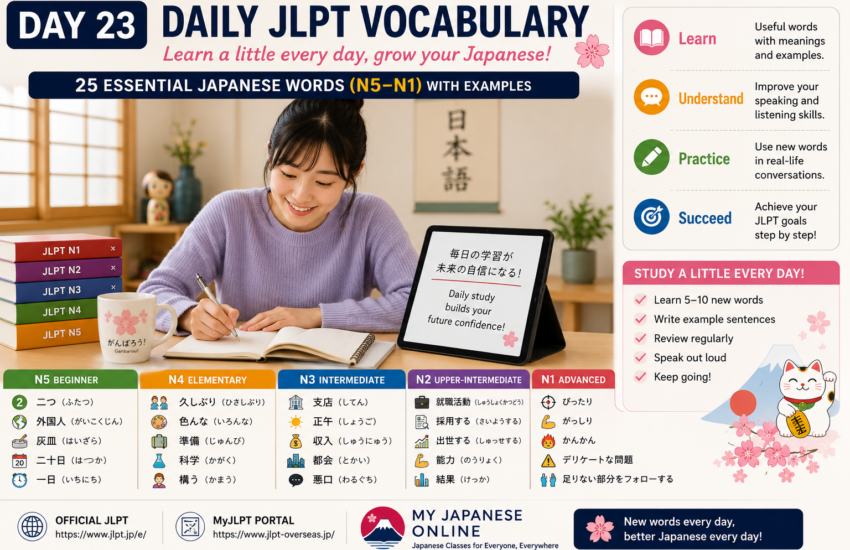
In this Day 23 lesson, you’ll learn 25 useful Japanese words from JLPT N5 to N1, along with their readings, English meanings, and practical example sentences. By studying a few words every day, you’ll steadily build the vocabulary needed for real-life conversations and JLPT success.
[IMAGE: Japanese learner studying vocabulary with notebook, smartphone, dictionary, and flashcards]
Image ALT: Japanese vocabulary for daily life
Table of Contents
- Japanese Vocabulary for Daily Life – JLPT N5
- Japanese Vocabulary for Daily Life – JLPT N4
- Japanese Vocabulary for Daily Life – JLPT N3
- Japanese Vocabulary for Daily Life – JLPT N2
- Japanese Vocabulary for Daily Life – JLPT N1
- Why Learning Daily Vocabulary Matters
- Practical Learning Tips
- Frequently Asked Questions
Japanese Vocabulary for Daily Life – JLPT N5
These beginner-level words are essential for everyday communication.
🔢 二つ(ふたつ)— Two
Meaning: Used when counting two objects.
Example
りんごを二つください。
English: Please give me two apples.
🌍 外国人(がいこくじん)— Foreigner
Meaning: A person from another country.
Example
あの人は外国人です。
English: That person is a foreigner.
🚬 灰皿(はいざら)— Ashtray
Meaning: A container used for cigarette ash.
Example
テーブルの上に灰皿があります。
English: There is an ashtray on the table.
📅 二十日(はつか)— Twentieth Day
Meaning: The 20th day of the month or twenty days.
Example
会議は二十日にあります。
English: The meeting is on the twentieth.
🕒 一日(いちにち)— One Day / All Day
Meaning: Refers to an entire day.
Example
今日は一日忙しいです。
English: I am busy all day today.
Japanese Vocabulary for Daily Life – JLPT N4
These words help you express yourself more naturally.
👋 久しぶり(ひさしぶり)— After a Long Time
Meaning: Used when meeting someone after a long period.
Example
久しぶりに友達に会いました。
English: I met my friend after a long time.
🎨 色んな(いろんな)— Various
Meaning: Many kinds of.
Example
色んな国の人がいます。
English: There are people from various countries.
🧳 準備(じゅんび)— Preparation
Meaning: To prepare for something.
Example
旅行の準備をします。
English: I prepare for my trip.
🔬 科学(かがく)— Science
Meaning: The study of the natural world.
Example
科学は大切な学問です。
English: Science is an important field of study.
🙅 構う(かまう)— To Mind
Meaning: To care about something.
Example
人の意見を構いません。
English: I don’t mind other people’s opinions.
Japanese Vocabulary for Daily Life – JLPT N3
Useful vocabulary for school, work, and everyday conversations.
🏢 支店(してん)— Branch Office
この銀行は駅前に支店があります。
English: This bank has a branch near the station.
🕛 正午(しょうご)— Noon
正午に昼休みが始まります。
English: Lunch break starts at noon.
💰 収入(しゅうにゅう)— Income
彼の収入は安定しています。
English: His income is stable.
🌆 都会(とかい)— Big City
私は都会に住んでいます。
English: I live in a big city.
🗣️ 悪口(わるぐち)— Speaking Badly About Someone
人の悪口を言ってはいけません。
English: You should not speak badly about others.
Image ALT: Japanese vocabulary for daily life examples
Japanese Vocabulary for Daily Life – JLPT N2
Advanced vocabulary for school and work.
💼 就職活動(しゅうしょくかつどう)— Job Hunting
就職活動が大変です。
English: Job hunting is difficult.
📄 採用する(さいようする)— To Hire
その会社は新しい社員を採用しました。
English: The company hired a new employee.
📈 出世する(しゅっせする)— To Get Promoted
彼は会社で出世しました。
English: He was promoted at work.
💪 能力(のうりょく)— Ability
彼女は高い能力を持っています。
English: She has excellent ability.
📊 結果(けっか)— Result
試験の結果が出ました。
English: The exam results were announced.
Japanese Vocabulary for Daily Life – JLPT N1
These expressions are common in formal conversations, business, and news.
🎯 ぴったり — Perfectly
この服は私にぴったりです。
English: These clothes fit me perfectly.
💪 がっしり — Solidly Built
彼はがっしりした体格をしています。
English: He has a sturdy build.
🔥 かんかん — Furious
先生はその態度にかんかんに怒りました。
English: The teacher became furious about that attitude.
⚠️ デリケートな問題 — Sensitive Issue
その話題はデリケートな問題です。
English: That topic is a sensitive issue.
🛠️ 足りない部分をフォローする — Cover What Is Lacking
チームで足りない部分をフォローします。
English: The team supports the areas that need improvement.
Why Learning Daily Vocabulary Matters
Learning vocabulary every day helps you:
- Improve speaking confidence
- Understand conversations more easily
- Read Japanese books, menus, and signs
- Prepare for the JLPT efficiently
- Build long-term fluency
Studying just 10–15 minutes a day can produce noticeable improvements over time.
Practical Learning Tips
- Learn 5–10 new words daily.
- Read every example sentence aloud.
- Create your own example sentence.
- Review previous vocabulary regularly.
- Use flashcards or vocabulary apps.
- Practice speaking with native speakers whenever possible.
Frequently Asked Questions
How many words should I study every day?
Learning 5–10 words daily is a realistic goal for most learners.
Are these vocabulary words useful in Japan?
Yes. They are commonly used in daily conversations, workplaces, schools, and public places.
Are these words included in the JLPT?
Yes. The vocabulary ranges from JLPT N5 to N1.
What’s the best way to remember vocabulary?
Regular review, writing your own sentences, and using the words in conversations are the most effective methods.
Continue Your Japanese Learning
Explore more resources from My Japanese Online:
Official Resources
- Official JLPT Website: https://www.jlpt.jp/e/
- MyJLPT Portal: https://www.jlpt-overseas.jp/