
 Posted by
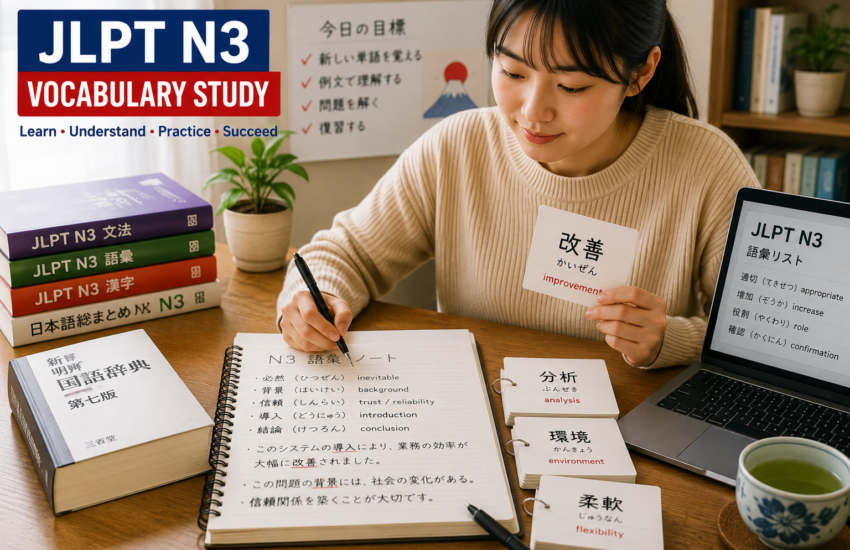
 Reaching the JLPT N3 level is an exciting milestone in your Japanese learning journey. At this stage, you’ll begin understanding more natural conversations, reading longer texts, and expressing ideas with greater confidence. Building a strong vocabulary is one of the most effective ways to improve your communication skills.
In this article, we’ll explore five useful JLPT N3 vocabulary words that frequently appear in daily conversations, school life, business settings, and news reports. By learning these words in context, you’ll be better prepared for both the JLPT exam and real-life situations in Japan.
Why Is JLPT N3 Vocabulary Important?
The JLPT N3 level bridges basic and advanced Japanese. Instead of relying only on simple expressions, you’ll start using vocabulary that helps you explain situations, discuss opinions, and understand more detailed information.
Learning practical N3 vocabulary helps you:
- Understand TV programs and news more easily.
- Improve reading comprehension.
- Express yourself more naturally.
- Prepare effectively for the JLPT N3 examination.
- Communicate confidently in everyday life and at work.
JLPT N3 Vocabulary List
⚠️ 万一(まんいち)— By Some Chance; In Case of Emergency
Meaning: Used when talking about an unexpected or emergency situation.
Example
万一事故が起きたら、電話してください。
まんいち じこが おきたら、でんわしてください。
Translation:
If by any chance an accident happens, please call me.
When You’ll Hear It
This expression is commonly used in:
- Emergency instructions
- Travel guidance
- Safety announcements
- Insurance information
Because it refers to unlikely situations, 万一 often appears together with words related to emergencies or preparation.
💰 利益(りえき)— Profit; Benefit
Meaning: Money earned from business or an advantage gained from something.
Example
会社は大きな利益を得ました。
かいしゃは おおきな りえきを えました。
Translation:
The company made a large profit.
Common Uses
You’ll frequently encounter 利益 in:
- Business news
- Company reports
- Economics articles
- Financial discussions
For learners interested in Business Japanese, this is an essential vocabulary word.
🚗 速度(そくど)— Speed
Meaning: The speed or velocity at which something moves.
Example
車の速度が速いです。
くるまの そくどが はやいです。
Translation:
The car’s speed is fast.
Practical Examples
You may see 速度 in:
- Road signs
- Traffic reports
- Driving lessons
- Train information
- Technology and internet speed discussions
Learning transportation-related vocabulary is especially useful for people living or traveling in Japan.
🏫 通学する(つうがくする)— To Commute to School
Meaning: To travel between home and school regularly.
Example
私は電車で通学しています。
わたしは でんしゃで つうがくしています。
Translation:
I commute to school by train.
Related Vocabulary
- 通勤(つうきん)する — To commute to work
- 通学路(つうがくろ)— School route
- 通学時間(つうがくじかん)— Commuting time to school
These words are commonly used in daily conversations and educational settings.
😲 随分(ずいぶん)— Very; Extremely; Quite
Meaning: Used to emphasize that something is much more than expected.
Example
今日は随分寒いですね。
きょうは ずいぶん さむいですね。
Translation:
It’s very cold today, isn’t it?
Everyday Usage
Native speakers often use 随分 to express surprise or emphasis, such as:
- 随分早いですね。
You’re quite early. - 随分変わりましたね。
You’ve changed a lot.
Using 随分 naturally can make your Japanese sound more fluent and expressive.
Vocabulary Summary
| Japanese | Reading | Meaning |
| 万一 | まんいち | By some chance; in case of emergency |
| 利益 | りえき | Profit; benefit |
| 速度 | そくど | Speed |
| 通学する | つうがくする | To commute to school |
| 随分 | ずいぶん | Very; extremely; quite |
Practical Learning Tips
Instead of memorizing vocabulary lists, try these techniques:
- Create your own example sentence for each new word.
- Read your sentences aloud every day.
- Use flashcards with Japanese on one side and English on the other.
- Review new vocabulary after one day, one week, and one month.
- Look for these words in Japanese news articles, books, or conversations.
Consistent practice is the key to long-term vocabulary retention.
Frequently Asked Questions
Is JLPT N3 vocabulary difficult?
JLPT N3 introduces more abstract and practical words than N4, but learning them in context makes them much easier to remember.
How many N3 vocabulary words should I study daily?
A realistic goal is to learn 5–10 new words each day while regularly reviewing previously learned vocabulary.
Can I use these words in daily conversations?
Yes. These vocabulary words are commonly used in schools, workplaces, transportation, business, and everyday communication.
How can I remember Japanese vocabulary more effectively?
Practice speaking, write your own example sentences, use spaced repetition flashcards, and review vocabulary regularly.
Practical Learning Tip
Choose one new vocabulary word each day and use it in three different sentences. This simple exercise strengthens both your memory and your confidence in using Japanese naturally.
Internal Link Suggestions
External Trusted Links
- Official JLPT Website: https://www.jlpt.jp/
- MyJLPT Portal: https://www.myjlpt.jp/
Your Next Step
Learning five new words every day may seem like a small step, but over time it leads to significant progress. Focus on understanding how each word is used in real situations, not just memorizing its meaning.
If you’re aiming to pass the JLPT N3 or improve your everyday Japanese, My Japanese Online offers structured online lessons taught by licensed native Japanese teachers. Our courses combine vocabulary, grammar, listening, speaking, and practical communication skills to help you achieve your language goals with confidence.