
 Posted by
 JLPT Japanese Vocabulary is essential for learning Japanese from N5 to N1 level. It helps learners understand real-life Japanese instead of memorizing isolated words.
Learning Japanese becomes easier when JLPT Japanese Vocabulary is studied with real examples from home, study, work, and communication.
In this lesson, you will learn practical JLPT Japanese Vocabulary from N5 to N1, along with natural example sentences. This approach helps improve speaking, reading, listening, and writing skills more effectively than memorization.
This JLPT Japanese Vocabulary guide is designed for learners preparing for JLPT N5, N4, N3, N2, and N1 exams.
📌 TABLE OF CONTENTS
- N5 Vocabulary (Basic Daily Life)
- N4 Vocabulary (Everyday Communication)
- N3 Vocabulary (Work & Interaction)
- N2 Vocabulary (Study & Academic Use)
- N1 Vocabulary (Advanced Expression)
- Learning Tips
- FAQ
🟢N5 Vocabulary – Japanese Vocabulary for Daily Life at Home
JLPT Japanese Vocabulary for N5 is used in daily life conversations.
🍚 朝ご飯(あさごはん) — breakfast
毎朝7時に朝ご飯を食べます。
(I eat breakfast every morning at 7.)
🌤 暖かい(あたたかい) — warm
今日はとても暖かいです。
(It is very warm today.)
⏰ 後(あと) — after / later
朝ご飯の後で散歩します。
(I take a walk after breakfast.)
🥩 豚肉(ぶたにく) — pork
豚肉の料理を作りました。
(I cooked a pork dish.)
🍳 台所(だいどころ) — kitchen
母は台所で料理をします。
(My mother cooks in the kitchen.)
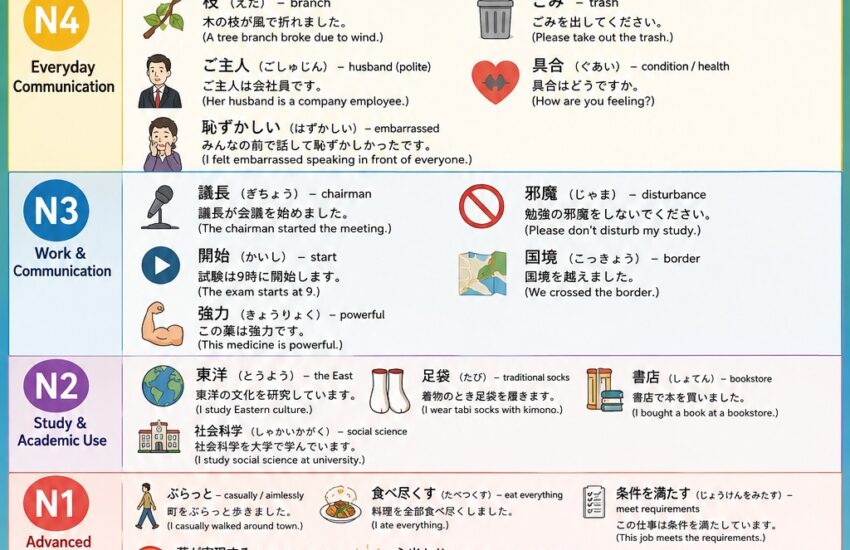
🟡 N4 Vocabulary – Japanese Vocabulary for Daily Communication
JLPT Japanese Vocabulary for N4 improves communication skills.
🌿 枝(えだ) — branch
木の枝が風で折れました。
(A tree branch broke due to wind.)
🗑 ごみ — trash
ごみを出してください。
(Please take out the trash.)
👨 ご主人(ごしゅじん) — husband (polite)
ご主人は会社員です。
(Her husband is a company employee.)
🩺 具合(ぐあい) — condition / health
具合はどうですか。
(How are you feeling?)
😳 恥ずかしい(はずかしい) — embarrassed
みんなの前で話して恥ずかしかったです。
(I felt embarrassed speaking in front of everyone.)
🔵 N3 Vocabulary – Japanese Vocabulary for Work & Communication
JLPT Japanese Vocabulary for workplace situations is important.
🎤 議長(ぎちょう) — chairman
議長が会議を始めました。
(The chairman started the meeting.)
🚫 邪魔(じゃま) — disturbance
勉強の邪魔をしないでください。
(Please don’t disturb my study.)
▶ 開始(かいし) — start
試験は9時に開始します。
(The exam starts at 9.)
🗺 国境(こっきょう) — border
国境を越えました。
(We crossed the border.)
💪 強力(きょうりょく) — powerful
この薬は強力です。
(This medicine is powerful.)
🟣 N2 Vocabulary – Japanese Vocabulary for Study & Academic Use
These are useful in study, travel, and formal discussions.
🌏 東洋(とうよう) — the East
東洋の文化を研究しています。
(I study Eastern culture.)
🧦 足袋(たび) — traditional socks
着物のとき足袋を履きます。
(I wear tabi socks with kimono.)
📚 書店(しょてん) — bookstore
書店で本を買いました。
(I bought a book at a bookstore.)
🏫 社会科学(しゃかいかがく) — social science
社会科学を大学で学んでいます。
(I study social science at university.)
🔴 N1 Vocabulary – Advanced Japanese Vocabulary
These words are used in advanced writing, speaking, and real-world thinking.
🚶 ぶらっと — casually / aimlessly
町をぶらっと歩きました。
(I casually walked around town.)
🍽 食べ尽くす(たべつくす) — eat everything
料理を全部食べ尽くしました。
(I ate everything.)
✅ 条件を満たす(じょうけんをみたす) — meet requirements
この仕事は条件を満たしています。
(This job meets the requirements.)
🌈 夢が実現する(ゆめがじつげんする) — dream comes true
夢が実現しました。
(My dream came true.)
💭 心当たり(こころあたり) — clue / idea
その件について心当たりがあります。
(I have an idea about that matter.)
Benefits of Learning JLPT Japanese Vocabulary
Studying JLPT Japanese Vocabulary every day helps learners improve their understanding of Japanese grammar, reading comprehension, and listening skills. A strong vocabulary foundation also makes it easier to communicate with native speakers and understand Japanese books, websites, and media.
By learning JLPT Japanese Vocabulary through example sentences, students can remember words more naturally and use them correctly in real-life situations. This method is especially helpful for learners preparing for the JLPT exam at any level from N5 to N1.
🧠 Smart Learning Strategy for Fast Improvement
To improve Japanese faster:
- Read example sentences aloud
- Create your own sentences
- Use vocabulary in daily life
- Revise previous lessons regularly
Even 10–15 minutes daily practice leads to strong improvement.
📈 Why Daily Vocabulary Practice Works
Daily vocabulary learning helps you:
- Improve speaking fluency
- Understand real conversations
- Prepare for JLPT exams
- Build natural Japanese thinking ability
Consistency matters more than speed.
Regular review of JLPT Japanese Vocabulary helps learners remember words for a longer period of time. Using vocabulary in daily conversations and writing practice can significantly improve Japanese language proficiency and exam performance.
❓ Frequently Asked Questions (FAQ)
Q1: How should I study JLPT vocabulary?
Study using example sentences and daily revision.
Q2: How many words should I learn daily?
5–10 words per day is ideal.
Q3: Are these words useful in real life?
Yes, they are commonly used in daily conversation and work situations.
🔗 Helpful Japanese Learning Resources
Official JLPT Website: https://www.jlpt.jp/e/
JLPT Information Portal: https://www.jlpt-overseas.jp/
📢 Quick Share Message for WhatsApp
📘 New Japanese Vocabulary Blog (JLPT N5–N1)
Learn practical Japanese words with real examples.
👉 Join WhatsApp Channel:
https://whatsapp.com/channel/0029Vb74C2T0wajtXvwo5r0p
👉 Read Blog:
https://myjapaneseonline.com/jlpt-vocabulary/
📖 References
Conclusion
Learning JLPT Japanese Vocabulary step by step from N5 to N1 is one of the most effective ways to improve your Japanese language skills. By studying vocabulary with example sentences and reviewing words regularly, you can build confidence and communicate more naturally in Japanese. Consistent practice of JLPT Japanese Vocabulary will help you prepare for the JLPT exam and understand real-life Japanese conversations more easily.