
 Posted by
 Learning Japanese vocabulary a little every day can help you build a stronger foundation for reading, listening, speaking, and JLPT preparation.
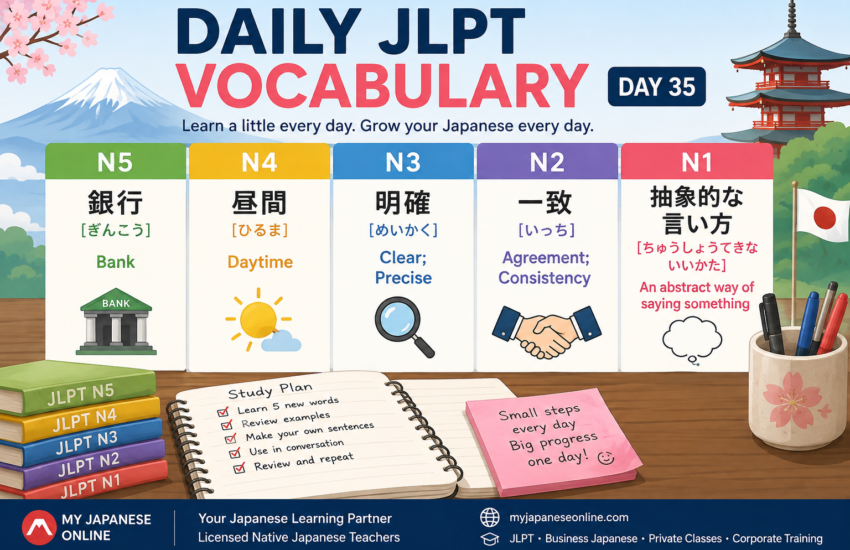
In Day 35 of our Daily JLPT Vocabulary series, we have five useful words and expressions for each level from N5 to N1.
The vocabulary ranges from everyday words such as 銀行[ぎんこう] (bank) and 妹[いもうと] (younger sister) to advanced expressions such as 抽象的[ちゅうしょうてき]な言い方[いいかた] (an abstract way of saying something) and 不利[ふり]な立場[たちば] (an unfavorable position).
Instead of memorizing all 25 words at once, try focusing on your JLPT level first. Then review a few words from the levels above you.
Table of Contents
- Why Study Japanese Vocabulary Every Day?
- Japanese Vocabulary N5: Build Your Foundation
- Japanese Vocabulary N4: Everyday Communication
- Japanese Vocabulary N3: More Precise Japanese
- Japanese Vocabulary N2: Modern and Practical Expressions
- Japanese Vocabulary N1: Advanced Expressions
- A Simple Way to Review Japanese Vocabulary
- 10 Key Words to Review First
- Practical Learning Tip: The 5-5-5 Method
- Frequently Asked Questions
- Vocabulary Summary
- Image Suggestions
- Internal Link Suggestions
- External Official Links
- Your Next Step
- Short WhatsApp Promotion
- References
Why Study JLPT Vocabulary Every Day?
Vocabulary is an important part of Japanese learning. Knowing individual words helps you understand sentences, conversations, reading passages, and everyday communication.
A simple daily routine can make vocabulary practice easier:
- Learn 5 new words.
- Read each example sentence aloud.
- Check the reading and meaning.
- Create one sentence of your own.
- Review yesterday’s vocabulary.
- Use the words in conversation or writing when possible.
Learning vocabulary in context is especially useful because an example sentence shows you how a word works in a real sentence. This approach is also consistent with the way My Japanese Online’s existing vocabulary lessons present words through meanings, examples, and practical usage.
JLPT N5 Vocabulary: Build Your Foundation
N5 learners should focus on vocabulary that appears in familiar daily situations.
1. 銀行[ぎんこう] — Bank
Meaning: Bank
Example:
銀行[ぎんこう]でお金[かね]を下[お]ろします。
Translation: I withdraw money at the bank.
Learning tip: 銀行[ぎんこう] is useful when talking about money, payments, and everyday errands.
2. 始[はじ]まる — To Begin
Meaning: To begin; to start
Example:
授業[じゅぎょう]は九時[くじ]に始[はじ]まります。
Translation: The class begins at 9 o’clock.
Learning tip: Notice that 始まる[はじまる] describes something that begins. It is useful for talking about classes, meetings, events, and schedules.
3. 速[はや]い — Fast; Quick
Meaning: Fast; quick
Example:
彼[かれ]は走[はし]るのが速[はや]いです。
Translation: He runs fast.
Learning tip: Practice using 速い[はやい] to describe speed in everyday situations.
4. 細[ほそ]い — Thin; Slender
Meaning: Thin; slender
Example:
彼女[かのじょ]は指[ゆび]が細[ほそ]いです。
Translation: She has slender fingers.
Learning tip: 細い[ほそい] can be used when describing something physically thin or slender.
5. 妹[いもうと] — Younger Sister
Meaning: Younger sister
Example:
妹[いもうと]は高校生[こうこうせい]です。
Translation: My younger sister is a high school student.
Learning tip: Learn family vocabulary together. For example, 妹[いもうと] is younger sister, while other family words can help you describe your family more naturally.
JLPT N4 Vocabulary: Everyday Communication
At N4, learners can start expanding beyond very basic vocabulary and recognize words used in everyday activities and information.
6. 昼間[ひるま] — Daytime
Meaning: Daytime; during the day
Example:
昼間[ひるま]は仕事[しごと]をしています。
Translation: I work during the day.
Learning tip: Use 昼間[ひるま] when talking about activities that happen during the daytime.
7. 放送[ほうそう] — Broadcast
Meaning: Broadcast; broadcasting
Example:
そのニュースはテレビで放送[ほうそう]されました。
Translation: The news was broadcast on TV.
Learning tip: 放送[ほうそう] is useful when discussing television, radio, announcements, and other broadcasts.
8. 字[じ] — Character; Letter
Meaning: Character; letter; handwriting
Example:
彼[かれ]は字[じ]が上手[じょうず]です。
Translation: He has good handwriting.
Learning tip: This word is useful when talking about writing and handwriting. Try connecting it with words related to writing and reading.
9. 十分[じゅうぶん] — Enough; Sufficient
Meaning: Enough; sufficient
Example:
お金[かね]は十分[じゅうぶん]あります。
Translation: There is enough money.
Learning tip: 十分[じゅうぶん] is useful when you want to say that something is enough or sufficient.
10. 変[か]える — To Change; To Transform
Meaning: To change; to transform
Example:
部屋[へや]のレイアウトを変[か]えました。
Translation: I changed the room layout.
Learning tip: Try using 変える[かえる] with things you can change, such as a schedule, plan, room layout, or settings.
JLPT N3 Vocabulary: More Precise Japanese
At N3, learners encounter more vocabulary for describing information, places, qualities, and situations.
11. 明確[めいかく] — Clear; Precise; Definite
Meaning: Clear; precise; definite
Example:
先生[せんせい]の説明[せつめい]は明確[めいかく]です。
Translation: The teacher’s explanation is clear.
Learning tip: 明確[めいかく] is particularly useful when discussing explanations, information, goals, or decisions.
12. 入場[にゅうじょう] — Entrance; Admission
Meaning: Entrance; admission
Example:
会場[かいじょう]に入場[にゅうじょう]してください。
Translation: Please enter the venue.
Learning tip: You may encounter 入場[にゅうじょう] in contexts involving events, venues, tickets, and admission.
13. 新鮮[しんせん] — Fresh
Meaning: Fresh
Example:
この野菜[やさい]はとても新鮮[しんせん]です。
Translation: These vegetables are very fresh.
Learning tip: 新鮮[しんせん] is especially useful when talking about food and ingredients.
14. 書斎[しょさい] — Study; Home Office
Meaning: Study; home office
Example:
父[ちち]は書斎[しょさい]で本[ほん]を読[よ]んでいます。
Translation: My father is reading a book in his study.
Learning tip: Connect 書斎[しょさい] with other vocabulary related to rooms, furniture, studying, and reading.
15. 売[う]れる — To Sell Well
Meaning: To sell; to sell well
Example:
この本[ほん]はよく売[う]れます。
Translation: This book sells well.
Learning tip: 売れる[うれる] is useful when describing products or items that have good sales.
JLPT N2 Vocabulary: Modern and Practical Expressions
N2 vocabulary often requires learners to understand words used in broader everyday, social, and professional contexts.
16. アクセスする — To Access
Meaning: To access
Example:
ウェブサイトにアクセスします。
Translation: I access the website.
Learning tip: アクセスする is a useful loanword in modern Japanese, especially when talking about websites, online services, and digital information.
17. ヒットする — To Be a Hit; To Become Popular
Meaning: To be a hit; to become popular
Example:
その映画[えいが]は大[だい]ヒットしました。
Translation: That movie became a big hit.
Learning tip: ヒットする is often useful when discussing movies, music, products, or other things that become popular.
18. レンタルする — To Rent
Meaning: To rent
Example:
DVDをレンタルしました。
Translation: I rented a DVD.
Learning tip: レンタルする is a useful example of how English loanwords are used with する in Japanese.
19. バランスがいい — Well-Balanced
Meaning: Well-balanced
Example:
この食事[しょくじ]はバランスがいいです。
Translation: This meal is well-balanced.
Learning tip: You can use this expression when discussing food, lifestyle, schedules, and other things that have a good balance.
20. カロリーが高[たか]い — High in Calories
Meaning: High in calories
Example:
このケーキはカロリーが高[たか]いです。
Translation: This cake is high in calories.
Learning tip: This expression is useful when talking about food and making everyday observations about meals.
JLPT N1 Vocabulary: Advanced Expressions
N1 learners need to understand more precise and abstract expressions. These words and phrases can appear in advanced conversations, writing, explanations, and formal contexts.
21. 大柄[おおがら]な女性[じょせい] — Big or Tall Woman
Meaning: A big/tall woman
Example:
彼女[かのじょ]は大柄[おおがら]な女性[じょせい]です。
Translation: She is a tall woman.
Learning tip: 大柄[おおがら] is used to describe someone or something with a relatively large physical build or size.
22. 抽象的[ちゅうしょうてき]な言[い]い方[かた] — An Abstract Way of Saying Something
Meaning: An abstract way of saying something
Example:
それは抽象的[ちゅうしょうてき]な言[い]い方[かた]ですね。
Translation: That is an abstract way of saying it.
Learning tip: 抽象的[ちゅうしょうてき] is useful when discussing ideas that are not concrete or specific.
23. 悲観的[ひかんてき]な見方[みかた] — Pessimistic View
Meaning: Pessimistic view
Example:
彼[かれ]は将来[しょうらい]について悲観的[ひかんてき]な見方[みかた]をしている。
Translation: He has a pessimistic view about the future.
Learning tip: 悲観的[ひかんてき] is useful when describing a negative or pessimistic way of looking at a situation.
24. 平易[へいい]な表現[ひょうげん] — Simple Expression
Meaning: Simple expression
Example:
先生[せんせい]は平易[へいい]な表現[ひょうげん]を使[つか]います。
Translation: The teacher uses simple expressions.
Learning tip: 平易[へいい] is useful in discussions about language, writing, explanations, and communication.
25. 不利[ふり]な立場[たちば] — Unfavorable Position
Meaning: Unfavorable position
Example:
彼[かれ]は不利[ふり]な立場[たちば]に立[た]っている。
Translation: He is in an unfavorable position.
Learning tip: This expression can help you describe situations where someone has a disadvantage compared with another person or group.
A Simple Way to Review Today’s 25 Words
Twenty-five words may look like a lot, but you do not need to memorize everything in one sitting.
Try this five-step review method:
Step 1: Focus on Your Level
If you are studying N5, start with the five N5 words.
If you are studying N3, review the N3 words first and then revisit some N4 vocabulary.
Advanced learners can use the N1 words to challenge themselves while reviewing lower-level vocabulary for fluency.
Step 2: Read the Example Sentences
Do not study only the English meaning.
Read the Japanese sentence aloud several times. This helps you connect the vocabulary with sentence structure and pronunciation.
Step 3: Make Your Own Sentence
Choose one word and create a sentence about your own life.
For example:
銀行[ぎんこう]でお金[かね]を下[お]ろします。
You could then make a new sentence:
銀行[ぎんこう]へ行[い]きました。
Creating your own sentences makes vocabulary more active and personal.
Step 4: Group Related Words
You can remember words more easily by connecting them.
For example:
Learning and communication
- 字[じ] — character; letter
- 明確[めいかく] — clear; precise
- 抽象的[ちゅうしょうてき] — abstract
- 平易[へいい] — simple
Daily life
- 銀行[ぎんこう] — bank
- 昼間[ひるま] — daytime
- 新鮮[しんせん] — fresh
- 妹[いもうと] — younger sister
Modern and practical Japanese
- アクセスする — to access
- ヒットする — to become popular
- レンタルする — to rent
- バランスがいい — well-balanced
Step 5: Review Tomorrow
Vocabulary becomes easier to remember when you review it regularly.
Tomorrow, spend a few minutes reviewing today’s words before learning something new.
10 Key Words to Review First
If you do not have time to study all 25 words today, start with these:
- 銀行[ぎんこう] — bank
- 始まる[はじまる] — to begin
- 速い[はやい] — fast
- 十分[じゅうぶん] — enough
- 変える[かえる] — to change
- 明確[めいかく] — clear; precise
- 新鮮[しんせん] — fresh
- アクセスする — to access
- バランスがいい — well-balanced
- 不利[ふり]な立場[たちば] — unfavorable position
Then return to the remaining words when you have more study time.
Practical Learning Tip: Use the “5-5-5” Method
For daily vocabulary practice, try this simple routine:
5 minutes — Learn
Study five new words and their meanings.
5 minutes — Read
Read the Japanese example sentences aloud.
5 minutes — Create
Write or say your own sentences using the new vocabulary.
This short routine can make daily study easier to maintain. The key is regular practice rather than trying to memorize a large vocabulary list in one session.
Frequently Asked Questions
How many Japanese vocabulary words should I learn each day?
There is no single correct number for every learner. Five words a day can be a manageable starting point, especially when you also review older vocabulary.
Should I study vocabulary from my JLPT level only?
Start with your current level, but reviewing easier vocabulary can strengthen your foundation. You can also gradually introduce words from the next level.
Is memorizing the English meaning enough?
No. Try to learn the reading, meaning, example sentence, and typical context together. Creating your own sentence is another useful step.
How can I remember difficult N1 vocabulary?
Break advanced expressions into smaller parts and learn them in context. For example, 不利[ふり]な立場[たちば] becomes easier to understand when you learn the complete expression rather than memorizing 不利[ふり] alone.
Is vocabulary enough to prepare for the JLPT?
No. Vocabulary is only one part of JLPT preparation. A balanced study plan should also include grammar, kanji, reading, and listening practice.
Vocabulary Summary
| Level | Vocabulary Focus |
| N5 | Everyday words and basic descriptions |
| N4 | Daily communication and common information |
| N3 | More precise descriptions and situations |
| N2 | Modern expressions and broader contexts |
| N1 | Advanced, abstract, and precise expressions |
Internal Link Suggestions
- JLPT N5–N1 course page: https://myjapaneseonline.com/home/courses
- Blog:https://myjapaneseonline.com/blog/
- My Japanese Online:https://myjapaneseonline.com/
External Official Links
For official JLPT information and current test rules, learners should check the official JLPT website:
[Official JLPT Website: https://www.jlpt.jp/]
JLPT schedules and rules can change. Always confirm the latest information on the official JLPT website.
Your Next Step
Choose five words from today’s Day 35 vocabulary and complete these three tasks:
- Read each word aloud.
- Write one original Japanese sentence for each word.
- Review the five words again tomorrow.
Small, consistent steps can help you build a stronger Japanese vocabulary over time.
If you want to study Japanese systematically with licensed native Japanese teachers, My Japanese Online offers structured Japanese learning support from JLPT N5 to N1, as well as Business Japanese and private online classes.
Short WhatsApp Promotion
📘 New Blog for Japanese Learners
Today’s topic: Day 35 JLPT Vocabulary: N5 to N1 Japanese Words
Learn 25 useful Japanese words with readings, meanings, example sentences, and practical study tips.
📚 Study a little every day and build your JLPT vocabulary step by step!
Read the full blog: [https://myjapaneseonline.com/blog/ ]
References
- My Japanese Online, “Master JLPT Vocabulary: 25 Essential Japanese Words for Daily Communication (N5–N1),” published July 18, 2026.
- My Japanese Online, “Japanese Words for School and Daily Life (JLPT N5–N1),” published May 13, 2026.
- Official Japanese-Language Proficiency Test website: https://www.jlpt.jp/