
 Posted by
 Daily JLPT vocabulary practice is one of the most effective ways to improve Japanese consistently from beginner to advanced level. Whether you are studying for JLPT N5, N4, N3, N2, or N1, learning vocabulary daily helps improve reading, listening, speaking, and overall confidence.
In this Daily JLPT Vocabulary Day 14 lesson, you will learn useful Japanese words with meanings and example sentences that help you understand natural Japanese usage.
Table of Contents
- Why Daily JLPT Vocabulary Is Important
- Daily JLPT N5 Vocabulary
- Daily JLPT N4 Vocabulary
- Daily JLPT N3 Vocabulary
- Daily JLPT N2 Vocabulary
- Daily JLPT N1 Vocabulary
- How to Remember Daily JLPT Vocabulary Faster
- FAQ About Daily JLPT Vocabulary
Why Daily JLPT Vocabulary Is Important
Daily JLPT vocabulary study helps learners build long-term memory naturally. Instead of memorizing hundreds of words at once, learning small groups of vocabulary daily improves consistency and motivation.
Benefits of daily JLPT vocabulary practice:
- Better memory retention
- Improved pronunciation
- Faster reading ability
- Stronger listening skills
- Better JLPT preparation
Even reviewing one short Japanese 文章(ぶんしょう) every day can improve your understanding gradually.
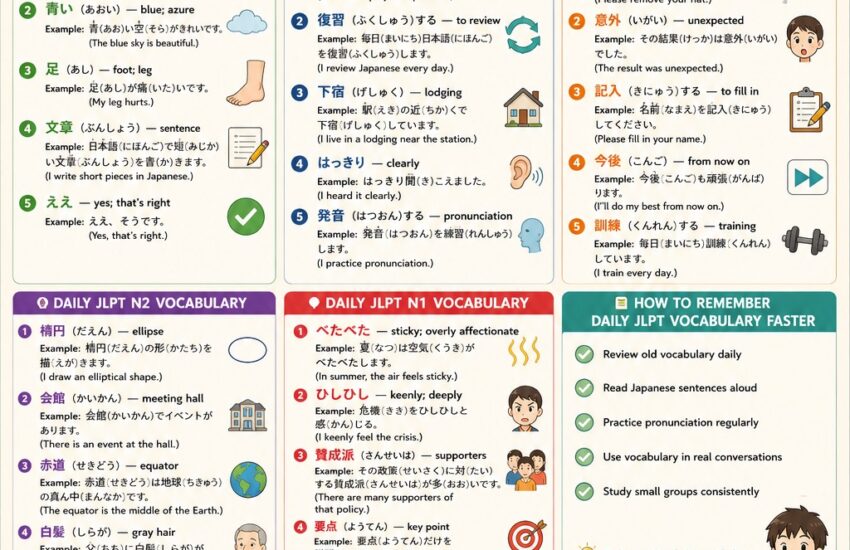
Daily JLPT N5 Vocabulary
👤 あなた — you
Example:
あなたは学生(がくせい)ですか。
(Are you a student?)
This is one of the most common beginner Japanese pronouns.
🔵 青い(あおい)— blue; azure
Example:
青(あお)い空(そら)がきれいです。
(The blue sky is beautiful.)
青い is a useful adjective that appears often in daily conversation.
🦶 足(あし)— foot; leg
Example:
足(あし)が痛(いた)いです。
(My leg hurts.)
足 can mean foot, leg, paw, or even part of furniture depending on context.
📝 文章(ぶんしょう)— sentence
Example:
日本語(にほんご)で短(みじか)い文章(ぶんしょう)を書(か)きます。
(I write short pieces in Japanese.)
Writing short Japanese sentences daily improves vocabulary memory.
✅ ええ — yes; that’s right
Example:
ええ、そうです。
(Yes, that’s right.)
This expression sounds softer and more natural than はい in casual situations.
Daily JLPT N4 Vocabulary
🎮 遊び(あそび)— playing
Example:
子供(こども)の遊(あそ)びは大切(たいせつ)です。
(Children’s play is important.)
遊び can refer to games, fun activities, or free time.
🔁 復習(ふくしゅう)する — to review
Example:
毎日(まいにち)日本語(にほんご)を復習(ふくしゅう)します。
(I review Japanese every day.)
復習 is one of the most important habits for JLPT success.
🏠 下宿(げしゅく)— lodging
Example:
駅(えき)の近(ちか)くで下宿(げしゅく)しています。
(I live in a lodging near the station.)
This word is often used by students living away from home.
🔍 はっきり — clearly
Example:
はっきり聞(き)こえました。
(I heard it clearly.)
This adverb is useful for communication and listening practice.
🗣️ 発音(はつおん)する — pronunciation
Example:
発音(はつおん)を練習(れんしゅう)します。
(I practice pronunciation.)
Good pronunciation improves speaking confidence naturally.
Daily JLPT N3 Vocabulary
❌ 外(はず)す — to remove; to miss
Example:
帽子(ぼうし)を外(はず)してください。
(Please remove your hat.)
外す can also mean missing an opportunity or making a mistake.
😲 意外(いがい)— unexpected
Example:
その結果(けっか)は意外(いがい)でした。
(The result was unexpected.)
This word is common in conversation and reaction expressions.
✍️ 記入(きにゅう)する — to fill in
Example:
名前(なまえ)を記入(きにゅう)してください。
(Please fill in your name.)
Useful for forms, applications, and office situations.
⏭️ 今後(こんご)— from now on
Example:
今後(こんご)も頑張(がんば)ります。
(I’ll do my best from now on.)
A very useful expression for future plans and motivation.
🏋️ 訓練(くんれん)する — training
Example:
毎日(まいにち)訓練(くんれん)しています。
(I train every day.)
Japanese learning itself is a kind of daily training.
Daily JLPT N2 Vocabulary
🔵 楕円(だえん)— ellipse
Example:
楕円(だえん)の形(かたち)を描(えが)きます。
(I draw an elliptical shape.)
This word appears in mathematics and design contexts.
🏛️ 会館(かいかん)— meeting hall
Example:
会館(かいかん)でイベントがあります。
(There is an event at the hall.)
会館 is commonly used for public buildings and event halls.
🌍 赤道(せきどう)— equator
Example:
赤道(せきどう)は地球(ちきゅう)の真ん中(まんなか)です。
(The equator is the middle of the Earth.)
This word appears often in geography topics.
👴 白髪(しらが)— gray hair
Example:
父(ちち)に白髪(しらが)が増(ふ)えました。
(My father has more gray hair.)
白髪 is a useful descriptive vocabulary word.
🏠 我(わ)が — my; our
Example:
我(わ)が国(くに)を大切(たいせつ)にします。
(We value our country.)
This formal expression appears in speeches and news.
Daily JLPT N1 Vocabulary
🧲 べたべた — sticky; overly affectionate
Example:
夏(なつ)は空気(くうき)がべたべたします。
(In summer, the air feels sticky.)
This word can describe both physical texture and emotional closeness.
💭 ひしひし — keenly; deeply
Example:
危機(きき)をひしひしと感(かん)じる。
(I keenly feel the crisis.)
An advanced expression often used in emotional situations.
👍 賛成派(さんせいは)— supporters
Example:
その政策(せいさく)に対(たい)する賛成派(さんせいは)が多(おお)いです。
(There are many supporters of that policy.)
Useful for politics, debates, and discussions.
🎯 要点(ようてん)— key point
Example:
要点(ようてん)だけを説明(せつめい)します。
(I’ll explain only the key points.)
Very useful for meetings and presentations.
👩👦 母親に甘える(ははおやにあまえる)— depend emotionally on one’s mother
Example:
彼(かれ)は母親(ははおや)に甘(あま)えすぎです。
(He relies too much on his mother.)
This expression reflects emotional dependence and Japanese cultural nuance.
How to Remember Daily JLPT Vocabulary Faster
Here are simple ways to improve daily JLPT vocabulary memory:
✅ Review old vocabulary daily
✅ Read Japanese sentences aloud
✅ Practice pronunciation regularly
✅ Use vocabulary in real conversations
✅ Study small groups consistently
Daily repetition helps vocabulary become natural over time.
Internal Link Suggestions
- JLPT N5 Course
- JLPT N4 Course
- JLPT N3 Course
- JLPT N2 Course
- JLPT N1 Course
- Online Japanese Conversation Lessons
External Official Links
Official JLPT Website:
https://www.jlpt.jp/e/
The Japan Foundation:
https://www.jpf.go.jp/e/
FAQ About Daily JLPT Vocabulary
How many daily JLPT vocabulary words should I learn?
Most learners improve steadily by studying 5–10 words daily.
Is daily JLPT vocabulary enough for JLPT preparation?
Vocabulary is essential, but learners should also practice grammar, listening, reading, and speaking.
Why is vocabulary review important?
Regular review improves long-term memory and recall speed.
Should beginners learn N1 vocabulary?
Beginners can explore advanced vocabulary, but should mainly focus on their current JLPT level.
What is the best way to remember vocabulary?
Using example sentences and speaking practice helps vocabulary stay in memory longer.
Final Motivation
Daily JLPT vocabulary practice may seem small today, but small daily habits create big long-term improvement.
Even one sentence, one review session, or one new word every day can help you move closer to fluency.
At My Japanese Online, our licensed native Japanese teachers help students improve naturally from JLPT N5 to N1 through structured lessons, speaking practice, and personalized support.
Regards
MY JAPANESE ONLINE
https://myjapaneseonline.com
+81-8037032389 (Japan)
References
- Official JLPT Website
https://www.jlpt.jp/e/
Accessed: 2026-05-29 - The Japan Foundation
https://www.jpf.go.jp/e/
Accessed: 2026-05-29