
 Posted by
 Introduction
Learning advanced Japanese vocabulary is an important part of preparing for the JLPT N1. At this level, learners need more than simple everyday words. They also need vocabulary and expressions connected to careers, media, presentations, publishing, and professional communication.
Table of Contents
- Introduction
- Why Learn Advanced JLPT N1 Vocabulary?
- 2.1 Improve Reading Comprehension
- 2.2 Understand Professional Japanese
- 2.3 Strengthen Listening Skills
- 2.4 Use Japanese More Naturally
- 5 Advanced JLPT N1 Vocabulary Words
- 3.1 プロとしてデビューする
- 3.2 フリーの編集者[フリーのへんしゅうしゃ]
- 3.3 リアルな映像[リアルなえいぞう]
- 3.4 レジュメに沿って説明する[レジュメにそってせつめいする]
- 3.5 最もポピュラーな名前[もっともポピュラーななまえ]
- Vocabulary Summary Table
- Why Learn Advanced JLPT N1 Vocabulary?
- Vocabulary by Situation
- Word Breakdown and Key Grammar Patterns
- Similar and Related Japanese Expressions
- Common Mistakes to Avoid
- Professional Japanese Example Sentences
- Mini Conversation Practice
- JLPT N1 Vocabulary Practice
- JLPT N1 Reading Practice
- Listening Practice
- Speaking Practice
- Writing Practice
- How to Remember Advanced JLPT N1 Vocabulary
- 5-Day JLPT N1 Vocabulary Study Plan
- Quick Vocabulary Review Checklist
- Frequently Asked Questions
- Continue Your JLPT N1 Journey
- Learn Japanese with My Japanese Online
- Suggested Internal Links
- Image Suggestions
- External Official Links
- References
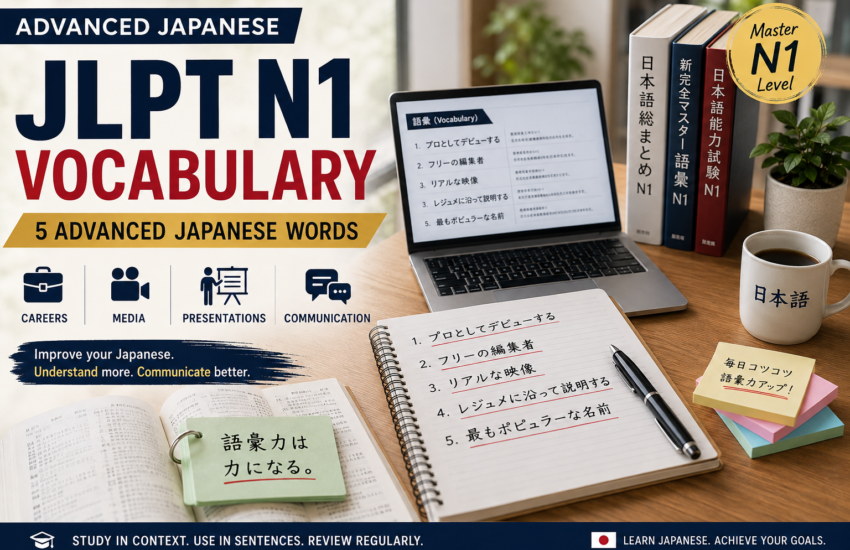
In this guide, you will learn five useful advanced Japanese expressions:
- プロとしてデビューする
- フリーの編集者[フリーのへんしゅうしゃ]
- リアルな映像[リアルなえいぞう]
- レジュメに沿って説明する[レジュメにそってせつめいする]
- 最もポピュラーな名前[もっともポピュラーななまえ]
Rather than memorizing definitions alone, study each expression with its meaning, example sentence, common situations, and learning tips.
1. プロとしてデビューする
Meaning
プロとしてデビューする
Meaning: To make one’s debut as a professional
This expression is used when someone begins working professionally in a particular field. It can be used when talking about entertainment, sports, and professional careers.
Example Sentence
彼は歌手としてプロデビューしました。
Translation: He made his debut as a professional singer.
When to Use
You may hear or read this expression when discussing:
- Entertainment
- Sports
- Professional careers
- Career achievements
- Interviews and biographies
JLPT Learning Tip
This expression is useful when reading articles about people’s careers and achievements.
Pay attention to として, which can indicate a person’s role or position.
For example:
- 歌手として — as a singer
- プロとして — as a professional
- 選手として — as a player
Learning these patterns can make longer Japanese sentences easier to understand.
2. フリーの編集者
Meaning
フリーの編集者[フリーのへんしゅうしゃ]
Meaning: Freelance editor
編集者[へんしゅうしゃ] means “editor.” The expression フリーの編集者 refers to an editor who works independently or on a freelance basis.
Example Sentence
彼女はフリーの編集者として働いています。
Translation: She works as a freelance editor.
When to Use
This expression is useful when discussing:
- Publishing
- Media and journalism
- Freelance work
- Modern work styles
- Professional careers
Related Vocabulary
- 編集[へんしゅう] — editing
- 編集者[へんしゅうしゃ] — editor
- 出版[しゅっぱん] — publishing
- 記者[きしゃ] — reporter
- フリーランス — freelancer
JLPT Learning Tip
Advanced Japanese reading passages may discuss modern careers and different ways of working.
When you see a word such as 編集者, try to understand it together with the surrounding vocabulary instead of translating each word separately.
3. リアルな映像
Meaning
リアルな映像[リアルなえいぞう]
Meaning: Realistic footage / realistic image
映像[えいぞう] is used when talking about visual content, footage, or images. リアルな映像 describes visual content that appears realistic.
Example Sentence
その映画はリアルな映像が多いです。
Translation: That movie has a lot of realistic footage.
When to Use
This expression can be used when discussing:
- Movies
- Documentaries
- Video games
- Technology
- Media
- Visual content
Related Vocabulary
- 映画[えいが] — movie
- 映像[えいぞう] — footage / visual image
- 技術[ぎじゅつ] — technology
- ドキュメンタリー — documentary
- メディア — media
JLPT Learning Tip
Media-related vocabulary can be useful when studying advanced Japanese listening and reading.
When watching Japanese documentaries, television programs, or interviews, listen for words describing visual content and production.
4. レジュメに沿って説明する
Meaning
レジュメに沿って説明する[レジュメにそってせつめいする]
Meaning: To explain according to the outline or handout
レジュメ refers to an outline or handout used for a presentation, seminar, lecture, or meeting.
The expression ~に沿って means to follow something or proceed according to something.
Example Sentence
レジュメに沿って説明してください。
Translation: Please explain according to the handout.
When to Use
This expression is especially useful in:
- Business meetings
- Seminars
- University lectures
- Presentations
- Workplace training
- Professional communication
Grammar Point: ~に沿って
Learning ~に沿って is useful for advanced Japanese.
It can be used when an action follows a plan, guideline, document, or direction.
For example:
計画に沿って進めます。
Translation: We will proceed according to the plan.
This type of expression is especially useful for learners studying Business Japanese and workplace communication.
JLPT Learning Tip
When you encounter an advanced grammar pattern such as ~に沿って, learn it together with example sentences.
This helps you understand how the expression works in real communication rather than simply memorizing its English definition.
5. 最もポピュラーな名前
Meaning
最もポピュラーな名前[もっともポピュラーななまえ]
Meaning: Most popular name
最も[もっとも] means “most” or “the most,” while ポピュラー means “popular.”
This expression can be used when discussing names, surveys, statistics, cultural topics, and trends.
Example Sentence
田中さんは日本で最もポピュラーな名前の一つです。
Translation: Tanaka is one of the most popular names in Japan.
When to Use
This expression is useful when discussing:
- Surveys and statistics
- Names
- Cultural discussions
- Trends
- Comparisons
- Popularity
JLPT Learning Tip
Pay attention to 最も, which is used to express the highest degree in a comparison.
Compare:
- 人気がある — popular
- より人気がある — more popular
- 最も人気がある — most popular
Understanding comparison expressions can help you follow Japanese articles and explanations more easily.
Vocabulary Summary Table
| Japanese | Reading | Meaning |
|---|---|---|
| プロとしてデビューする | プロとしてデビューする | Make one’s professional debut |
| フリーの編集者 | フリーのへんしゅうしゃ | Freelance editor |
| リアルな映像 | リアルなえいぞう | Realistic footage / image |
| レジュメに沿って説明する | レジュメにそってせつめいする | Explain according to the outline/handout |
| 最もポピュラーな名前 | もっともポピュラーななまえ | Most popular name |
Why Learn Advanced JLPT N1 Vocabulary?
- Understand professional Japanese
- Improve reading comprehension
- Recognize vocabulary in media
- Follow presentations and lectures
- Build workplace communication skills
Common Situations Where You’ll Hear These Expressions
These five expressions cover several areas of advanced Japanese.
Business Presentations
You may encounter レジュメに沿って説明する in presentations, meetings, seminars, and workplace training.
Japanese Television and Media
リアルな映像 can be useful when discussing movies, documentaries, television, and other visual media.
News Reports
Advanced vocabulary related to careers, media, statistics, and professional communication can appear in news and informational content.
Publishing and Editing
フリーの編集者 is useful vocabulary when discussing publishing, journalism, and freelance work.
Professional Interviews
プロとしてデビューする can appear when discussing a person’s career history and professional achievements.
Movies and Documentaries
リアルな映像 is useful when describing visual content and production.
How to Master JLPT N1 Professional Vocabulary
Learning advanced Japanese vocabulary takes more than memorizing definitions. To remember JLPT N1 professional vocabulary, study each expression in context and use it in your own practice.
1. Read the Example Sentences Aloud
Start by reading each Japanese example sentence aloud.
For example:
レジュメに沿って説明してください。
Reading aloud helps you become more familiar with the expression and its natural sentence structure.
2. Create Your Own Sentences
After learning each expression, write one original sentence.
For example:
私は会議でレジュメに沿って説明しました。
Translation: I explained according to the handout at the meeting.
Creating your own examples helps connect new vocabulary to situations you understand.
3. Use Flashcards
Add the five expressions to your flashcards.
Include:
- Japanese expression
- Reading
- English meaning
- Example sentence
Instead of reviewing only the English definition, try to remember the Japanese expression from the example sentence.
4. Review After 24 Hours
Review the vocabulary again after 24 hours.
Regular review can help you remember advanced expressions for longer.
5. Find the Vocabulary in Real Japanese
Try to identify these expressions or similar vocabulary in:
- Japanese news articles
- Japanese television
- Documentaries
- Business articles
- Interviews
- Professional presentations
The more often you encounter advanced vocabulary in context, the easier it becomes to recognize it naturally.
Practice Activity
Test yourself by completing the following sentences.
1.
彼は歌手として______。
2.
彼女は______として働いています。
3.
その映画は______が多いです。
4.
______説明してください。
5.
田中さんは日本で______名前の一つです。
Answers
- プロとしてデビューしました
- フリーの編集者
- リアルな映像
- レジュメに沿って
- 最もポピュラーな
Frequently Asked Questions
Are these words common in daily conversation?
Some expressions, such as リアルな映像, can be used in everyday conversations about media. Others, such as レジュメに沿って説明する, are more closely connected to academic and professional situations.
Are these words useful for JLPT N1 study?
These expressions are useful advanced vocabulary for N1 learners, especially when studying professional, media, academic, and workplace contexts. Learners should study them together with other vocabulary, grammar, reading, and listening practice.
How can I remember advanced Japanese vocabulary?
Study vocabulary in context, read example sentences aloud, create your own sentences, use flashcards, and review the words regularly.
Where can I practice professional Japanese vocabulary?
You can practice by reading Japanese business articles, watching interviews and documentaries, listening to presentations, and studying Business Japanese materials.
Should I learn vocabulary individually or by topic?
Learning by topic can make advanced vocabulary easier to remember. For example, you can create separate vocabulary groups for careers, media, presentations, publishing, and workplace communication.
Continue Your JLPT Journey
If you are preparing for the JLPT N1, learning vocabulary in context can make your study more practical and meaningful.
Start with these five expressions:
- プロとしてデビューする
- フリーの編集者
- リアルな映像
- レジュメに沿って説明する
- 最もポピュラーな名前
Read the examples, create your own sentences, and review the vocabulary regularly.
Consistent practice can help you become more comfortable with advanced Japanese vocabulary in reading, listening, and professional communication.
Learn Japanese with My Japanese Online
At My Japanese Online, licensed native Japanese teachers provide structured online lessons for JLPT N5–N1, Business Japanese, private Japanese lessons, and corporate Japanese training.
Whether you are preparing for the JLPT or improving your professional communication, studying Japanese with clear goals and regular practice can help you build stronger language skills.
Ready to continue your Japanese learning journey? Explore My Japanese Online’s JLPT and Japanese learning programs.
Suggested Internal Links
Corporate Japanese Training:
https://myjapaneseonline.com/home/corporates
JLPT N1 Course:
https://myjapaneseonline.com/home/courses?category=2:6:6
Business Japanese Course:
https://myjapaneseonline.com/home/courses?category=4:12
Private Japanese Lessons:
https://myjapaneseonline.com/private-japanese-lessons/
My Japanese Online Blog:
https://myjapaneseonline.com/blog/
My Japanese Online:
https://myjapaneseonline.com
Image Suggestions
[IMAGE: Advanced Japanese learner studying JLPT N1 vocabulary with Japanese flashcards, notebook, and laptop]
[IMAGE: Japanese professional giving a presentation while referring to a レジュメ handout]
[IMAGE: Freelance editor working on Japanese publishing and media content]
[IMAGE: Japanese media and professional communication concept featuring books, video footage, presentation slides, and office materials]
External Official Links
JLPT Official Website:
https://www.jlpt.jp/e/
JLPT Official Test Information:
https://www.jlpt.jp/e/guideline/testsections.html
Your Next Step
Today, try this five-step vocabulary routine:
- Read all five expressions aloud.
- Review their meanings.
- Write one sentence for each expression.