
 Posted by
 Learning Japanese vocabulary becomes easier when you connect new words to situations you already know.
For JLPT N5 learners, everyday topics such as numbers, dates, clothes, and food are especially useful. Instead of memorizing vocabulary as isolated words, try learning each word with a simple sentence.
Table of Contents
- Why Learn JLPT N5 Vocabulary in Context?
- 八[はち] — Eight
- 一番[いちばん] — Number One, Best, Most
- 二日[ふつか] — The Second Day / Two Days
- 服[ふく] — Clothes
- 牛肉[ぎゅうにく] — Beef
- 5 JLPT N5 Vocabulary Words to Review
- Mini Practice Quiz
- Practical Learning Tip
- Frequently Asked Questions
- Your Next Step
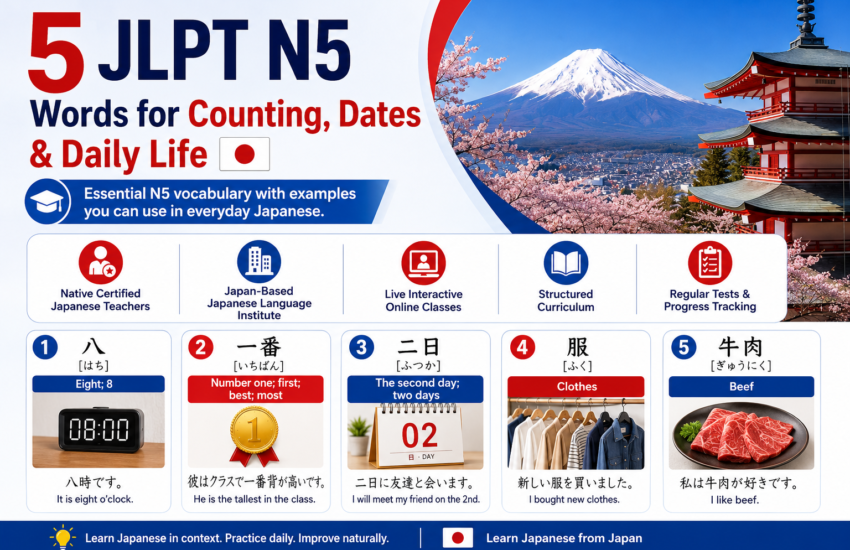
In this lesson, we will learn five useful Japanese words:
- 八[はち] — eight
- 一番[いちばん] — number one; first; best; most
- 二日[ふつか] — the second day of the month; two days
- 服[ふく] — clothes
- 牛肉[ぎゅうにく] — beef
These words can help you talk about shopping, dates, preferences, food, and everyday situations.
Why Learn JLPT N5 Vocabulary in Context?
Vocabulary is an important part of the JLPT N5. The official JLPT includes vocabulary questions that test areas such as kanji reading, orthography, expressions defined by context, and paraphrases.
But vocabulary study is not only about passing an exam.
When you learn a word with an example sentence, you also learn how that word works in real Japanese.
For example:
- 八[はち] helps you talk about numbers.
- 二日[ふつか] helps you talk about dates and periods of time.
- 服[ふく] is useful when shopping.
- 牛肉[ぎゅうにく] is useful when talking about food.
- 一番[いちばん] helps you express comparisons and preferences.
Let’s look at each word more closely.
1. 八[はち] — Eight
Meaning: eight; 8
八[はち] is the Japanese number eight.
Example
りんごを八つ[やっつ]買[か]いました。
Translation: I bought eight apples.
Learning Tip: 八[はち] vs 八つ[やっつ]
Beginners may notice something interesting in the example.
The number 8 is 八[はち], but when counting general objects, you can use 八つ[やっつ].
For example:
- 八[はち] — eight
- 八つ[やっつ] — eight things
You will learn that Japanese numbers can change pronunciation depending on what you are counting.
For now, remember this useful pair:
八[はち] → 八つ[やっつ]
More Practice
八時[はちじ]です。
Translation: It is eight o’clock.
2. 一番[いちばん] — Number One, Best, Most
Meaning: number one; first; best; most
一番[いちばん] is a very useful word for beginners. Depending on the sentence, it can mean “number one,” “first,” “best,” or “most.”
Example
彼[かれ]はクラスで一番[いちばん]背[せ]が高[たか]いです。
Translation: He is the tallest in the class.
Here, 一番[いちばん] is used to express the highest degree of something.
Useful Pattern
A useful beginner pattern is:
AはBで一番[いちばん] + adjective + です。
For example:
日本[にほん]で東京[とうきょう]が一番[いちばん]大[おお]きいです。
Translation: Tokyo is the biggest in Japan.
Another Useful Expression
一番[いちばん]好[す]きです。
Translation: I like it the most.
This makes 一番[いちばん] a useful word for talking about your favorite food, place, hobby, or activity.
3. 二日[ふつか] — The Second Day / Two Days
Meaning: the second day of the month; two days
二日[ふつか] is an important beginner word because Japanese uses a special reading for the second day of the month.
Example
二日[ふつか]に友達[ともだち]と会[あ]います。
Translation: I will meet my friend on the 2nd.
Notice that 二日 is read ふつか, not simply ににち.
二日[ふつか] Can Also Mean “Two Days”
The same word can also refer to a period of two days.
For example:
二日[ふつか]休[やす]みます。
Translation: I will take two days off.
This is a useful word to remember because you may see it when talking about dates, plans, holidays, or time periods.
Learning Tip
When learning Japanese dates, do not assume that every date follows the same pronunciation pattern.
Some dates have special readings, so practice them as vocabulary rather than trying to calculate the pronunciation every time.
4. 服[ふく] — Clothes
Meaning: clothes
服[ふく] is a common everyday Japanese noun.
You can use it when talking about what you wear, what you buy, or what you like.
Example
新[あたら]しい服[ふく]を買[か]いました。
Translation: I bought new clothes.
Useful Vocabulary with 服[ふく]
You can combine 服[ふく] with other beginner-friendly words:
- 新[あたら]しい服[ふく] — new clothes
- 古[ふる]い服[ふく] — old clothes
- 白[しろ]い服[ふく] — white clothes
- 黒[くろ]い服[ふく] — black clothes
- 好[す]きな服[ふく] — clothes you like
Practical Situation
Imagine you are shopping in Japan.
You might say:
この服[ふく]が好[す]きです。
Translation: I like these clothes.
Learning vocabulary through situations like shopping can make words easier to remember and use.
5. 牛肉[ぎゅうにく] — Beef
Meaning: beef
牛肉[ぎゅうにく] means beef.
The word is made from:
- 牛[うし] — cow; cattle
- 肉[にく] — meat
Together:
牛肉[ぎゅうにく] — beef
Example
私[わたし]は牛肉[ぎゅうにく]が好[す]きです。
Translation: I like beef.
Related Food Vocabulary
Once you know 牛肉[ぎゅうにく], you can start learning other types of meat:
- 牛肉[ぎゅうにく] — beef
- 豚肉[ぶたにく] — pork
- 鶏肉[とりにく] — chicken
- 肉[にく] — meat
This is useful vocabulary for restaurants, supermarkets, cooking, and everyday conversations.
Today’s 5 JLPT N5 Vocabulary Words
| Japanese | Reading | Meaning |
| 八 | はち | eight; 8 |
| 一番 | いちばん | number one; first; best; most |
| 二日 | ふつか | the second day; two days |
| 服 | ふく | clothes |
| 牛肉 | ぎゅうにく | beef |
Mini Practice Quiz
Test yourself before looking at the answers.
Question 1
Which Japanese word means “clothes”?
A. 牛肉[ぎゅうにく]
B. 服[ふく]
C. 二日[ふつか]
Answer: B. 服[ふく]
Question 2
How do you read 二日?
A. ににち
B. はち
C. ふつか
Answer: C. ふつか
Question 3
Which word means “beef”?
A. 牛肉[ぎゅうにく]
B. 服[ふく]
C. 一番[いちばん]
Answer: A. 牛肉[ぎゅうにく]
Question 4
What does 一番[いちばん] mean in this sentence?
彼[かれ]はクラスで一番[いちばん]背[せ]が高[たか]いです。
A. He is the shortest in the class.
B. He is the tallest in the class.
C. He is new in the class.
Answer: B. He is the tallest in the class.
Practical Learning Tip: Make Your Own Sentences
One of the best ways to turn vocabulary recognition into active knowledge is to create your own sentences.
Try this simple five-minute exercise.
Step 1: Read
Read each word aloud three times.
Step 2: Write
Write each Japanese word once without looking at the answer.
Step 3: Speak
Say the example sentence aloud.
Step 4: Personalize
Create one sentence about your own life.
For example:
私[わたし]は黒[くろ]い服[ふく]が好[す]きです。
Translation: I like black clothes.
Then try:
- Your favorite food with 牛肉[ぎゅうにく]
- A sentence using 八[はち]
- A date using 二日[ふつか]
- A comparison using 一番[いちばん]
This approach helps you learn vocabulary together with grammar and sentence structure.
Vocabulary Review Challenge
Can you complete these sentences?
- りんごを__つ買[か]いました。
- 私[わたし]は新[あたら]しい__を買[か]いました。
- __に友達[ともだち]と会[あ]います。
- 私[わたし]は__が好[す]きです。
- 彼[かれ]はクラスで__背[せ]が高[たか]いです。
Answers
- 八[やっつ]
- 服[ふく]
- 二日[ふつか]
- 牛肉[ぎゅうにく]
- 一番[いちばん]
How These Words Help with JLPT N5
These five words show why learning vocabulary in context is valuable.
The official JLPT N5 includes a vocabulary section, along with grammar, reading, and listening components.
The N5 vocabulary section can test kanji reading, orthography, contextually defined expressions, and paraphrases.
So, when you study a word, do not only memorize its English meaning.
Try to learn:
Kanji → Reading → Meaning → Example → Usage
For example:
牛肉 → ぎゅうにく → beef → 牛肉が好きです。 → food vocabulary
This gives you a stronger connection between the written word and its use.
Frequently Asked Questions
Is this vocabulary useful for JLPT N5?
These are beginner-level Japanese words that are useful for studying basic vocabulary and everyday communication. However, learners should not rely on five words alone for JLPT preparation. The JLPT also tests grammar, reading, and listening skills.
Why is 二日 read as ふつか?
二日[ふつか] is the established Japanese reading used for the second day of the month and can also mean a period of two days. It is best learned as a vocabulary item.
What is the difference between 八[はち] and 八つ[やっつ]?
八[はち] is the number eight. 八つ[やっつ] is a general counter meaning eight things. Japanese uses different counters depending on what is being counted.
How can I remember Japanese vocabulary better?
Use new words in short sentences, read them aloud, review them regularly, and connect them with real situations such as shopping, eating, or making plans.
Is vocabulary enough to pass JLPT N5?
No. Vocabulary is only one part of JLPT preparation. You should also practice grammar, reading, and listening. The official JLPT N5 includes these areas.
5 Words to Review Today
Before you finish your study session, say these five words aloud:
- 八[はち] — eight
- 一番[いちばん] — number one; best; most
- 二日[ふつか] — the second day; two days
- 服[ふく] — clothes
- 牛肉[ぎゅうにく] — beef
Then make one original Japanese sentence for each word.
Small vocabulary practice every day can help you build a stronger foundation for Japanese learning.
Internal Link Suggestions
- JLPT N5 Preparation: Explore My Japanese Online JLPT and Japanese learning courses
- Japanese Vocabulary Practice: JLPT Japanese Vocabulary N5–N1
- Daily JLPT N5 Vocabulary: Daily JLPT N5 Vocabulary for Beginners
- All Japanese Learning Articles: My Japanese Online Blog
External Official Link
For official information about the Japanese-Language Proficiency Test, visit:
JLPT schedules and rules can change. Always confirm the latest information on the official JLPT website.
Learn Japanese with My Japanese Online
Want to improve your Japanese step by step?
Start learning Japanese with My Japanese Online
My Japanese Online provides online Japanese lessons with licensed native Japanese teachers, including structured JLPT preparation from N5 to N1.
Your Next Step
Today, try this five-minute JLPT N5 challenge:
☐ Read the five words aloud.
☐ Write each word in Japanese.
☐ Review the readings.
☐ Make one sentence for each word.
☐ Test yourself again tomorrow without looking at the answers.
JLPT schedules and rules can change. Always confirm the latest information on the official JLPT website.
Learn Japanese with My Japanese Online
If you want to study Japanese step by step with licensed native Japanese teachers, My Japanese Online can support your learning journey.
For structured JLPT preparation, you can build your Japanese skills through vocabulary, grammar, kanji, reading, listening, and practical communication practice.