
 Posted by
 Learning new vocabulary every day is one of the best ways to improve your Japanese. If you’re preparing for the JLPT N3, understanding words in different real-life situations will help you strengthen your reading, listening, and conversation skills.
In this article, you’ll learn five useful JLPT N3 vocabulary words with meanings, example sentences, and practical tips to help you remember them more easily.
Table of Contents
- Why Learn JLPT N3 Vocabulary Daily?
- JLPT N3 Vocabulary List
- Vocabulary Summary
- Study Tips
- Frequently Asked Questions
Why Daily Vocabulary Practice Matters
The JLPT N3 level introduces more complex vocabulary than the beginner levels. Instead of memorizing long word lists, it’s more effective to study words with example sentences and understand how they are used in everyday life.
Benefits of daily vocabulary study include:
- Better reading comprehension
- Improved listening skills
- More natural conversations
- Stronger JLPT preparation
- Increased confidence in using Japanese
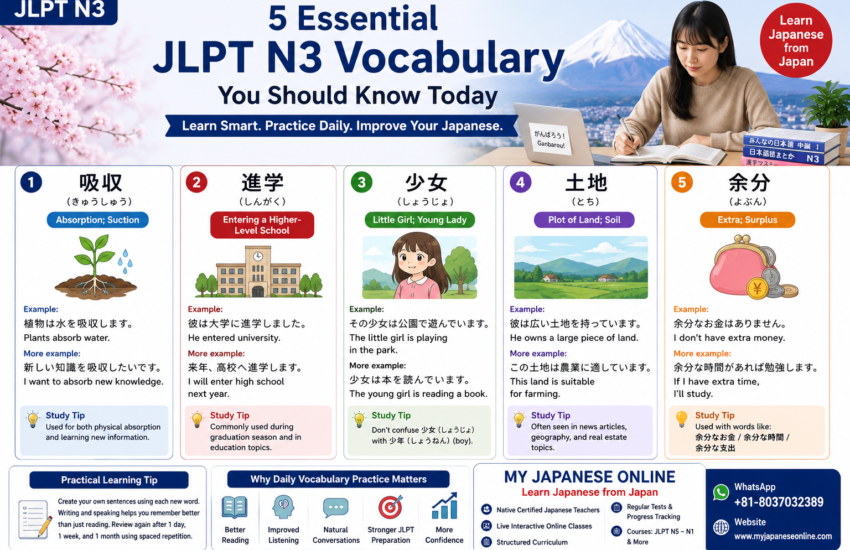
1. 吸収(きゅうしゅう)— Absorption; Suction
Meaning: To absorb something, such as water, knowledge, or information.
Example:
植物(しょくぶつ)は水(みず)を吸収(きゅうしゅう)します。
Plants absorb water.
More Example
- 新(あたら)しい知識(ちしき)を吸収(きゅうしゅう)したいです。
I want to absorb new knowledge.
Study Tip
Remember that 吸収 is used both for physical absorption and learning new information.
2. 進学(しんがく)— Entering a Higher-Level School
Meaning: To continue your education by entering high school, university, or another higher educational institution.
Example:
彼(かれ)は大学(だいがく)に進学(しんがく)しました。
He entered university.
More Example
- 来年(らいねん)、高校(こうこう)へ進学(しんがく)します。
I will enter high school next year.
Study Tip
You’ll often hear this word during graduation season and when discussing education in Japan.
3. 少女(しょうじょ)— Little Girl; Young Lady
Meaning: A young girl, usually a child or teenager.
Example:
その少女(しょうじょ)は公園(こうえん)で遊(あそ)んでいます。
The little girl is playing in the park.
More Example
- 少女(しょうじょ)は本(ほん)を読(よ)んでいます。
The young girl is reading a book.
Study Tip
Don’t confuse 少女(しょうじょ) with 少年(しょうねん), which means “boy.”
4. 土地(とち)— Plot of Land; Soil
Meaning: A piece of land or a particular area.
Example:
彼(かれ)は広(ひろ)い土地(とち)を持(も)っています。
He owns a large piece of land.
More Example
- この土地(とち)は農業(のうぎょう)に適(てき)しています。
This land is suitable for farming.
Study Tip
You’ll often encounter 土地 in news articles, geography, and real estate topics.
5. 余分(よぶん)— Extra; Surplus
Meaning: More than necessary.
Example:
余分(よぶん)なお金(かね)はありません。
I don’t have extra money.
More Example
- 余分(よぶん)な時間(じかん)があれば勉強(べんきょう)します。
If I have extra time, I’ll study.
Study Tip
You’ll frequently see 余分 used with words like:
- 余分なお金 (extra money)
- 余分な時間 (extra time)
- 余分な支出(ししゅつ) (extra expenditure)
Quick Vocabulary Summary
| Japanese | Reading | Meaning |
| 吸収 | きゅうしゅう | Absorption; to absorb |
| 進学 | しんがく | Enter a higher-level school |
| 少女 | しょうじょ | Little girl |
| 土地 | とち | Plot of land |
| 余分 | よぶん | Extra; surplus |
Practical Learning Tip
Instead of memorizing vocabulary one word at a time, create your own sentences using each new word. Writing and speaking the words regularly helps you remember them much more effectively than simply reading a list.
Try reviewing today’s vocabulary again after one day, one week, and one month using spaced repetition.
Frequently Asked Questions
Is this vocabulary included in the JLPT N3?
Yes. These are commonly studied words appropriate for learners preparing for the JLPT N3.
How many vocabulary words should I study each day?
Learning 5–10 new words daily, along with regular review, is a practical goal for most learners.
Should I memorize example sentences?
Yes. Learning vocabulary through context helps you understand how words are naturally used and improves both reading and speaking skills.
What’s the best way to remember JLPT vocabulary?
Use flashcards, read Japanese regularly, listen to native audio, and practice creating your own example sentences.
Image Suggestions
- [IMAGE: Student studying JLPT N3 vocabulary with Japanese flashcards]
Alt text: Student reviewing JLPT N3 vocabulary flashcards at a desk - [IMAGE: Illustrated vocabulary cards showing the five featured words]
Alt text: Illustrated JLPT N3 vocabulary cards featuring words like 吸収, 進学, 少女, 土地, and 余分 - [IMAGE: Japanese learner reviewing vocabulary on a laptop during an online lesson]
Alt text: Japanese learner studying JLPT N3 vocabulary online with a native teacher
Internal Link Suggestions
- My Japanese Online JLPT N3 Course
- JLPT Preparation Page
- Private Japanese Lessons
- Japanese Vocabulary Learning Resources
Your Next Step
✅ Learn today’s five words.
✅ Create one original sentence using each word.
✅ Review them again tomorrow.
✅ Continue building your JLPT N3 vocabulary one day at a time.
If you’d like structured guidance from licensed native Japanese teachers, My Japanese Online offers online JLPT courses from N5 to N1, personalized lessons, and practical learning support to help you reach your Japanese language goals.
Suggested WhatsApp Promotion
📘 New JLPT N3 Vocabulary Blog! 🇯🇵
Today’s lesson features 5 essential JLPT N3 vocabulary words with meanings, example sentences, and practical study tips to help you remember them more easily.
Start learning and strengthen your Japanese every day!
👉 Read the full blog: https://myjapaneseonline.com/blog/jlpt-n3-vocabulary-essential-words
- Official JLPT Website: https://www.jlpt.jp/e/
- MyJLPT Portal: https://info.jees-jlpt.jp/
- The Japan Foundation: https://www.jpf.go.jp/e/
Conclusion
To continue building your JLPT N3 vocabulary, explore our Online Japanese Classes and JLPT Courses, designed for learners from N5 to N1. Whether you’re studying for the JLPT, improving daily communication, or preparing for work in Japan, My Japanese Online offers practical lessons taught by licensed native Japanese teachers.