
 Posted by
 Building your Japanese vocabulary daily is one of the most effective ways to improve fluency and confidence. Whether you’re preparing for the JLPT exam or simply aiming to communicate better in real-life situations, consistent vocabulary practice makes a big difference.
In this lesson, we cover essential JLPT vocabulary from N5 (beginner) to N1 (advanced), complete with meanings and example sentences. These words are carefully selected to help you understand real conversations, improve reading skills, and strengthen your overall Japanese foundation.
Make it a habit to review, repeat, and use these words in your daily life. Let’s get started with today’s vocabulary!
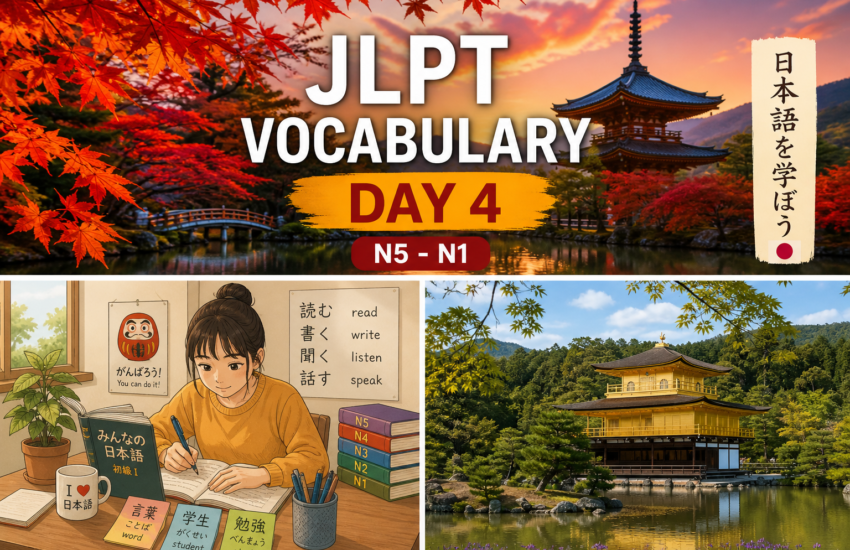
This JLPT vocabulary with examples day 4 N5 to N1 lesson helps learners understand real-life usage easily.
JLPT N5 Vocabulary
Word: 秋
Reading: あき
Meaning: autumn; fall
Example: 秋になると葉が赤くなります。
Translation: When autumn comes, the leaves turn red.
Word: あの
Reading: あの
Meaning: that
Example: あの店は有名です。
Translation: That shop is famous.
Word: 明日
Reading: あした
Meaning: tomorrow
Example: 明日は学校があります。
Translation: There is school tomorrow.
Word: 会う
Reading: あう
Meaning: to meet; to see
Example: 友達に駅で会います。
Translation: I will meet my friend at the station.
Word: 勉強
Reading: べんきょう
Meaning: to study
Example: 毎日日本語を勉強しています。
Translation: I study Japanese every day.
JLPT N4 Vocabulary
Word: アクセサリー
Reading: あくせさりー
Meaning: accessory
Example: 彼女は新しいアクセサリーを買いました。
Translation: She bought new accessories.
Word: アルバイト
Reading: あるばいと
Meaning: part-time job
Example: 学生は週末にアルバイトをしています。
Translation: The student works a part-time job on weekends.
Word: ぶどう
Reading: ぶどう
Meaning: grapes
Example: ぶどうを食べるのが大好きです。
Translation: I love eating grapes.
Word: 血
Reading: ち
Meaning: blood
Example: 怪我をして血が出ました。
Translation: I got injured and blood came out.
Word: 駐車場
Reading: ちゅうしゃじょう
Meaning: parking lot
Example: このビルの駐車場は広いです。
Translation: The parking lot of this building is spacious.
JLPT N3 Vocabulary
Word: 分
Reading: ぶん
Meaning: part; portion; share
Example: ケーキを3つに分しました。
Translation: We divided the cake into three portions.
Word: 昼食
Reading: ちゅうしょく
Meaning: lunch; midday meal
Example: 学校で昼食を食べました。
Translation: I ate lunch at school.
Word: 再び
Reading: ふたたび
Meaning: again; once more
Example: 彼は再び挑戦しました。
Translation: He tried again.
Word: 販売
Reading: はんばい
Meaning: sales; selling
Example: この店は新商品を販売しています。
Translation: This store is selling new products.
Word: 一人一人
Reading: ひとりひとり
Meaning: one by one; each
Example: 一人一人に感謝の手紙を書きました。
Translation: I wrote a thank-you letter to each person.
JLPT N2 Vocabulary
Word: 出入口
Reading: でいりぐち
Meaning: entrance and exit
Example: 駅の出入口は二つあります。
Translation: The station has two entrances and exits.
Word: 寺院
Reading: じいん
Meaning: Buddhist temple
Example: 京都には多くの寺院があります。
Translation: There are many temples in Kyoto.
Word: 見学
Reading: けんがく
Meaning: study by observation; tour
Example: 学生たちは工場を見学しました。
Translation: The students toured the factory.
Word: 転がす
Reading: ころがす
Meaning: to roll
Example: 子供がボールを転がして遊んでいます。
Translation: The children are rolling the ball and playing.
Word: 窓口
Reading: まどぐち
Meaning: counter; ticket window
Example: 銀行の窓口で手続きをしました。
Translation: I completed the procedures at the bank counter.
JLPT N1 Vocabulary
Word: 研究成果
Reading: けんきゅうせいか
Meaning: research results
Example: この論文は彼の研究成果です。
Translation: This paper is the result of his research.
Word: 当選する
Reading: とうせんする
Meaning: to be elected
Example: 彼女は市議会に当選しました。
Translation: She was elected to the city council.
Word: 見積もりをとる
Reading: みつもりをとる
Meaning: to get a quote
Example: 引越しの前に業者から見積もりをとりました。
Translation: I got a quote before moving.
Word: 天候の回復
Reading: てんこうのかいふく
Meaning: weather clearing up
Example: 午後には天候の回復が見込まれています。
Translation: The weather is expected to clear up in the afternoon.
Word: 極めて難しい
Reading: きわめてむずかしい
Meaning: extremely difficult
Example: この問題は極めて難しいです。
Translation: This problem is extremely difficult.
How to Use These Words in Daily Japanese Practice
To truly remember vocabulary, you need to use it actively. Try creating your own sentences using each word. Practice speaking aloud, especially with verbs like 会う (to meet) or 勉強 (to study).
You can also:
- Keep a daily vocabulary notebook
- Use new words in conversations or language exchange
- Review words before sleeping for better retention
Consistency is the key to mastering Japanese.
Quick Practice Quiz
- What does 「明日(あした)」 mean?
- Fill in the blank: 友達に駅で______。
- What is the meaning of 「販売(はんばい)」?
- Choose the correct meaning of 「見学(けんがく)」:
a) To buy
b) To observe/visit
c) To write - What does 「極めて難しい」 mean?
Ready to Learn Japanese Faster?
Ready to speak Japanese confidently? Learn Japanese online with native licensed teachers through structured JLPT and communication courses. Book your trial class today.
Website: https://myjapaneseonline.com
WhatsApp Channel: https://whatsapp.com/channel/0029Vb74C2T0wajtXvwo5r0p
Contact: +81-8037032389
Internal Linking Suggestions
- JLPT Course Page (N5–N1 levels)
- Private Japanese Lessons Page
- Business Japanese Course Page
- Previous Blog: JLPT Vocabulary Day 3
- Next Blog: JLPT Vocabulary Day 5
By mastering JLPT vocabulary with examples day 4, you can boost your fluency and JLPT exam performance.
Categories and Tags
Categories:
- JLPT Vocabulary
- Learn Japanese
Tags:
- JLPT N5 vocabulary
- JLPT N4 vocabulary
- JLPT N3 vocabulary
- JLPT N2 vocabulary
- JLPT N1 vocabulary
- Japanese vocabulary with examples
- Learn Japanese online