
 Posted by
Introduction
Learning Japanese vocabulary is an important part of preparing for the JLPT N3 examination. At the intermediate level, you need to understand more than basic words. You also need to recognize expressions used to describe time, dates, situations, and everyday experiences.
For example, how would you describe something that happened in the middle of the night? What Japanese expression would you use when talking about the middle of next month or the New Year holidays?
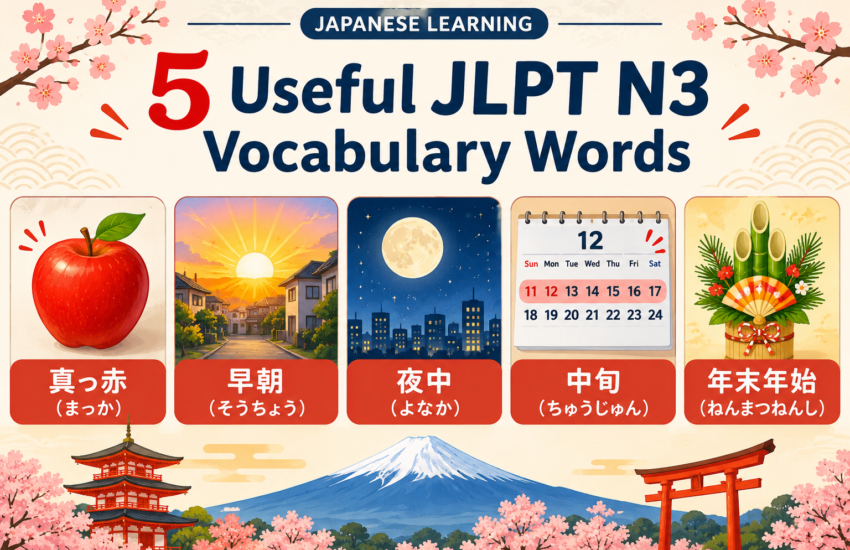
In this lesson, we will explore five useful JLPT N3 vocabulary words:
- 真っ赤(まっか)— Bright red; deep red
- 早朝(そうちょう)— Early morning
- 夜中(よなか)— Midnight; middle of the night
- 中旬(ちゅうじゅん)— Middle ten days of the month
- 年末年始(ねんまつねんし)— Year-end and New Year’s holidays
Let’s learn their meanings, example sentences, and practical usage.
1. 真っ赤(まっか)— Bright Red; Deep Red 🔴
Meaning: Bright red; completely red; deep red.
真っ赤(まっか) is used to describe something that is strongly or completely red.
It is commonly used when describing a person’s face, flowers, fruits, and other objects.
Example Sentence
彼(かれ)の顔(かお)は真っ赤(まっか)になりました。
English: His face turned bright red.
More Examples
- りんごが真っ赤(まっか)です。
- The apple is bright red.
- 恥(は)ずかしくて、顔(かお)が真っ赤(まっか)になりました。
- I was embarrassed, and my face turned bright red.
Learning Tip
Remember the expression 真っ赤になる(まっかになる), which means “to turn bright red.”
You can also learn these related expressions:
- 真っ白(まっしろ)— Pure white
- 真っ黒(まっくろ)— Completely black
- 真っ青(まっさお)— Deep blue; pale (depending on context)
Learning these expressions together can help expand your descriptive vocabulary.
2. 早朝(そうちょう)— Early Morning 🌅
Meaning: Early morning; very early in the morning.
早朝(そうちょう) refers to the early hours of the morning, usually before most people begin their normal daily activities.
This word is useful when talking about exercise, travel, work schedules, and daily routines.
Example Sentence
早朝(そうちょう)にジョギングをします。
English: I go jogging early in the morning.
More Examples
- 早朝(そうちょう)に空港(くうこう)へ行(い)きました。
- I went to the airport early in the morning.
- 早朝(そうちょう)は空気(くうき)がきれいです。
- The air is clean in the early morning.
Learning Tip
Compare these Japanese expressions for different times of the day:
- 朝(あさ)— Morning
- 早朝(そうちょう)— Early morning
- 昼(ひる)— Daytime; noon
- 夕方(ゆうがた)— Evening; late afternoon
- 夜(よる)— Night
- 夜中(よなか)— Middle of the night
Understanding these differences will help you describe your daily schedule more naturally.
3. 夜中(よなか)— Midnight; Middle of the Night 🌙
Meaning: Midnight; the middle of the night.
夜中(よなか) refers to the late hours of the night, especially when most people are sleeping.
It is commonly used when talking about waking up, sleeping, unexpected sounds, and nighttime activities.
Example Sentence
夜中(よなか)に目(め)が覚(さ)めました。
English: I woke up in the middle of the night.
More Examples
- 夜中(よなか)に電話(でんわ)がありました。
- I received a phone call in the middle of the night.
- 夜中(よなか)まで勉強(べんきょう)していました。
- I was studying until late at night.
Learning Tip
Do not confuse 夜(よる) and 夜中(よなか).
- 夜(よる) means night in general.
- 夜中(よなか) refers to the middle or late part of the night.
For example:
夜(よる)に映画(えいが)を見(み)ます。
I watch a movie at night.
夜中(よなか)に目(め)が覚(さ)めました。
I woke up in the middle of the night.
4. 中旬(ちゅうじゅん)— Middle Ten Days of the Month 📅
Meaning: The middle ten days of a month.
中旬(ちゅうじゅん) is used to describe approximately the 11th to the 20th day of a month.
Japanese speakers commonly use this expression when discussing travel plans, appointments, schedules, and business arrangements.
Example Sentence
来月(らいげつ)の中旬(ちゅうじゅん)に旅行(りょこう)します。
English: I will travel in the middle of next month.
More Examples
- 試験(しけん)は来月(らいげつ)の中旬(ちゅうじゅん)にあります。
- The examination is scheduled for the middle of next month.
- 仕事(しごと)は12月(じゅうにがつ)の中旬(ちゅうじゅん)に終(お)わります。
- The work will finish in the middle of December.
Important Vocabulary: Three Parts of a Month
Japanese has three useful expressions for describing different parts of a month.
| Japanese | Reading | Meaning |
| 上旬 | じょうじゅん | Beginning of the month (approximately 1st–10th) |
| 中旬 | ちゅうじゅん | Middle of the month (approximately 11th–20th) |
| 下旬 | げじゅん | Latter part of the month (approximately 21st–end) |
Learning Tip
Try remembering these three expressions together.
They are particularly useful when reading Japanese schedules, announcements, business emails, and travel information.
5. 年末年始(ねんまつねんし)— Year-End and New Year’s Holidays 🎍
Meaning: The year-end and New Year’s period.
年末年始(ねんまつねんし) refers to the period around the end of one year and the beginning of the next year.
In Japan, this expression is frequently used when talking about family gatherings, holidays, travel plans, and business schedules.
Example Sentence
年末年始(ねんまつねんし)は家族(かぞく)と過(す)ごします。
English: I spend the year-end and New Year holidays with my family.
More Examples
- 年末年始(ねんまつねんし)は日本(にほん)へ帰(かえ)ります。
- I will return to Japan during the year-end and New Year holidays.
- 年末年始(ねんまつねんし)の予定(よてい)を決(き)めました。
- I decided my plans for the year-end and New Year holidays.
Learning Tip
Learn these related expressions to understand Japanese conversations about the end of the year:
- 年末(ねんまつ)— End of the year
- 年始(ねんし)— Beginning of the year
- 正月(しょうがつ)— New Year; New Year period
- 休暇(きゅうか)— Holiday; leave
These words are especially useful when discussing holidays and annual schedules in Japan.
Quick Review: Today’s 5 JLPT N3 Vocabulary Words
Let’s review all five words before moving on to the practice activity.
| Japanese | Reading | English Meaning |
| 真っ赤 | まっか | Bright red; deep red |
| 早朝 | そうちょう | Early morning |
| 夜中 | よなか | Midnight; middle of the night |
| 中旬 | ちゅうじゅん | Middle ten days of the month |
| 年末年始 | ねんまつねんし | Year-end and New Year’s holidays |
Practice Time! Can You Remember These Words?
Test your understanding of today’s vocabulary.
Question 1: Which word means “early morning”?
A. 夜中
B. 早朝
C. 年末年始
Question 2: What does 中旬 mean?
A. Beginning of the month
B. Middle of the month
C. End of the year
Question 3: Which expression means “bright red”?
A. 真っ赤
B. 真っ白
C. 真っ黒
Question 4: What does 夜中 mean?
A. Morning
B. Afternoon
C. Middle of the night
Question 5: Which word describes the year-end and New Year’s period?
A. 年末年始
B. 早朝
C. 中旬
Answers
- B — 早朝(そうちょう)
- B — 中旬(ちゅうじゅん)
- A — 真っ赤(まっか)
- C — 夜中(よなか)
- A — 年末年始(ねんまつねんし)
How many answers did you get correct?
Practical Learning Tip: Learn Vocabulary Through Sentences
Simply memorizing Japanese words and their English meanings may not be enough to use them confidently.
Try this simple three-step learning method:
1. Read the vocabulary aloud
Practice the Japanese word and its correct pronunciation.
2. Understand the example sentence
Pay attention to how the word is used in a complete sentence.
3. Create your own sentence
Write one original sentence using each new word.
For example:
毎朝(まいあさ)、早朝(そうちょう)に起(お)きます。
I wake up early every morning.
Creating your own examples helps you understand vocabulary more deeply and improves your ability to use Japanese in real situations.
Frequently Asked Questions (FAQs)
1. Are these words useful for JLPT N3 preparation?
These five words are useful for intermediate Japanese vocabulary practice. Learning them in context can support your reading comprehension and everyday communication.
2. What is the difference between 夜 and 夜中?
夜(よる) means night in general, while 夜中(よなか) refers to the middle or late part of the night.
3. What is the difference between 上旬, 中旬, and 下旬?
上旬 refers approximately to the 1st–10th, 中旬 to the 11th–20th, and 下旬 to the 21st through the end of the month.
4. How can I remember Japanese vocabulary more easily?
Use flashcards, read example sentences aloud, write your own sentences, and review previously learned words regularly.
5. Should I learn JLPT vocabulary with example sentences?
Yes. Example sentences help you understand the meaning and context of each word. They also help you recognize vocabulary when reading or listening to Japanese.
Improve Your Japanese with My Japanese Online
Building strong Japanese vocabulary takes consistent practice. By learning new words, understanding their meanings, and using them in sentences, you can gradually improve your Japanese communication skills.
If you are preparing for the JLPT N3 examination, My Japanese Online offers structured JLPT courses from N5 to N1, taught by licensed native Japanese teachers.
Our online lessons support learners who want to improve their vocabulary, grammar, kanji, reading, listening, and overall Japanese communication.
Start building your Japanese skills one lesson at a time with My Japanese Online!
Your Next Step
Before moving on to tomorrow’s vocabulary:
- Review today’s five Japanese words.
- Read all five example sentences aloud.
- Write one original sentence for each word.
- Complete the five-question vocabulary quiz.
- Review these words again tomorrow.
Remember: Learning five words every day and using them in real sentences is a practical way to build your Japanese vocabulary.
Internal Link Suggestions
- JLPT Courses (N5–N1): https://myjapaneseonline.com/
- JLPT Daily Vocabulary: https://myjapaneseonline.com/blog/jlpt-daily-vocabulary/
- Related Japanese Vocabulary Lessons: https://myjapaneseonline.com/blog/
External Links
I recommend these three resources for readers who want to improve their Japanese vocabulary and JLPT preparation.
1. Official JLPT Sample Questions – Practice N3 vocabulary, grammar, reading, and listening questions.
JLPT Official Practice Questions
2. Official JLPT FAQ – Understand the JLPT examination structure and study resources.
JLPT Official FAQ
3. Japanese Vocabulary Dictionary – Check the meaning, reading, and usage of 真っ赤.
JapanDict – 真っ赤