
 Posted by
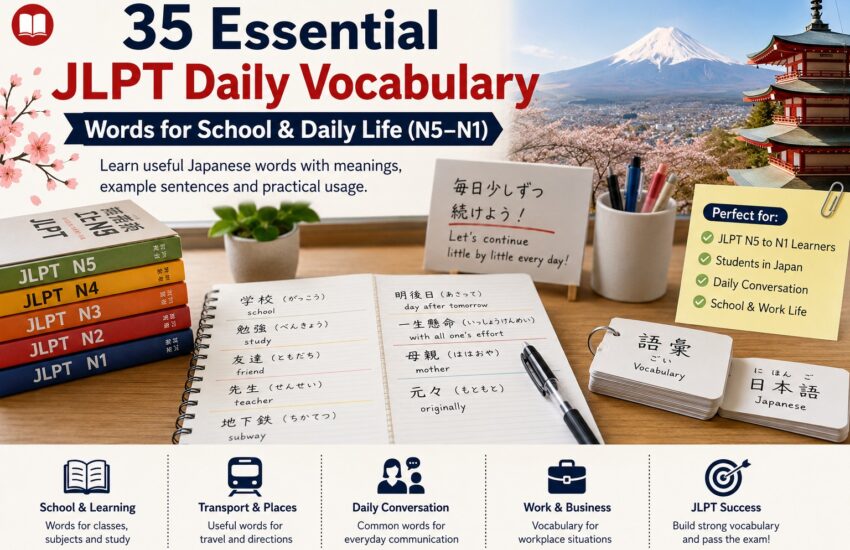
 JLPT daily vocabulary practice helps Japanese learners improve reading, listening, speaking, and exam confidence step by step. Learning JLPT daily vocabulary with useful example sentences makes Japanese easier to remember and use in daily life.
“Learning JLPT daily vocabulary step by step improves reading, listening, and speaking skills.”
In this blog, we will learn useful Japanese vocabulary from JLPT N5 to N1 related to school, learning, communication, and everyday life in Japan.
Whether you are preparing for the JLPT, studying in Japan, or improving your conversation skills, these words will help build your confidence step by step.
Table of Contents
Study Tips
JLPT Daily Vocabulary for Beginners
JLPT Daily Vocabulary for Intermediate Learners
Advanced JLPT Daily Vocabulary
Vocabulary Quiz
JLPT Daily Vocabulary for Beginners (N5)
🗓️ 明後日(あさって)— Day After Tomorrow
Example:
明後日(あさって)は雨(あめ)が降(ふ)ります。
(It will rain the day after tomorrow.)
Learning Tip
Useful for making plans and talking about schedules.
🔢 番号(ばんごう)— Number
Example:
学生番号(がくせいばんごう)を書(か)いてください。
(Please write your student number.)
Common Usage
- 電話番号(telephone number)
- 学生番号(student ID number)
🚇 地下鉄(ちかてつ)— Subway
Example:
地下鉄(ちかてつ)で学校(がっこう)へ行(い)きます。
(I go to school by subway.)
Useful in Japan
This is an essential word for transportation in cities like Tokyo and Osaka.
[IMAGE: Japanese subway station with signs in Japanese]
🎓 大学(だいがく)— University
Example:
兄(あに)は大学(だいがく)で経済(けいざい)を勉強(べんきょう)しています。
(My older brother studies economics at university.)
❓ 誰(だれ)— Who
Example:
あの人(ひと)は誰(だれ)ですか。
(Who is that person?)
This is one of the most important beginner question words in Japanese.
JLPT Daily Vocabulary for Intermediate Learners (N4–N3)
🌊 浅い(あさい)— Shallow
Example:
この川(かわ)は浅(あさ)いです。
(This river is shallow.)
🌍 地理(ちり)— Geography
Example:
私(わたし)は地理(ちり)が好(す)きです。
(I like geography.)
⏳ できるだけ — As Much As Possible
Example:
できるだけ早(はや)く来(き)てください。
(Please come as early as possible.)
This phrase is commonly used in daily conversations and workplaces.
🙇 遠慮(えんりょ)する — To Refrain / Hold Back
Example:
遠慮(えんりょ)しないで食(た)べてください。
(Please eat without holding back.)
This expression is closely connected to Japanese manners and politeness culture.
🌊 深い(ふかい)— Deep
Example:
この海(うみ)はとても深(ふか)いです。
(This sea is very deep.)
JLPT N3 Vocabulary – Practical Everyday Expressions
💴 円(えん)— Yen / Japanese Currency
Example:
この本(ほん)は千円(せんえん)です。
(This book costs 1,000 yen.)
👩 母親(ははおや)— Mother
Example:
母親(ははおや)は料理(りょうり)が上手(じょうず)です。
(My mother is good at cooking.)
🕐 一時(いちじ)— One O’clock
Example:
会議(かいぎ)は一時(いちじ)に始(はじ)まります。
(The meeting starts at one o’clock.)
Useful for meetings, appointments, and daily scheduling.
📘 一般(いっぱん)— General / Common
Example:
これは一般(いっぱん)の意見(いけん)です。
(This is a general opinion.)
❗ 一体(いったい)— What on Earth / Why in the World
Example:
一体(いったい)何(なに)が起(お)きたのですか。
(What on earth happened?)
This word adds emotional emphasis in conversation.
Advanced JLPT Daily Vocabulary for N2–N1
❌ 外れる(はずれる)— To Come Off / Be Disconnected
Example:
ボタンが外(はず)れました。
(The button came off.)
🚀 加速度(かそくど)— Acceleration
Example:
車(くるま)の加速度(かそくど)が速(はや)い。
(The car’s acceleration is fast.)
🛂 国籍(こくせき)— Nationality / Citizenship
Example:
彼(かれ)は日本国籍(にほんこくせき)です。
(He has Japanese nationality.)
🔁 元々(もともと)— Originally
Example:
元々(もともと)東京(とうきょう)に住(す)んでいました。
(I originally lived in Tokyo.)
👦 青少年(せいしょうねん)— Youth / Young People
Example:
青少年(せいしょうねん)の教育(きょういく)は大切(たいせつ)です。
(Education of youth is important.)
JLPT N1 Vocabulary – Academic and Professional Japanese
📜 古い書物(ふるいしょもつ)— Old Book
Example:
図書館(としょかん)で古い書物(ふるいしょもつ)を読(よ)みました。
(I read an old book at the library.)
📊 数値(すうち)— Numerical Value
Example:
数値(すうち)を正確(せいかく)に記録(きろく)する。
(Record the numerical values accurately.)
📚 必修科目(ひっしゅうかもく)— Compulsory Subject
Example:
英語(えいご)は必修科目(ひっしゅうかもく)です。
(English is a compulsory subject.)
🔥 日頃の努力(ひごろ の どりょく)— Daily Effort
Example:
日頃(ひごろ)の努力(どりょく)が成功(せいこう)につながる。
(Daily effort leads to success.)
This phrase is excellent motivation for JLPT learners.
👥 チームを率いる(チームをひきいる)— To Lead a Team
Example:
彼(かれ)は会社(かいしゃ)でチームを率(ひき)いています。
(He leads a team at the company.)
This is useful for business Japanese and workplace communication.
Study Tips for JLPT Daily Vocabulary
“Reviewing JLPT daily vocabulary every day improves long-term memory.”
Quick Vocabulary Quiz
1. What does 地下鉄(ちかてつ) mean?
A. Bus
B. Subway
C. Airport
✅ Answer: B. Subway
2. Which word means “nationality”?
A. 国籍(こくせき)
B. 数値(すうち)
C. 一般(いっぱん)
✅ Answer: A. 国籍(こくせき)
3. What does 日頃の努力(ひごろ の どりょく) mean?
A. School subject
B. Daily effort
C. Team meeting
✅ Answer: B. Daily effort
4. Which word means “who”?
A. 誰(だれ)
B. 一時(いちじ)
C. 深い(ふかい)
✅ Answer: A. 誰(だれ)
Practical Study Tips for JLPT Vocabulary
- Study a few words every day instead of memorizing large lists at once.
- Read example sentences aloud to improve pronunciation and memory.
- Group vocabulary by theme such as school, travel, work, or daily life.
- Practice using new words in your own sentences.
- Review vocabulary regularly using flashcards or JLPT quizzes.
Consistency is more important than studying for many hours at once.
Using JLPT daily vocabulary in conversations helps learners remember words faster.
Why Daily Vocabulary Practice Matters
Building vocabulary gradually helps improve:
- Reading comprehension
- Listening skills
- Conversation confidence
- JLPT test performance
- Workplace communication in Japan
Even learning five new words daily can create strong long-term progress.
If you want structured support from licensed native Japanese teachers, My Japanese Online offers online Japanese lessons from JLPT N5 to N1, including Business Japanese and private classes.
Start Learning Japanese with My Japanese Online
Ready to improve your Japanese step by step?
✅ Learn with licensed native Japanese teachers
✅ JLPT N5–N1 preparation
✅ Business Japanese lessons
✅ Private online classes
✅ Flexible study schedule
For official JLPT exam information and updates, learners can visit the official JLPT website and the Japan Foundation website.
https://myjapaneseonline.com/business-japanese/