
 Posted by
Introduction
AJLPT N5 Japanese vocabulary is an important part of learning basic Japanese and preparing for the JLPT N5 examination.
If you are a beginner Japanese learner, learning useful daily Japanese words can help you improve your reading, listening, speaking, and writing skills. By understanding how to use vocabulary in everyday situations, you can gradually build confidence in communicating in Japanese.
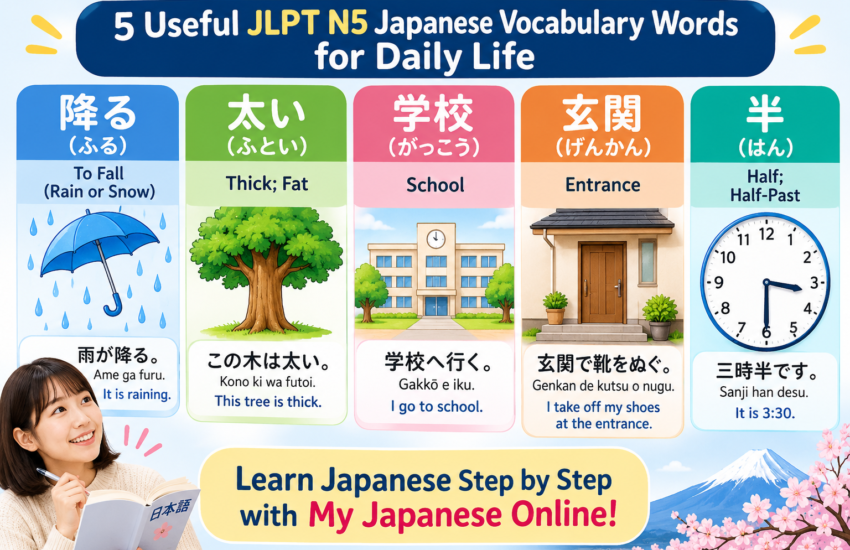
In this lesson, we will introduce five useful JLPT N5 vocabulary words related to weather, descriptions, school, home, and time.
Each word includes its Japanese reading, English meaning, example sentence, and a practical learning tip.
Let’s get started!
1. 降る[ふる] – To Fall (Rain or Snow)
Meaning: To fall, especially when talking about rain or snow.
降る[ふる] is a useful Japanese verb when discussing the weather.
You can use it to talk about rain, snow, and other types of precipitation.
Example Sentence:
昨日[きのう]、雪[ゆき]が降[ふ]りました。
English Translation: It snowed yesterday.
More Examples:
- 雨[あめ]が降[ふ]っています。
- It is raining.
- 明日[あした]、雪[ゆき]が降[ふ]るでしょう。
- It will probably snow tomorrow.
Learning Tip:
Remember this simple pattern:
- 雨が降る – It rains.
- 雪が降る – It snows.
Practice using 降る[ふる] when talking about the weather.
2. 太い[ふとい] – Thick; Fat
Meaning: Thick or fat, depending on the object being described.
太い[ふとい] is an い-adjective used to describe something with a large width or thickness.
It can describe trees, ropes, pencils, and other objects. When describing a person’s body, it can mean fat or thick and may sound insensitive depending on the context.
Example Sentence:
この木[き]はとても太[ふと]いです。
English Translation: This tree is very thick.
More Examples:
- このペンは太[ふと]いです。
- This pen is thick.
- 太[ふと]い木[き]があります。
- There is a thick tree.
Learning Tip:
Remember the opposite adjective:
- 太い[ふとい] – Thick
- 細い[ほそい] – Thin
Learning opposite adjectives together can make vocabulary easier to remember.
3. 学校[がっこう] – School
Meaning: School.
学校[がっこう] is one of the most useful beginner-level Japanese nouns.
You can use it when talking about studying, attending classes, or describing your daily routine.
Example Sentence:
毎朝[まいあさ]学校[がっこう]へ行[い]きます。
English Translation: I go to school every morning.
More Examples:
- 学校[がっこう]で日本語[にほんご]を勉強[べんきょう]します。
- I study Japanese at school.
- 私[わたし]の学校[がっこう]は大[おお]きいです。
- My school is big.
Learning Tip:
Remember these useful expressions:
- 学校へ行く – To go to school.
- 学校で勉強する – To study at school.
- 学校の先生 – School teacher.
Try making three sentences about your school or studies.
4. 玄関[げんかん] – Entrance
Meaning: Entrance or entryway of a home or building.
玄関[げんかん] is an important word when learning about Japanese homes and everyday culture.
In many Japanese homes, the 玄関 is the entrance area where people remove their shoes before entering the main living space.
Example Sentence:
玄関[げんかん]で靴[くつ]をぬぎます。
English Translation: I take off my shoes at the entrance.
More Examples:
- 玄関[げんかん]に靴[くつ]があります。
- There are shoes at the entrance.
- 玄関[げんかん]を掃除[そうじ]します。
- I clean the entrance.
Learning Tip:
Connect 玄関[げんかん] with these useful Japanese words:
- 靴[くつ] – Shoes
- 家[いえ] – House
- 入る[はいる] – To enter
- 掃除[そうじ] – Cleaning
Understanding vocabulary through everyday situations makes it easier to remember.
5. 半[はん] – Half; Half-Past
Meaning: Half; used when expressing half an hour or 30 minutes past an hour.
半[はん] is commonly used when talking about time in Japanese.
For example, 三時半[さんじはん] means 3:30.
Example Sentence:
今[いま]は三時半[さんじはん]です。
English Translation: It is 3:30 now.
More Examples:
- 七時半[しちじはん]に起[お]きます。
- I wake up at 7:30.
- 授業[じゅぎょう]は九時半[くじはん]からです。
- The class starts at 9:30.
Learning Tip:
Remember these common time expressions:
- 一時半[いちじはん] – 1:30
- 三時半[さんじはん] – 3:30
- 五時半[ごじはん] – 5:30
- 七時半[しちじはん] – 7:30
Practice saying different times aloud to improve your Japanese speaking skills.
Quick Review: 5 JLPT N5 Vocabulary Words
| Japanese | Reading | English Meaning |
| 降る | ふる | To fall (rain/snow) |
| 太い | ふとい | Thick; fat |
| 学校 | がっこう | School |
| 玄関 | げんかん | Entrance |
| 半 | はん | Half; half-past |
Mini JLPT N5 Vocabulary Quiz
Test your understanding of today’s five Japanese words!
1. What does 降る[ふる] mean?
A. To eat
B. To fall (rain/snow)
C. To study
Answer: B. To fall (rain/snow).
2. Which Japanese word means school?
A. 学校
B. 玄関
C. 太い
Answer: A. 学校.
3. What does 太い[ふとい] mean?
A. Thin
B. Small
C. Thick
Answer: C. Thick.
4. What does 玄関[げんかん] mean?
A. Entrance
B. Classroom
C. Kitchen
Answer: A. Entrance.
5. What does 三時半[さんじはん] mean?
A. 3:00
B. 3:30
C. 4:30
Answer: B. 3:30.
Practical Learning Tip: How to Remember Japanese Vocabulary
Learning five new words is a good start, but reviewing them regularly is equally important.
Try this simple daily study routine:
- Read each Japanese word aloud three times.
- Memorize its reading and English meaning.
- Read the example sentence carefully.
- Write each vocabulary word in a notebook.
- Create one original Japanese sentence using each word.
- Review the vocabulary again the following day.
Bonus Challenge: Try describing your daily routine using 学校[がっこう], 玄関[げんかん], and 半[はん]. You can also make a sentence about the weather using 降る[ふる].
Small and consistent practice can help you build a stronger Japanese vocabulary.
Frequently Asked Questions (FAQs)
1. What is JLPT N5 Japanese vocabulary?
JLPT N5 Japanese vocabulary refers to beginner-level words that learners study to develop basic Japanese reading and communication skills.
2. How many Japanese vocabulary words should I learn every day?
Start with three to five words per day. Focus on understanding their meanings, readings, and example sentences rather than memorizing too many words at once.
3. How can I remember Japanese vocabulary easily?
Use vocabulary in example sentences, read the words aloud, write them down, and review them regularly.
4. Is learning vocabulary important for JLPT N5 preparation?
Yes. Vocabulary is an important part of beginner Japanese learning and JLPT preparation. Combine vocabulary study with grammar, kanji, reading, and listening practice.
5. Can I learn Japanese vocabulary without attending classes?
You can begin learning independently with books, online resources, and daily practice. However, structured lessons and teacher feedback can help you identify mistakes and improve your communication skills.
Learn Japanese Step by Step with My Japanese Online
Learning Japanese becomes easier when you follow a structured study plan and practice consistently.
At My Japanese Online, we provide Japanese language lessons for beginners and advanced learners, including JLPT preparation courses from N5 to N1.
Our lessons are taught by licensed native Japanese teachers and focus on developing practical Japanese communication skills.
Whether you want to pass the JLPT, communicate confidently in daily life, or improve your Japanese for work, we can support your learning journey.
Start building your Japanese skills today!
Visit: https://myjapaneseonline.com/
Your Next Step: Daily Japanese Practice
Before moving to the next vocabulary lesson, complete this checklist:
- Memorize all five vocabulary words.
- Practice reading each word aloud.
- Write five example sentences.
- Complete the mini vocabulary quiz.
- Review today’s words tomorrow.
Remember: Learn a little Japanese every day, and keep moving forward!
Internal Link Suggestions
- JLPT Courses: https://myjapaneseonline.com/
- Related vocabulary article: https://myjapaneseonline.com/blog/jlpt-n5-japanese-vocabulary/
- Daily JLPT Vocabulary: https://myjapaneseonline.com/blog/jlpt-daily-vocabulary/
External Official Link
- JLPT Official Website: https://www.jlpt.jp/e/
JLPT schedules and rules can change. Always confirm the latest information on the official JLPT website.
WhatsApp Blog Promotion Message
📘 New Blog for Japanese Learners 🇯🇵
Today’s topic: 5 Useful JLPT N5 Japanese Vocabulary Words for Daily Life!
Learn five practical Japanese words with meanings, readings, example sentences, and easy learning tips.
Improve your Japanese vocabulary step by step!
🔗 Read the blog:https://myjapaneseonline.com/blog/
📚 Keep learning Japanese every day with My Japanese Online!