
 Posted by
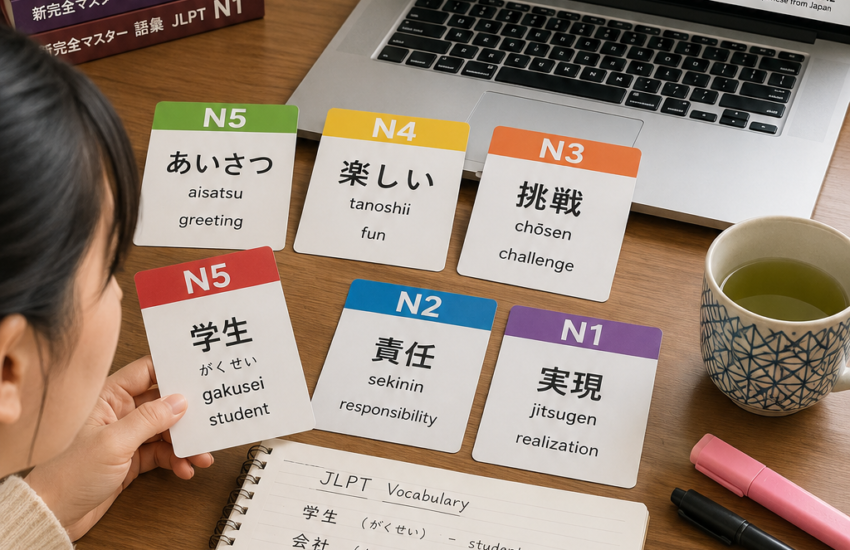
 Learning Japanese doesn’t have to feel overwhelming. One of the most effective ways to improve your Japanese is by studying a few new words every day and using them in real-life situations.
In today’s Daily JLPT Vocabulary – Day 31, you’ll learn useful vocabulary from JLPT N5 to N1, complete with English meanings and example sentences. Whether you’re just beginning your Japanese journey or preparing for the highest JLPT level, these words will help expand your vocabulary naturally.
Table of Contents
Introduction
Why Study Daily JLPT Vocabulary Every Day?
Daily JLPT Vocabulary for JLPT N5
Daily JLPT Vocabulary for JLPT N4
Daily JLPT Vocabulary for JLPT N3
Daily JLPT Vocabulary for JLPT N2
Daily JLPT Vocabulary for JLPT N1
Study Tip
FAQ
Conclusion
Why Study Daily JLPT Vocabulary Every Day?
Daily vocabulary practice helps you:
- Build long-term memory through consistent learning.
- Improve reading, listening, speaking, and writing.
- Understand Japanese conversations more naturally.
- Prepare effectively for every JLPT level.
- Gain confidence using Japanese in daily life and at work.
Even studying just five to ten words each day can make a significant difference over time.
Daily JLPT Vocabulary for JLPT N5
本(ほん)— Book; Volume; Script
Example
私は毎日本を読みます。
(わたし は まいにち ほん を よみます。)
Translation: I read a book every day.
Learning Tip: Try reading a few pages of a simple Japanese book every day to strengthen your vocabulary.
いかが — How? How about?
Example
コーヒーはいかがですか。
Translation: How about some coffee?
This expression is a polite way to offer something and is commonly heard in restaurants and shops.
入口(いりぐち)— Entrance
Example
入口はあそこです。
Translation: The entrance is over there.
You’ll frequently see 入口 on station signs, shopping malls, hospitals, and office buildings.
引く(ひく)— To Pull
Example
ドアを引いてください。
Translation: Please pull the door.
Many automatic and manual doors in Japan display 引 (pull) or 押 (push).
鼻(はな)— Nose
Example
風邪で鼻がつまっています。
Translation: My nose is blocked because of a cold.
Useful vocabulary when visiting a clinic or pharmacy in Japan.
Daily JLPT Vocabulary for JLPT N4
引っ越す(ひっこす)— To Move House
Example
来月、東京に引っ越します。
Translation: I will move to Tokyo next month.
翻訳(ほんやく)— Translation
Example
この本を英語に翻訳します。
Translation: I will translate this book into English.
医学(いがく)— Medical Science
Example
兄は大学で医学を勉強しています。
Translation: My older brother is studying medicine at university.
いっぱい — Full
Example
お腹がいっぱいです。
Translation: I am full.
This expression is commonly used after meals.
時代(じだい)— Era; Period
Example
これは古い時代の写真です。
Translation: This is a photo from an old era.
Daily JLPT Vocabulary for JLPT N3
学ぶ(まなぶ)— To Learn Deeply
Unlike 勉強する, which means “to study,” 学ぶ often refers to gaining deeper knowledge through experience and understanding.
Example
私は日本語を学んでいます。
Translation: I am studying Japanese.
お昼(おひる)— Noon; Lunch
Example
お昼に友達とご飯を食べます。
Translation: I will eat lunch with my friend.
製品(せいひん)— Product
Example
この会社は新しい製品を作りました。
Translation: This company made a new product.
商品(しょうひん)— Merchandise; Goods
Example
店には安い商品がたくさんあります。
Translation: There are many inexpensive products in the store.
徹夜(てつや)— Staying Up All Night
Example
試験の前に徹夜しました。
Translation: I stayed up all night before the exam.
Although many students do this before exams, regular study habits are much more effective than staying up all night.
Daily JLPT Vocabulary for JLPT N2
見比べる(みくらべる)— To Compare Carefully
Example
二つの写真を見比べます。
Translation: I compare the two photographs.
取り返す(とりかえす)— To Regain
Example
失くした時間を取り返したいです。
Translation: I want to regain the lost time.
引き受ける(ひきうける)— To Accept Responsibility
Example
その仕事を引き受けました。
Translation: I accepted that job.
Often used in business situations when accepting tasks or responsibilities.
成績が上がる — Grades Improve
Example
たくさん勉強して、成績が上がりました。
Translation: I studied hard, and my grades improved.
予想が当たる — Prediction Comes True
Example
彼の予想が当たりました。
Translation: His prediction was correct.
Daily JLPT Vocabulary for JLPT N1
再利用(さいりよう)— Reuse
Example
この紙は再利用できます。
Translation: This paper can be reused.
純金(じゅんきん)— Pure Gold
Example
これは純金の指輪です。
Translation: This is a pure gold ring.
勝ちまくる(かちまくる)— To Keep Winning
Example
そのチームは大会で勝ちまくりました。
Translation: That team kept winning throughout the tournament.
ぎっしり — Packed Full
Example
箱には本がぎっしり入っています。
Translation: The box is tightly packed with books.
くすくす — Giggle Softly
Example
子供たちがくすくす笑っています。
Translation: The children are giggling softly.
This adverb describes quiet, restrained laughter.
Vocabulary Spotlight
| Word | Meaning | JLPT |
| 本 | Book | N5 |
| 引っ越す | Move house | N4 |
| 学ぶ | Learn deeply | N3 |
| 引き受ける | Accept responsibility | N2 |
| 再利用 | Reuse | N1 |
Practical Study Tip
Don’t just memorize vocabulary lists. Try to:
- Write one original sentence using each new word.
- Say the sentence aloud.
- Review yesterday’s vocabulary before learning today’s.
- Use flashcards or spaced repetition apps for long-term retention.
Consistency is more effective than studying for many hours only once a week.
Frequently Asked Questions
How many vocabulary words should I study every day?
Learning 5–10 new words daily while reviewing older vocabulary is a sustainable pace for most learners.
Is learning vocabulary enough to pass the JLPT?
Vocabulary is essential, but you should also study grammar, kanji, reading comprehension, and listening.
What is the best way to remember Japanese vocabulary?
Practice using new words in your own sentences, review them regularly, and encounter them in real reading and listening materials.
Which JLPT level should beginners start with?
Most beginners start with JLPT N5 before progressing to higher levels.
Internal Link Suggestions
Help readers continue their learning with these My Japanese Online resources:
- Online Japanese Classes – https://myjapaneseonline.com/
- More Japanese Learning Articles – https://myjapaneseonline.com/blog/
External Official Resources
For additional Japanese learning support, visit these trusted resources:
- Official JLPT Website: https://www.jlpt.jp/e/
- Japan Foundation: https://www.jpf.go.jp/e/
- NHK World Easy Japanese: https://www3.nhk.or.jp/nhkworld/en/learnjapanese/
- Japan Foundation Japanese-Language Learning Portal (JF Japanese e-Learning): https://minato-jf.jp/
Your Next Step
Learning Japanese becomes much easier when you study consistently. Make daily vocabulary practice part of your routine, review what you’ve learned regularly, and try using new words in conversations or writing.
If you’re looking for structured guidance from licensed native Japanese teachers, My Japanese Online offers online Japanese courses from JLPT N5 to N1, along with Business Japanese and private lessons designed to help learners achieve their goals step by step.