
 Posted by
 JLPT N4 vocabulary** is one of the most important areas to master if you’re preparing for the Japanese Language Proficiency Test. Learning JLPT N4 vocabulary every day helps you improve reading, listening, speaking, and overall communication in Japanese
At the JLPT N4 level, you’ll begin using more practical words that appear in daily conversations, news, schools, workplaces, and everyday situations. Instead of memorizing long vocabulary lists, it’s much more effective to learn words in context through real-life examples.
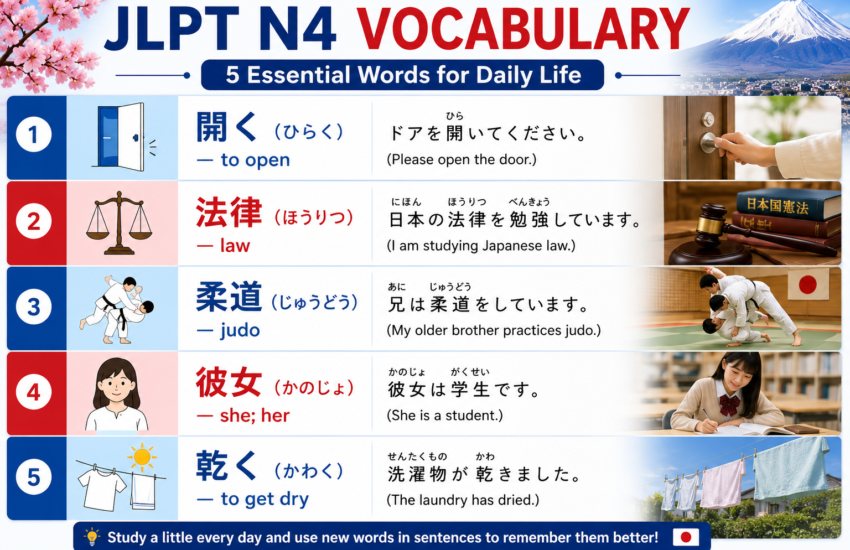
In today’s lesson, we’ll explore five useful JLPT N4 vocabulary words, learn their meanings, study example sentences, and discover how you can remember them more effectively.
Table of Contents
- Why Learn JLPT N4 Vocabulary Every Day?
- JLPT N4 Vocabulary: 開く(ひらく)— To Open
- JLPT N4 Vocabulary: 法律(ほうりつ)— Law
- JLPT N4 Vocabulary: 柔道(じゅうどう)— Judo
- JLPT N4 Vocabulary: 彼女(かのじょ)— She / Her / Girlfriend
- JLPT N4 Vocabulary: 乾く(かわく)— To Get Dry
- JLPT N4 Vocabulary Summary
- How to Improve Your JLPT N4 Vocabulary Every Day
- Frequently Asked Questions About JLPT N4 Vocabulary
- Continue Learning with My Japanese Online
Why Is Daily Vocabulary Practice Important?
Vocabulary is the building block of communication. Even if you know grammar well, it’s difficult to understand conversations or express yourself without enough words.
Daily vocabulary practice helps you:
- Improve listening comprehension.
- Read Japanese signs, notices, and articles more confidently.
- Express yourself naturally in conversations.
- Build confidence for the JLPT N4 examination.
- Expand your understanding of Japanese culture and daily life.
A simple habit of learning five new words every day can significantly improve your Japanese over time.
1. 開く(ひらく)— To Open
Reading: ひらく
Meaning: To open
Example Sentence
ドアを開いてください。
Translation: Please open the door.
Additional Examples
店が開きます。
The shop opens.
会議を開きます。
Hold a meeting.
Usage Tip
The verb 開く(ひらく) is commonly used when talking about opening doors, windows, shops, events, meetings, or ceremonies. Depending on the context and the object being opened, Japanese also uses 開ける(あける), so it’s helpful to become familiar with both verbs as you continue your studies.
2. 法律(ほうりつ)— Law
Reading: ほうりつ
Meaning: Law
Example Sentence
日本の法律を勉強しています。
Translation: I am studying Japanese law.
Where You’ll See This Word
You’ll often encounter 法律 in:
- Government websites
- Immigration information
- News reports
- University courses
- Legal documents
- Public announcements
Understanding this word is especially useful if you’re living, studying, or working in Japan.
Related Vocabulary
- 弁護士(べんごし)— Lawyer
- 裁判(さいばん)— Trial
- 規則(きそく)— Rule
3. 柔道(じゅうどう)— Judo
Reading: じゅうどう
Meaning: Judo
Example Sentence
兄は柔道をしています。
Translation: My older brother practices judo.
About Judo
Judo is one of Japan’s most famous martial arts and is practiced around the world. Learning sports-related vocabulary helps you talk about hobbies, school activities, and personal interests.
More Examples
柔道が好きです。
I like judo.
学校で柔道を習いました。
I learned judo at school.
Related Vocabulary
- 空手(からて)— Karate
- 剣道(けんどう)— Kendo
- スポーツ — Sports
4. 彼女(かのじょ)— She / Her / Girlfriend
Reading: かのじょ
Meaning:
- She
- Her
- Girlfriend (depending on context)
Example Sentence
彼女は学生です。
Translation: She is a student.
Important Usage Note
Japanese often relies on context. The word 彼女 may simply refer to “she” or “her,” but it can also mean “girlfriend” in casual conversation.
For example:
彼女は医者です。
She is a doctor.
彼女がいます。
I have a girlfriend.
Understanding the surrounding conversation will help you identify the intended meaning.
5. 乾く(かわく)— To Get Dry
Reading: かわく
Meaning: To become dry
Example Sentence
洗濯物が乾きました。
Translation: The laundry has dried.
More Examples
髪が乾きました。
My hair has dried.
道が乾いています。
The road is dry.
Usage Tip
You’ll frequently hear 乾く when discussing weather, laundry, hair, towels, roads, paint, or anything that becomes dry naturally.
Vocabulary Summary
| Japanese | Reading | Meaning |
| 開く | ひらく | To open |
| 法律 | ほうりつ | Law |
| 柔道 | じゅうどう | Judo |
| 彼女 | かのじょ | She / Her / Girlfriend |
| 乾く | かわく | To get dry |
Effective Study Tips for JLPT N4 Vocabulary
Learning vocabulary is much easier when you actively use new words instead of simply memorizing them.
Here are a few strategies that work well:
- Learn 5–10 new words each day.
- Read every example sentence aloud.
- Write your own sentence using each new word.
- Review previous vocabulary regularly.
- Practice listening to native Japanese speakers.
- Use flashcards or spaced repetition apps to reinforce your memory.
Consistency is more important than studying large amounts of vocabulary at once.
Frequently Asked Questions
Is this vocabulary included in JLPT N4?
Yes. These words are commonly studied at the JLPT N4 level and frequently appear in everyday Japanese conversations and learning materials.
How many vocabulary words should I learn every day?
For most learners, studying between five and ten new words daily while reviewing older vocabulary provides steady progress without becoming overwhelming.
What’s the best way to remember Japanese vocabulary?
Using new vocabulary in speaking, writing, reading, and listening activities is far more effective than memorization alone. Creating your own example sentences and reviewing them regularly helps move words into long-term memory.
Is vocabulary alone enough to pass JLPT N4?
No. Vocabulary is only one part of the exam. You should also study grammar, kanji, reading comprehension, and listening skills to prepare thoroughly for the JLPT N4 examination.
Continue Your Japanese Learning Journey
Building your vocabulary one day at a time is one of the most effective ways to improve your Japanese. By studying words in context and practicing them regularly, you’ll become more confident in conversations and better prepared for the JLPT.
At My Japanese Online, we offer structured online Japanese courses from JLPT N5 to N1, taught by Native Certified Japanese Teachers. Our live interactive classes focus on vocabulary, grammar, kanji, reading, listening, and real-life communication to help you achieve your Japanese language goals.
Whether you’re preparing for the JLPT, planning to study in Japan, or improving your Japanese for work or daily life, we’re here to support your learning every step of the way.
Start learning Japanese from Japan with My Japanese Online and take the next step toward fluency!
JLPT Courses:https://myjapaneseonline.com/jlpt-courses/
Online Japanese Classes:https://myjapaneseonline.com/
Contact Our Team:https://myjapaneseonline.com/#enquiry