
 Posted by
 Daily JLPT Vocabulary is one of the easiest ways to improve your Japanese every day. Learning a few new words regularly helps you build confidence for the JLPT, understand native conversations, and communicate naturally. In today’s Daily JLPT Vocabulary lesson, you’ll learn 25 practical words from JLPT N5 to N1 with meanings, example sentences, and useful study tips.
Learning vocabulary is one of the best ways to improve your Japanese. Every new word helps you understand conversations, read with confidence, and prepare for the JLPT.
If you’re studying for the JLPT, explore our JLPT Online Courses (N5–N1) to learn vocabulary, grammar, kanji, and exam strategies with licensed native Japanese teachers.
Table of Contents
- What Is Daily JLPT Vocabulary?
- JLPT N5 Vocabulary
- JLPT N4 Vocabulary
- JLPT N3 Vocabulary
- JLPT N2 Vocabulary
- JLPT N1 Vocabulary
- Study Tips
- Frequently Asked Questions
- Continue Learning Japanese
🌱 JLPT N5 Vocabulary
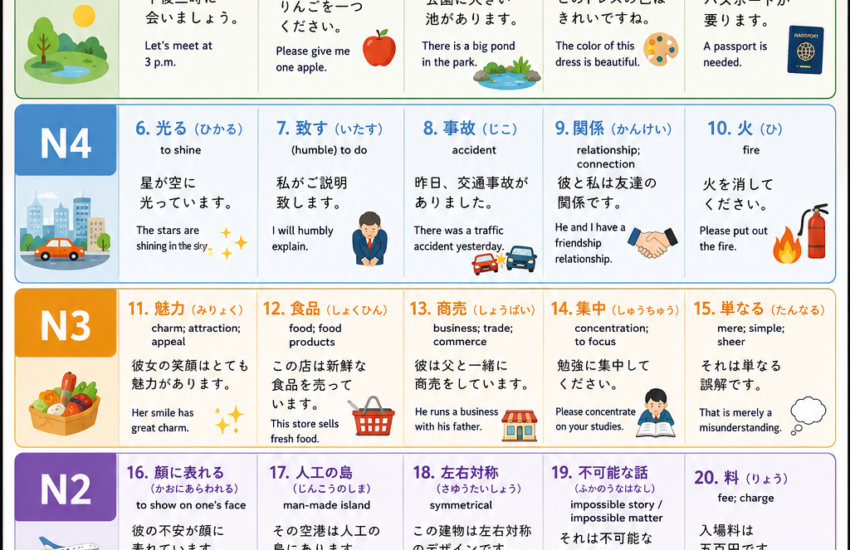
1. 午後(ごご)
Meaning: Afternoon; P.M.
Part of Speech: Noun
Example 1
午後三時に会いましょう。
Let’s meet at 3 p.m.
Example 2
午後は日本語を勉強します。
I study Japanese in the afternoon.
2. 一つ(ひとつ)
Meaning: One (general counter)
Part of Speech: Counter
Example 1
りんごを一つください。
Please give me one apple.
Example 2
質問が一つあります。
I have one question.
3. 池(いけ)
Meaning: Pond
Part of Speech: Noun
Example 1
公園に大きい池があります。
There is a big pond in the park.
Example 2
池で魚を見ました。
I saw fish in the pond.
4. 色(いろ)
Meaning: Color
Part of Speech: Noun
Example 1
このドレスの色はきれいですね。
The color of this dress is beautiful.
Example 2
青い色が好きです。
I like the color blue.
5. 要る(いる)
Meaning: To need
Part of Speech: Godan Verb
Example 1
パスポートが要ります。
A passport is needed.
Example 2
明日は傘が要ります。
You will need an umbrella tomorrow.
🌸 JLPT N4 Vocabulary
6. 光る(ひかる)
Meaning: To shine
Part of Speech: Godan Verb
Example 1
星が空に光っています。
The stars are shining in the sky.
Example 2
海が太陽に光っています。
The sea is shining in the sunlight.
7. 致す(いたす)
Meaning: To do (humble expression)
Part of Speech: Verb
Example 1
私がご説明致します。
I will humbly explain.
Example 2
よろしくお願い致します。
Thank you in advance.
8. 事故(じこ)
Meaning: Accident
Part of Speech: Noun
Example 1
昨日、交通事故がありました。
There was a traffic accident yesterday.
Example 2
事故に気を付けてください。
Please be careful of accidents.
9. 関係(かんけい)
Meaning: Relationship; Connection
Part of Speech: Noun
Example 1
彼と私は友達の関係です。
He and I are friends.
Example 2
仕事と健康には深い関係があります。
Work and health are closely related.
10. 火(ひ)
Meaning: Fire
Part of Speech: Noun
Example 1
火を消してください。
Please put out the fire.
Example 2
火は危ないです。
Fire is dangerous.
📚 JLPT N3 Vocabulary
11. 魅力(みりょく)
Meaning: Charm; Attraction
Part of Speech: Noun
Example 1
彼女の笑顔はとても魅力があります。
Her smile is very charming.
Example 2
京都には多くの魅力があります。
Kyoto has many attractions.
12. 食品(しょくひん)
Meaning: Food products
Part of Speech: Noun
Example 1
この店は新鮮な食品を売っています。
This store sells fresh food.
Example 2
冷凍食品を買いました。
I bought frozen food.
13. 商売(しょうばい)
Meaning: Business; Trade
Part of Speech: Noun
Example 1
彼は父と商売をしています。
He runs a business with his father.
Example 2
商売は順調です。
Business is going well.
14. 集中(しゅうちゅう)
Meaning: Concentration; Focus
Part of Speech: Noun / Suru Verb
Example 1
勉強に集中してください。
Please concentrate on your studies.
Example 2
仕事に集中しています。
I am concentrating on my work.
15. 単なる(たんなる)
Meaning: Mere; Simple
Part of Speech: Na-adjective
Example 1
それは単なる誤解です。
That is simply a misunderstanding.
Example 2
単なる冗談でした。
It was just a joke.
🎓 JLPT N2 Vocabulary
16. 顔に表れる(かおにあらわれる)
Meaning: To show on one’s face
Part of Speech: Expression
Example 1
彼の不安が顔に表れています。
His anxiety is showing on his face.
Example 2
喜びが顔に表れました。
Joy appeared on her face.
17. 人工の島(じんこうのしま)
Meaning: Man-made island
Part of Speech: Noun Phrase
Example 1
その空港は人工の島にあります。
The airport is on a man-made island.
Example 2
人工の島には多くの建物があります。
There are many buildings on the artificial island.
18. 左右対称(さゆうたいしょう)
Meaning: Symmetrical
Part of Speech: Na-adjective
Example 1
この建物は左右対称です。
This building is symmetrical.
Example 2
蝶の羽は左右対称です。
A butterfly’s wings are symmetrical.
19. 不可能な話(ふかのうなはなし)
Meaning: Impossible matter
Part of Speech: Expression
Example 1
それは不可能な話です。
That is impossible.
Example 2
時間がないので不可能な話です。
Without enough time, it is impossible.
20. 料(りょう)
Meaning: Fee; Charge
Part of Speech: Suffix
Example 1
入場料は500円です。
The entrance fee is 500 yen.
Example 2
送料は無料です。
Shipping is free.
🏆 JLPT N1 Vocabulary
21. 手を引く(てをひく)
Meaning: To withdraw; Pull back
Part of Speech: Idiom
Example 1
彼はその計画から手を引きました。
He withdrew from the project.
Example 2
会社はその事業から手を引きました。
The company withdrew from the business.
22. 足が棒になる(あしがぼうになる)
Meaning: Legs become stiff from walking
Part of Speech: Idiom
Example 1
たくさん歩いて足が棒になりました。
I walked so much that my legs became stiff.
Example 2
旅行の後、足が棒になりました。
After the trip, my legs were exhausted.
23. 鼻にかける(はなにかける)
Meaning: To boast; Show off
Part of Speech: Idiom
Example 1
彼は成功を鼻にかけています。
He boasts about his success.
Example 2
彼女は英語が話せることを鼻にかけています。
She shows off her English ability.
24. 顔色をうかがう(かおいろをうかがう)
Meaning: To read someone’s expression
Part of Speech: Idiom
Example 1
彼は上司の顔色をうかがっています。
He is watching his boss’s expression.
Example 2
子どもは母親の顔色をうかがいました。
The child watched his mother’s expression.
25. 首をかしげる(くびをかしげる)
Meaning: To tilt one’s head in doubt
Part of Speech: Idiom
Example 1
彼女はその答えに首をかしげました。
She tilted her head in doubt.
Example 2
そのニュースを聞いて皆が首をかしげました。
Everyone looked puzzled after hearing the news.
Continue Learning with My Japanese Online
Whether you’re preparing for JLPT N5, N4, N3, N2, or N1, or improving your Business Japanese, we’re here to support your learning journey.
✔ Live online lessons
✔ Licensed native Japanese teachers
✔ Private and group classes
✔ Business Japanese training
✔ JLPT preparation from beginner to advanced
🌐 Website: https://myjapaneseonline.com
📚 Read More Blogs: https://myjapaneseonline.com/blog
📩 Contact Us: https://myjapaneseonline.com/contact
External Resources
- Official JLPT Website: https://www.jlpt.jp/
- Japan Foundation: https://www.jpf.go.jp/