
 Posted by
 Learning Japanese becomes easier when you study words you can actually use in daily life. Whether you are preparing for the JLPT, living in Japan, working in a Japanese company, or planning a trip, practical vocabulary helps you communicate naturally and confidently.
In this article, we introduce useful JLPT vocabulary from N5 to N1 levels with meanings, example sentences, and English translations. These words are commonly used in conversations, workplaces, schools, transportation, and everyday situations.
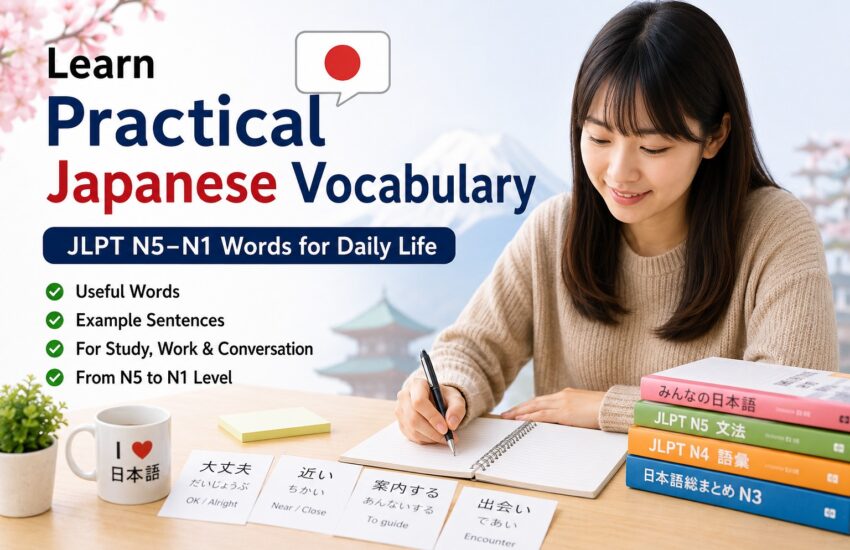
[IMAGE: Japanese learner studying vocabulary while living daily life in Japan]
Table of Contents
- Practical Japanese Vocabulary for Beginners
- JLPT N5 Practical Japanese Vocabulary
- JLPT N4 Practical Japanese Vocabulary
- JLPT N3 Practical Japanese Vocabulary
- JLPT N2 Practical Japanese Vocabulary
- JLPT N1 Practical Japanese Vocabulary
- Practical Japanese Vocabulary Learning Tips
- FAQ
Why Practical Vocabulary Matters
Many students memorize vocabulary only for exams. However, learning practical words helps you:
- Understand real conversations
- Improve speaking confidence
- Read signs, menus, and documents
- Communicate at work or school
- Prepare for JLPT naturally
The more you connect vocabulary to real situations, the easier it becomes to remember.
JLPT N5 Vocabulary
どっち — Which One?
Meaning
Which; which one
Example
どっちがいいですか。
(Which one is better?)
This is a very common word when choosing between two things.
Practical Situation
- Choosing food
- Picking clothes
- Asking for opinions
動物(どうぶつ)— Animal
Example
動物(どうぶつ)が好(す)きです。
(I like animals.)
Useful for:
- Daily conversation
- Talking about pets
- Visiting zoos or parks
映画(えいが)— Movie
Example
映画(えいが)を見(み)ます。
(I watch a movie.)
This word is commonly used when discussing hobbies and entertainment.
大丈夫(だいじょうぶ)— OK; Alright
Example
大丈夫(だいじょうぶ)です。ありがとう。
(It’s okay. Thank you.)
One of the most useful Japanese expressions for beginners.
Common Uses
- “I’m okay.”
- “No problem.”
- “It’s safe.”
近い(ちかい)— Near; Close
Example
駅(えき)は近(ちか)いです。
(The station is near.)
Very useful when asking about locations in Japan.
JLPT N4 Vocabulary
チェックする — To Check
Example
書類(しょるい)をチェックします。
(I check the documents.)
Frequently used in offices, schools, and daily life.
電灯(でんとう)— Electric Light
Example
電灯(でんとう)をつけます。
(I turn on the light.)
Useful household vocabulary for beginners.
ガラス — Glass
Example
窓(まど)はガラスです。
(The window is made of glass.)
This word comes from Portuguese and is widely used in Japanese.
案内(あんない)する — To Guide
Example
駅(えき)まで案内(あんない)します。
(I will guide you to the station.)
Important for:
- Travel situations
- Customer service
- Workplace communication
倍(ばい)— Double
Example
料金(りょうきん)が二倍(にばい)です。
(The price is double.)
Useful when talking about prices, quantities, and statistics.
JLPT N3 Vocabulary
出会い(であい)— Encounter; Meeting
Example
大切(たいせつ)な出会い(であい)でした。
(It was an important encounter.)
This word often appears in emotional or meaningful conversations.
博物館(はくぶつかん)— Museum
Example
博物館(はくぶつかん)へ行(い)きます。
(I go to the museum.)
Useful for travelers and cultural discussions.
国会(こっかい)— National Diet
Example
国会(こっかい)で話(はな)し合(あ)います。
(They discuss it in the National Diet.)
Important vocabulary for reading Japanese news.
今回(こんかい)— This Time
Example
今回(こんかい)は成功(せいこう)しました。
(This time, it was a success.)
A very common word in conversation and writing.
教科書(きょうかしょ)— Textbook
Example
教科書(きょうかしょ)を読(よ)みます。
(I read the textbook.)
Useful for students preparing for JLPT exams.
JLPT N2 Vocabulary
自習(じしゅう)する — To Self-Study
Example
家(いえ)で自習(じしゅう)します。
(I study by myself at home.)
Self-study is very important for JLPT success.
Study Tip
Create a daily study schedule and review vocabulary regularly.
加速(かそく)する — To Accelerate
Example
車(くるま)が加速(かそく)します。
(The car accelerates.)
Often used in news, technology, and business contexts.
木材(もくざい)— Lumber; Timber
Example
家(いえ)は木材(もくざい)で作(つく)られています。
(The house is made of wood.)
Useful for architecture and construction topics.
刺す(さす)— To Stab; To Prick
Example
とげが指(ゆび)を刺(さ)しました。
(A thorn pricked my finger.)
This word can appear in daily life and medical situations.
速力(そくりょく)— Speed
Example
この道路(どうろ)は速度制限(そくどせいげん)が時速(じそく)60キロです。
(The speed limit on this road is 60 km/h.)
Useful for driving and transportation topics.
JLPT N1 Vocabulary
メリットが多い — Have Many Advantages
Example
この仕事(しごと)はメリットが多(おお)いです。
(This job has many advantages.)
Frequently used in business discussions and presentations.
15日以降(じゅうごにちいこう)— After the 15th
Example
15日以降(じゅうごにちいこう)に来(き)てください。
(Please come after the 15th.)
Useful for schedules, appointments, and office communication.
勤務シフト(きんむシフト)— Work Shift
Example
勤務(きんむ)シフトを確認(かくにん)します。
(I check my work shift.)
Important vocabulary for workers in Japan.
トータルな目標(もくひょう)— Overall Goal
Example
トータルな目標(もくひょう)を立(た)てます。
(I set an overall goal.)
Useful for business, education, and self-improvement.
じめじめ — Damp; Humid
Example
今日はじめじめして嫌(いや)な天気(てんき)です。
(Today is humid and unpleasant.)
Very useful during Japan’s rainy season.
[IMAGE: Rainy and humid Japanese street during tsuyu season]
Practical Learning Tip
Instead of memorizing words alone, try using each vocabulary word in your own sentence. This helps improve memory and speaking ability faster.
You can also:
- Review vocabulary daily
- Listen to Japanese audio
- Practice speaking aloud
- Use vocabulary in real conversations
Vocabulary Summary Table
| Word | Meaning | JLPT Level |
| どっち | Which one | N5 |
| 大丈夫 | OK; alright | N5 |
| 案内する | To guide | N4 |
| 出会い | Encounter | N3 |
| 自習する | Self-study | N2 |
| 勤務シフト | Work shift | N1 |
FAQ
How can I remember Japanese vocabulary faster?
Practice vocabulary daily with example sentences and real conversations.
Is learning vocabulary enough for JLPT?
No. You should also study grammar, kanji, listening, and reading practice.
Which JLPT level should beginners start with?
Most beginners start with JLPT N5.
How many vocabulary words should I learn daily?
Even 5–10 words daily can create strong long-term improvement.
Can practical vocabulary improve speaking skills?
Yes. Practical vocabulary helps you communicate naturally in daily situations.
External Official Links
- Official JLPT Website: https://www.jlpt.jp/e/
- JLPT Information for Overseas: https://www.myjlpt.jp
Your Next Step
Choose 5 words from today’s list and create your own example sentences. Speaking and writing with vocabulary regularly will improve your Japanese naturally.
If you want structured Japanese lessons with licensed native Japanese teachers, My Japanese Online offers online Japanese courses from JLPT N5 to N1, Business Japanese lessons, and private classes for learners worldwide.
References
- Official JLPT Website
https://www.jlpt.jp/e/
Accessed: 2026-05-28 - MyJLPT Official Information
https://www.myjlpt.jp
Accessed: 2026-05-28
Here’s a short WhatsApp promotion message for the blog:
📘 New Blog for Japanese Learners
Practical Japanese Vocabulary for Daily Life (JLPT N5–N1)
Learn useful Japanese words, meanings, and example sentences for study, work, travel, and daily conversation in Japan.
Read here:
https://myjapaneseonline.com/blog/
🇯🇵 Learn Japanese step by step with My Japanese Online!