
 Posted by
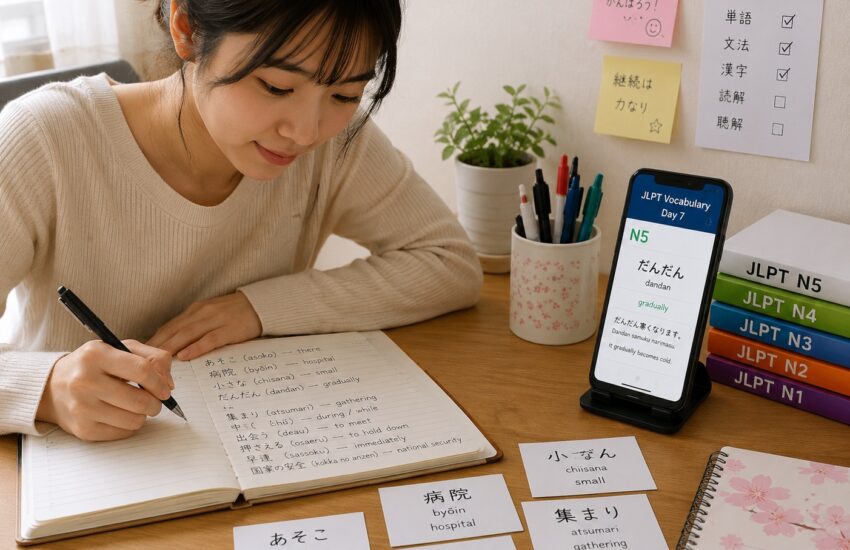
 Japanese vocabulary for daily life is one of the most important parts of learning Japanese naturally and confidently. Whether you are preparing for the JLPT, living in Japan, or studying for work and travel, practical vocabulary helps you communicate more smoothly every day.
In this Day 7 JLPT vocabulary collection, you will learn useful Japanese words from JLPT N5 to N1 with meanings, readings, and example sentences.
JLPT N5 Vocabulary – Basic Everyday Japanese
These beginner-level words are useful for daily conversations and simple communication.
📍 あそこ(asoko) — there; over there
Example:
あそこに学校[がっこう]があります。
(There is a school over there.)
🧈 バター(bataa) — butter
Example:
パンにバターをつけます。
(I put butter on bread.)
🏥 病院[びょういん](byouin) — hospital
Example:
病院[びょういん]へ行[い]きます。
(I am going to the hospital.)
🐭 小さな[ちいさな](chiisana) — small; little
Example:
小[ちい]さな犬[いぬ]です。
(It is a small dog.)
📉 だんだん(dandan) — gradually
Example:
だんだん寒[さむ]くなります。
(It gradually becomes cold.)
JLPT N4 Vocabulary – Useful Expressions for Daily Communication
JLPT N4 vocabulary helps learners speak more naturally in everyday situations.
👀 あんな(anna) — such; that kind of
Example:
あんな人[ひと]は知[し]りません。
(I don’t know such a person.)
😲 びっくり(bikkuri) — to be surprised
Example:
ニュースを聞[き]いてびっくりしました。
(I was surprised to hear the news.)
👧 ちゃん(chan) — familiar suffix
Example:
花子[はなこ]ちゃんは学生[がくせい]です。
(Hanako-chan is a student.)
🎓 大学生[だいがくせい](daigakusei) — university student
Example:
兄[あに]は大学生[だいがくせい]です。
(My older brother is a university student.)
🦁 動物園[どうぶつえん](doubutsuen) — zoo
Example:
動物園[どうぶつえん]へ行[い]きました。
(I went to the zoo.)
JLPT N3 Vocabulary – Intermediate Japanese for Work and Social Situations
At the N3 level, vocabulary becomes more practical for meetings, communication, and social interactions.
👥 集まり[あつまり](atsumari) — gathering; meeting
Example:
会社[かいしゃ]の集[あつ]まりがあります。
(There is a company meeting.)
⏰ 中[ちゅう](chuu) — during; while
Example:
会議[かいぎ]中[ちゅう]です。
(The meeting is in progress.)
🤝 出会う[であう](deau) — to meet by chance
Example:
駅[えき]で友達[ともだち]に出会[であ]いました。
(I ran into a friend at the station.)
✨ 品[ひん](hin) — elegance; article
Example:
品[ひん]のある人[ひと]です。
(He is an elegant person.)
⏳ 今に[いまに](imani) — before long
Example:
今[いま]に分[わ]かります。
(You’ll understand before long.)
JLPT N2 Vocabulary – Advanced Daily and Workplace Japanese
N2 vocabulary is useful for professional communication and understanding more complex situations.
🔄 回転[かいてん](kaiten) — rotation; turning
Example:
ドアが回転[かいてん]します。
(The door rotates.)
🏫 校庭[こうてい](koutei) — schoolyard
Example:
校庭[こうてい]で遊[あそ]びます。
(We play in the schoolyard.)
😨 真っ青[まっさお](massao) — deep blue; pale
Example:
顔[かお]が真[ま]っ青[さお]になりました。
(His face turned pale.)
✋ 押さえる[おさえる](osaeru) — to hold down
Example:
書類[しょるい]が飛[と]ばないように押[お]さえてください。
(Please hold down the documents so they don’t fly away.)
⚡ 早速[さっそく](sassoku) — immediately
Example:
早速[さっそく]始[はじ]めましょう。
(Let’s start right away.)
JLPT N1 Vocabulary – High-Level Japanese Expressions
These advanced words are often used in formal discussions, news, and professional environments.
🛡️ 国家の安全[こっかのあんぜん](kokka no anzen) — national security
Example:
国家[こっか]の安全[あんぜん]は重要[じゅうよう]です。
(National security is important.)
💱 通貨[つうか](tsuuka) — currency
Example:
日本[にほん]の通貨[つうか]は円[えん]です。
(Japan’s currency is the yen.)
🌊 洪水[こうずい](kouzui) — flood
Example:
洪水[こうずい]で道[みち]が使[つか]えません。
(The road cannot be used due to flooding.)
🎨 淡い緑[あわいみどり](awai midori) — pale green
Example:
淡い[あわい]緑[みどり]の服[ふく]を着[き]ています。
(She is wearing pale green clothes.)
📞 直ちに連絡する[ただちにれんらくする](tadachini renraku suru) — contact immediately
Example:
問題[もんだい]があれば直[ただ]ちに連絡[れんらく]してください。
(If there is a problem, contact me immediately.)
Practical Learning Tip
Instead of memorizing vocabulary alone, try using each word in your own sentence. Speaking and writing example sentences helps you remember vocabulary faster and improves your communication skills naturally.
A good daily study method is:
- Learn 5 new words
- Read the example sentences aloud
- Write one original sentence
- Review old vocabulary before learning new words
Small daily practice can build strong JLPT confidence over time.
Why Daily Vocabulary Practice Matters for JLPT
Consistent vocabulary study helps you:
- Improve reading speed
- Understand conversations more easily
- Prepare for JLPT listening sections
- Speak more naturally
- Build confidence step by step
Even studying for 10–15 minutes daily can make a big difference.
If you want structured JLPT preparation with licensed native Japanese teachers, My Japanese Online offers online Japanese lessons from JLPT N5 to N1 for learners worldwide.
FAQ
What is the best way to memorize JLPT vocabulary?
The best method is daily repetition with reading, listening, speaking, and example sentences.
Should I study vocabulary by JLPT level?
Yes. Studying by level helps you build vocabulary step by step without feeling overwhelmed.
How many vocabulary words should I learn daily?
Learning 5–15 words daily consistently is more effective than studying too many at once.
Are these words useful in real life?
Yes. Many of these vocabulary words are commonly used in daily conversations, schools, workplaces, and public places in Japan.
Can beginners start learning N5 vocabulary immediately?
Absolutely. N5 vocabulary is designed for beginner learners and everyday communication.
External Official Links
Your Next Step
✅ Choose 5 words from today’s list
✅ Read the example sentences aloud
✅ Create your own example sentence
✅ Review yesterday’s vocabulary
✅ Practice every day consistently
Daily practice leads to long-term Japanese improvement 🌱
Short WhatsApp Promotion Message
📘 New Blog for Japanese Learners
Today’s topic: Useful Japanese Vocabulary for Daily Life and Work (JLPT N5–N1)
Learn practical Japanese vocabulary with meanings, readings, and example sentences from N5 to N1.
Read here: https://whatsapp.com/channel/0029Vb74C2T0wajtXvwo5r0p
References
- Official JLPT Website
https://www.jlpt.jp/e/
Accessed: 2026-05-17 - MyJLPT Official Portal
https://www.jlpt-overseas.jp/onlineresults/preinput.do
Accessed: 2026-05-17