
 Posted by
 Introduction
JLPT N1 vocabulary includes many expressive words and phrases that help advanced learners understand natural Japanese conversations. Learning these expressions in context can help you describe feelings, attitudes, and everyday situations more accurately.
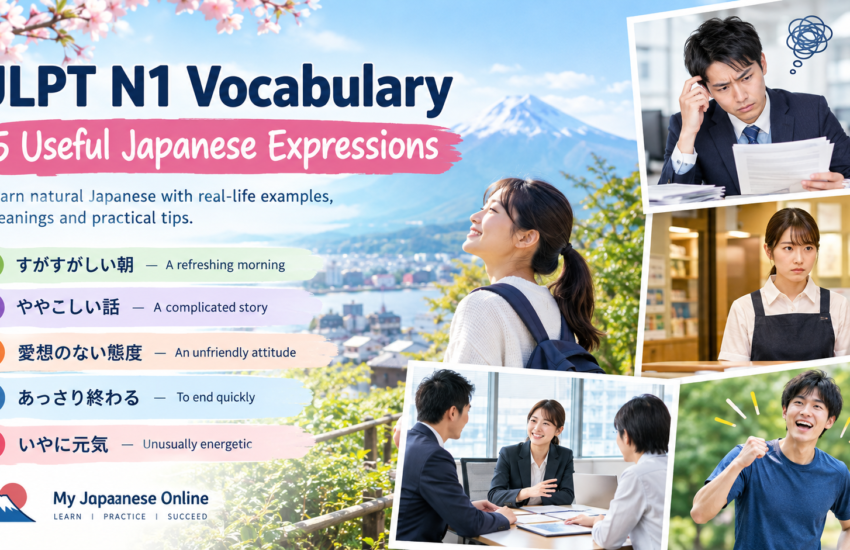
In this guide, you will learn five useful Japanese expressions, including すがすがしい朝, ややこしい話, 愛想のない態度, あっさり終わる, and いやに元気.
Each expression includes its Japanese reading, English meaning, example sentence, and practical usage tip. You will also find a short quiz to review what you have learned.
Japanese has many expressive words and phrases that help you communicate these ideas naturally.
In this lesson, we will explore five useful expressions for advanced Japanese learners:
- すがすがしい朝(すがすがしいあさ)— a refreshing, crisp morning
- ややこしい話(ややこしいはなし)— a complicated or confusing story
- 愛想のない態度(あいそのないたいど)— an unfriendly attitude
- あっさり終わる(あっさりおわる)— to end quickly or without much fuss
- いやに元気(いやにげんき)— unusually energetic
Each expression includes its meaning, an example sentence, an English translation, and a practical usage tip.
Why Learn Japanese Expressions in Context?
Knowing the meaning of a word is a good start, but understanding how it works in a sentence is equally important.
Learning expressions in context can help you:
- Understand Japanese conversations more easily.
- Improve vocabulary recognition in JLPT reading practice.
- Describe your feelings and observations more precisely.
- Recognize subtle differences in meaning and tone.
- Build confidence when speaking Japanese.
Instead of memorizing isolated words, try learning each expression as part of a complete sentence.
1. すがすがしい朝(すがすがしいあさ)— A Refreshing Morning
Meaning
すがすがしい means refreshing, fresh, or invigorating. It often describes a pleasant feeling of freshness, such as the feeling you experience in clean morning air or after completing something successfully.
The word can describe more than the weather. It can also express a refreshing feeling or a clear, pleasant state of mind.
Example sentence
すがすがしい朝(あさ)に散歩(さんぽ)すると、気分(きぶん)がよくなります。
Translation: Taking a walk on a refreshing morning makes me feel good.
Common expressions
- すがすがしい朝 — a refreshing morning
- すがすがしい空気(くうき)— refreshing air
- すがすがしい気分(きぶん)— a refreshed feeling
When should you use it?
Use すがすがしい when you want to describe a pleasant sense of freshness or relief.
For example, after opening the windows in the morning and breathing fresh air, you might say:
今朝(けさ)は空気(くうき)がすがすがしいですね。
Translation: The air feels refreshing this morning, doesn’t it?
Learning tip: Remember the difference between すがすがしい and 涼しい(すずしい). 涼しい means cool or pleasantly cool, while すがすがしい emphasizes freshness and a refreshing feeling.
2. ややこしい話(ややこしいはなし)— A Complicated or Confusing Story
Meaning
ややこしい means complicated, confusing, or difficult to understand because something involves many details or is not easy to follow.
It is useful in everyday conversations when an explanation, situation, problem, or set of instructions is difficult to understand.
Example sentence
そのややこしい話(はなし)はまだ理解(りかい)できません。
Translation: I still cannot understand that complicated explanation.
Common expressions
- ややこしい話 — a complicated story or explanation
- ややこしい問題(もんだい)— a complicated problem
- ややこしい手続き(てつづき)— complicated procedures
- ややこしい関係(かんけい)— a complicated relationship
When should you use it?
You can use ややこしい when something is difficult to follow or involves confusing details.
For example:
この手続き(てつづき)はややこしいので、もう一度(いちど)説明(せつめい)してください。
Translation: These procedures are complicated, so please explain them once more.
Learning tip: ややこしい is common in conversational Japanese. In formal writing, 複雑(ふくざつ)な, meaning “complex,” may be more appropriate.
3. 愛想のない態度(あいそのないたいど)— An Unfriendly Attitude
Meaning
愛想(あいそ) refers to friendliness, pleasant behavior, or a socially warm manner. The expression 愛想のない describes someone who does not appear friendly, welcoming, or pleasant in their interactions.
It can be used to describe a person’s behavior toward customers, colleagues, acquaintances, or other people.
Example sentence
店員(てんいん)の愛想(あいそ)のない態度(たいど)に驚(おどろ)きました。
Translation: I was surprised by the shop assistant’s unfriendly attitude.
Common expressions
- 愛想のない態度 — an unfriendly attitude
- 愛想のない人(ひと)— an unfriendly person
- 愛想がいい — friendly and pleasant
- 愛想よく話す(はなす)— to speak in a friendly manner
When should you use it?
Use 愛想のない when describing behavior that seems cold, unfriendly, or lacking in warmth.
For example:
彼(かれ)は少(すこ)し愛想(あいそ)がないですが、仕事(しごと)はとても丁寧(ていねい)です。
Translation: He is a little unfriendly, but he is very careful and thorough in his work.
Learning tip: Compare 愛想がいい with 愛想がない. The first describes someone who is friendly and pleasant, while the second suggests that the person is not very friendly.
Be careful when using 愛想のない to describe someone directly, because it can sound critical.
4. あっさり終わる(あっさりおわる)— To End Quickly or Without Much Fuss
Meaning
あっさり is an adverb with several meanings depending on the context. It can describe something that happens easily, quickly, or without much difficulty, drama, or resistance.
When used with 終わる(おわる), it describes something that finishes without becoming complicated or taking much effort.
Example sentence
会議(かいぎ)はあっさり終(お)わりました。
Translation: The meeting ended quickly without much fuss.
Common expressions
- あっさり終わる — to end easily or without much fuss
- あっさり勝つ(かつ)— to win easily
- あっさり断る(ことわる)— to refuse without hesitation
- あっさり諦める(あきらめる)— to give up easily
When should you use it?
Use あっさり when an event or action happens more easily or with less resistance than expected.
For example:
難(むずか)しいと思(おも)っていた試験(しけん)が、あっさり終(お)わりました。
Translation: The exam I thought would be difficult was over surprisingly quickly.
Learning tip: あっさり can also describe food that is light in flavor or not rich and heavy. Its meaning changes depending on what it describes.
For example:
このスープはあっさりしています。
Translation: This soup has a light flavor.
5. いやに元気(げんき)— Unusually Energetic
Meaning
いやに is an adverb meaning unusually, strangely, or noticeably more than expected. Depending on the context, it can suggest that the speaker finds something surprising or slightly suspicious.
When combined with 元気(げんき), it describes someone who seems unusually energetic or lively.
Example sentence
彼(かれ)は今日(きょう)、いやに元気(げんき)ですね。
Translation: He seems unusually energetic today, doesn’t he?
Common expressions
- いやに元気 — unusually energetic
- いやに静か(しずか)— unusually quiet
- いやに詳しい(くわしい)— unusually knowledgeable
- いやに早い(はやい)— unusually early or fast
When should you use it?
Use いやに when something stands out because it seems different from what you normally expect.
For example:
今日(きょう)はいやに静(しず)かですね。何(なに)かあったんですか。
Translation: It’s unusually quiet today. Did something happen?
Learning tip: いやに often expresses the speaker’s personal impression. It can sound more emotionally marked than simply saying とても, which means “very.”
Compare:
- 彼はとても元気です。— He is very energetic.
- 彼はいやに元気です。— He is unusually energetic.
The second sentence suggests that his energy is noticeable or unexpected.
Vocabulary Summary
| Japanese expression | Reading | English meaning |
| すがすがしい朝 | すがすがしいあさ | A refreshing morning |
| ややこしい話 | ややこしいはなし | A complicated or confusing story |
| 愛想のない態度 | あいそのないたいど | An unfriendly attitude |
| あっさり終わる | あっさりおわる | To end quickly or without much fuss |
| いやに元気 | いやにげんき | Unusually energetic |
How to Remember These Expressions
Try this simple four-step study routine.
1. Read each sentence aloud
Read the Japanese example sentence two or three times. Pay attention to pronunciation and how the expression fits into the sentence.
2. Learn the whole expression
Instead of memorizing only すがすがしい, learn すがすがしい朝. Instead of studying あっさり alone, remember あっさり終わる.
Learning words in meaningful combinations can make them easier to recall.
3. Create your own examples
Write one sentence for each expression using a situation from your daily life.
For example:
今日(きょう)の会議(かいぎ)はあっさり終(お)わりました。
Translation: Today’s meeting ended quickly.
4. Review after a short interval
Review the expressions the following day, then again several days later. Try recalling the meaning before looking at your notes.
Quick Practice Quiz
Test your understanding of the five expressions.
1. Which expression describes a fresh and pleasant feeling?
A. ややこしい
B. すがすがしい
C. 愛想のない
2. What does ややこしい問題 mean?
A. A simple problem
B. A refreshing problem
C. A complicated problem
3. Which expression describes someone who behaves in an unfriendly way?
A. 愛想のない態度
B. すがすがしい朝
C. あっさり終わる
4. What does 会議があっさり終わった suggest?
A. The meeting became complicated.
B. The meeting ended without much fuss.
C. The meeting was cancelled.
5. What does 彼はいやに元気ですね imply?
A. He seems unusually energetic.
B. He is always tired.
C. He is unfriendly.
Answers
- B — すがすがしい
- C — A complicated problem
- A — 愛想のない態度
- B — The meeting ended without much fuss
- A — He seems unusually energetic
Frequently Asked Questions
1. Are these expressions useful for JLPT N1 learners?
Yes. They are useful expressions for expanding your vocabulary and understanding nuances in Japanese. Study them alongside vocabulary, grammar, reading, and listening practice.
2. Can I use these expressions in everyday conversations?
Yes. All five can be useful in everyday communication, although the most natural choice depends on the situation and context.
3. What is the difference between ややこしい and 複雑な?
Both can mean complicated. ややこしい is common in conversation and often emphasizes confusion, while 複雑な can be used in both everyday and more formal contexts to describe complexity.
4. Does あっさり always mean quickly?
No. Depending on the context, あっさり can mean easily, without hesitation, without much fuss, or light in flavor. Learn it through example sentences.
5. How can I improve my advanced Japanese vocabulary?
Read example sentences, listen to natural Japanese, write your own examples, and review expressions regularly. For JLPT preparation, combine vocabulary study with grammar, kanji, reading comprehension, and listening exercises.
Practical Learning Tip: Make Vocabulary Personal
The best way to practice these expressions is to connect them with your own experiences.
Think about your day and complete these sentences:
- 今朝は______朝でした。
- この説明は少し______です。
- あの人の______態度が気になりました。
- 今日の会議は______終わりました。
- 今日はいつもより______元気ですね。
Try to complete each sentence without checking the vocabulary list. Then say the sentences aloud to practice using the expressions naturally.
Internal Link Suggestions
Add links to relevant pages on My Japanese Online:
- JLPT N1 Course: https://myjapaneseonline.com/home/courses
- Advanced Japanese Vocabulary: https://myjapaneseonline.com/blog/
- My Japanese Online:https://myjapaneseonline.com/
Related published reading: 5 Practical JLPT N1 Vocabulary Words You Can Use Every Day.
Your Next Step
Before moving on to new vocabulary, try these three actions:
- Learn the meanings and readings of all five expressions.
- Write one original Japanese sentence for each expression.
- Complete the quiz again without looking at the answers.
If you want to strengthen your advanced Japanese step by step, My Japanese Online offers structured JLPT preparation with licensed native Japanese teachers. Our lessons can help you practice vocabulary, grammar, reading, listening, and practical communication.
Keep learning one expression at a time, and make every new word part of your Japanese.
Short WhatsApp Promotion
📘 New Blog for Japanese Learners 🇯🇵
Today’s topic: 5 Japanese Expressions to Describe Feelings and Situations
Learn five useful Japanese expressions with meanings, natural examples, and a quick quiz!
✨ Discover how to describe a refreshing morning, a complicated explanation, an unfriendly attitude, and more.
Read here: 🔗 https://whatsapp.com/channel/0029Vb74C2T0wajtXvwo5r0p