
 Posted by
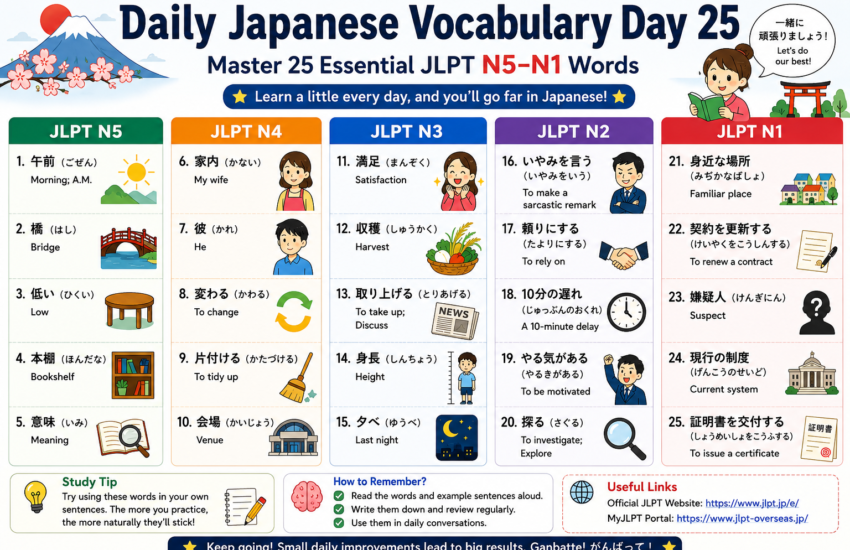
 Daily Japanese Vocabulary Day 25 is designed to help you expand your Japanese naturally through practical words and real-life examples. Whether you’re preparing for the JLPT, working in Japan, or improving your daily communication, today’s vocabulary will strengthen your language skills step by step.
In today’s lesson, we’ll follow a typical day in Japan and naturally learn 25 useful Japanese words from JLPT N5 to N1.
Daily JDaily Japanese Vocabulary Day 25: JLPT N5 Vocabulary
Every Japanese learning journey begins with simple words used in daily conversations. These beginner-friendly words help you talk about time, places, and common objects you see every day.
🌅 午前(ごぜん)— Morning; A.M.
The word 午前(ごぜん) refers to the time before noon.
Example
午前七時に起きます。
I wake up at 7:00 a.m.
Extra Example
会議は午前九時に始まります。
The meeting starts at 9:00 a.m.
🌉 橋(はし)— Bridge
You’ll often see this word on maps, road signs, and while giving directions.
Example
この橋はとても長いです。
This bridge is very long.
Extra Example
橋を渡ると駅があります。
There is a station after crossing the bridge.
📏 低い(ひくい)— Low
Use this adjective to describe something that is not high.
Example
このテーブルは低いです。
This table is low.
Extra Example
今日は気温が低いです。
The temperature is low today.
📚 本棚(ほんだな)— Bookshelf
A useful word for students learning Japanese.
Example
本を本棚に置きます。
I put the books on the bookshelf.
Extra Example
本棚には日本語の本がたくさんあります。
There are many Japanese books on the bookshelf.
💡 意味(いみ)— Meaning
One of the most useful classroom words.
Example
この言葉の意味が分かりません。
I don’t understand the meaning of this word.
Extra Example
この漢字の意味を教えてください。
Please tell me the meaning of this kanji.
Daily Japanese Vocabulary Day 25: JLPT N4 Vocabulary
Once you’ve mastered the basics, you’ll start talking about your family, home, and daily activities. These words are common in conversations and everyday life.
🏠 家内(かない)— My Wife
Example
家内は家で料理をしています。
My wife is cooking at home.
Extra Example
家内は日本語を勉強しています。
My wife is studying Japanese.
👨 彼(かれ)— He
Example
彼は日本人です。
He is Japanese.
Extra Example
彼は私の友達です。
He is my friend.
🔄 変わる(かわる)— To Change
Example
天気が急に変わりました。
The weather changed suddenly.
Extra Example
予定が変わりました。
The schedule has changed.
🧹 片付ける(かたづける)— To Tidy Up
Example
部屋を片付けてください。
Please tidy up the room.
Extra Example
勉強の前に机を片付けました。
I cleaned my desk before studying.
🏢 会場(かいじょう)— Venue
Example
会場は駅の近くです。
The venue is near the station.
Extra Example
会場には多くの人が集まりました。
Many people gathered at the venue.
Daily Japanese Vocabulary Day 25: JLPT N3 Vocabulary
JLPT N3 vocabulary allows you to express opinions, describe experiences, and communicate more naturally in everyday conversations.
😊 満足(まんぞく)— Satisfaction
Example
試験の結果に満足しています。
I am satisfied with the exam results.
Extra Example
サービスに満足しました。
I was satisfied with the service.
🌾 収穫(しゅうかく)— Harvest
Example
今年は米の収穫が多いです。
This year’s rice harvest is plentiful.
Extra Example
今日の勉強は大きな収穫がありました。
Today’s study session was very productive.
📄 取り上げる(とりあげる)— To Take Up
Example
先生はその問題を取り上げました。
The teacher discussed that issue.
Extra Example
新聞でその話題が取り上げられました。
The topic was featured in the newspaper.
📏 身長(しんちょう)— Height
Example
私の身長は170センチです。
My height is 170 cm.
Extra Example
彼は身長が高いです。
He is tall.
🌙 夕べ(ゆうべ)— Last Night
Example
夕べ友達と映画を見ました。
I watched a movie with a friend last night.
Extra Example
夕べはよく眠れました。
I slept well last night.
Daily Japanese Vocabulary Day 25: JLPT N2 Vocabulary
These expressions are commonly used in offices, meetings, and professional communication.
😏 いやみを言う(いやみをいう)— To Make a Sarcastic Remark
Example
彼は会議でいやみを言いました。
He made a sarcastic remark during the meeting.
Extra Example
いやみを言わないようにしましょう。
Let’s avoid making sarcastic remarks.
🤝 頼りにする(たよりにする)— To Rely On
Example
私は先輩を頼りにしています。
I rely on my senior.
Extra Example
家族を頼りにしています。
I rely on my family.
⏰ 10分の遅れ(じゅっぷんのおくれ)— A 10-Minute Delay
Example
電車は10分の遅れです。
The train is delayed by 10 minutes.
Extra Example
飛行機も遅れています。
The airplane is also delayed.
🔥 やる気がある(やるきがある)— To Be Motivated
Example
彼女は仕事にやる気があります。
She is motivated at work.
Extra Example
やる気があれば成功できます。
If you’re motivated, you can succeed.
🔍 探る(さぐる)— To Investigate
Example
原因を探っています。
They are investigating the cause.
Extra Example
新しい方法を探っています。
We are exploring a new method.
Daily Japanese Vocabulary Day 25: JLPT N1 Vocabulary
Advanced vocabulary helps you understand formal Japanese used in contracts, government offices, and news reports.
📍 身近な場所(みぢかなばしょ)— Familiar Place
Example
ここは子供のころから身近な場所です。
This has been a familiar place since my childhood.
Extra Example
身近な話題から始めましょう。
Let’s start with a familiar topic.
📝 契約を更新する(けいやくをこうしんする)— To Renew a Contract
Example
来月、契約を更新します。
I will renew my contract next month.
Extra Example
アパートの契約を更新しました。
I renewed my apartment contract.
🚨 嫌疑人(けんぎにん)— Suspect
Example
警察は嫌疑人を調べています。
The police are investigating the suspect.
Extra Example
嫌疑人は逮捕されました。
The suspect was arrested.
🏛️ 現行の制度(げんこうのせいど)— Current System
Example
現行の制度には問題があります。
There are problems with the current system.
Extra Example
現行の法律を確認してください。
Please check the current law.
📄 証明書を交付する(しょうめいしょをこうふする)— To Issue a Certificate
Example
市役所で証明書を交付してもらいました。
I received a certificate issued at the city office.
Extra Example
学校が卒業証明書を交付しました。
The school issued a graduation certificate.
Why Learning Through Context Works
Instead of memorizing isolated words, imagine where you would actually use them.
For example:
- 午前 when talking about your daily schedule.
- 本棚 while describing your room.
- 意味 when asking questions during class.
- 橋 while giving directions.
- 片付ける when discussing household chores.
- 会場 when attending an event.
Connecting vocabulary with real situations makes learning more enjoyable and helps you remember words longer.
Today’s Practice
Try creating your own sentences using these words:
- 午前
- 本棚
- 意味
- 橋
- 低い
- 片付ける
- 会場
The more you use new vocabulary in your own sentences, the faster it becomes part of your active Japanese.
Continue Learning
In the next sections of this lesson, you’ll learn JLPT N3, N2, and N1 vocabulary used in workplaces, public transportation, official procedures, and everyday conversations, helping you expand your Japanese step by step.
If you’re preparing for the JLPT or want to improve your practical communication skills, My Japanese Online offers structured online courses from JLPT N5 to N1, Business Japanese lessons, private classes, and corporate Japanese training with licensed native Japanese teachers.
Internal Link
External link
- Official JLPT Website: https://www.jlpt.jp/e/
- MyJLPT Portal: https://www.jlpt-overseas.jp/